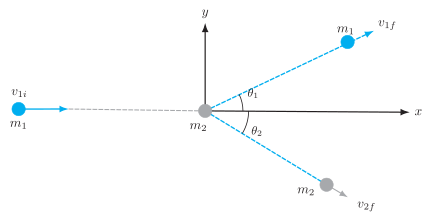
Q.Consider the collision depicted in Fig. 5.10 to be between two billiard balls with equal masses . The first ball is called the cue while the second ball is called the target. The billiard player wants to 'sink' the target ball in a corner pocket, which is at an angle . Assume that the collision is elastic and that friction and rotational motion are not important. Obtain .
You're viewing a preview — the full solution, concept, methods & PYQ mapping are locked.
Start your 14-day free trial to unlock the full solution →For an elastic collision between equal-mass billiard balls, the cue ball always deflects at to the target ball’s direction. Given , the cue ball’s angle is .
The figure is a two-panel sketch on an – coordinate grid. The origin marks the point of collision. Before the collision, a blue sphere of mass moves horizontally from the left along the -axis with velocity . A grey sphere of mass sits stationary at the origin. After the collision, the blue sphere moves up and to the right at an angle above the -axis, with final velocity . The grey sphere moves down and to the right at an angle below the -axis, with final velocity . The arrows representing and are drawn from the origin, showing the two outgoing paths.
The physical idea is a two-dimensional elastic collision between a moving projectile and a stationary target. The figure makes clear that the motion is confined to a plane — the incoming momentum is entirely along , but after the collision the momentum is shared between both bodies in both and directions. The angles and are measured from the original line of motion (the -axis), and they are not independent: conservation of momentum in the -direction forces a relation between them.
The textbook develops the two fundamental conservation laws from this figure. For an elastic collision, kinetic energy is also conserved. The key equations are:
The first equation is conservation of momentum along the -axis: the initial momentum equals the sum of the -components of the final momenta. The second equation is conservation of momentum along the -axis: the initial -momentum is zero, so the upward -component of 's final momentum must equal the downward -component of 's final momentum (the minus sign accounts for opposite directions). The third equation is conservation of kinetic energy, which holds only for an elastic collision.
The angles and are not arbitrary. For a given , , and , these three equations determine the four unknowns , , , and only if one additional condition is given — for example, the impact parameter or the fact that the collision is elastic. In many textbook problems, one of the angles or final speeds is provided.
The figure thus serves as the visual anchor for the entire analysis of two-dimensional collisions. It shows that the problem is not one-dimensional: the outgoing paths are symmetric about the line of approach only when the masses are equal, but the diagram itself is general. The key takeaway is that momentum is a vector — it must be conserved separately in each direction — and that the collision geometry is captured entirely by the two angles and the two final speeds.
The key to this problem is the Impulse-Momentum Theorem applied to a collision — but here, the real insight comes from combining conservation laws. When two equal masses collide elastically and one is initially at rest, something beautiful happens: the two velocity vectors after the collision are always perpendicular. Let’s see why.
Why perpendicular? The concept
In any collision, momentum is conserved as a vector. For an elastic collision, kinetic energy is also conserved. When the masses are equal and the target starts at rest, these two conditions force the final velocities to satisfy (from energy) and (from momentum). Square the momentum equation: . Comparing with the energy equation, the dot product must be zero — so .
That’s the core idea. The cue ball and target ball always leave at right angles to each other in this special case.
Step-by-step solution
- Set up the coordinate system. …
Unlock everything free for 14 days
- Full step-by-step solutions
- Concept-first explanations
- Methods, shortcuts & mistakes
- PYQ mapping + timed mock tests
Full access for 14 days. No credit card required.