Physical Education · Ch 8 — Biomechanics and Sports
Projectile in Sports
Projectile in Sports
Projectile in Sports
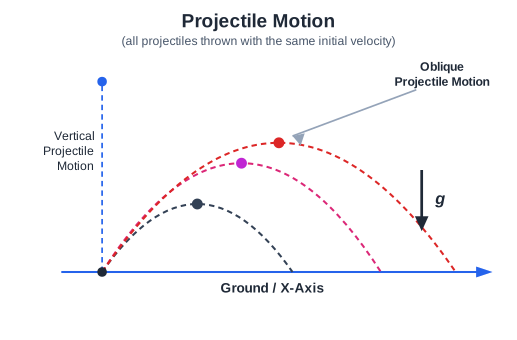
A projectile is an object that, once thrown or dropped, keeps moving by its own inertia and is acted upon by only one real force — the downward pull of gravity (with air resistance also at work in practice). Without gravity a projectile would simply carry on in a straight line; because of gravity it instead follows a curved, parabolic trajectory. Projectile motion is one of the most visible pieces of biomechanics in the CBSE Class 12 Physical Education course.
Drawn by us to help you understand the concept clearly, and verified to make sure it's accurate. For exams, practice from your textbook's own diagram.
A diagram titled 'Projectile Motion' comparing a straight vertical path (vertical projectile motion) with several oblique parabolic arcs of increasing range (oblique projectile motion), all launched with the same initial velocity, with a downward 'g' arrow showing th …
Defining Projectiles
A projectile is any object on which the only force acting is gravity. There are several everyday examples (provided air resistance is negligible in each case): an object dropped from rest, an object thrown vertically upward, and an object thrown upward at an angle to the horizontal. In simple words, an object in flight after being thrown is in projectile motion.
Examples from sport:
- Objects that act as projectiles: the basketball, football, shot-put, hammer, discus, javelin, golf ball, volleyball and tennis ball.
- The body itself acts as a projectile in the high jump, long jump, gymnastics, diving, figure skating and ski jumping.
Drawn by us to help you understand the concept clearly, and verified to make sure it's accurate. For exams, practice from your textbook's own diagram.
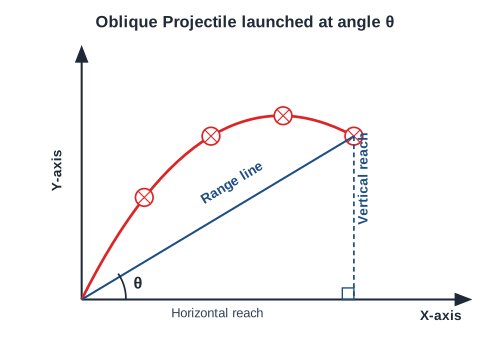
A coordinate diagram showing a ball launched at an angle theta from the origin, its red parabolic path with the ball drawn at successive positions, a straight range line to the far point and a vertical drop with a right-angle marker, illustrating the h …
…