Physical Education · Ch 7 — Physiology and Injuries in Sports
Effect of Exercise on Respiratory System
7.3.2
Effect of Exercise on Respiratory System
Exercise changes the way the respiratory system works, again with both short-term and long-term effects.
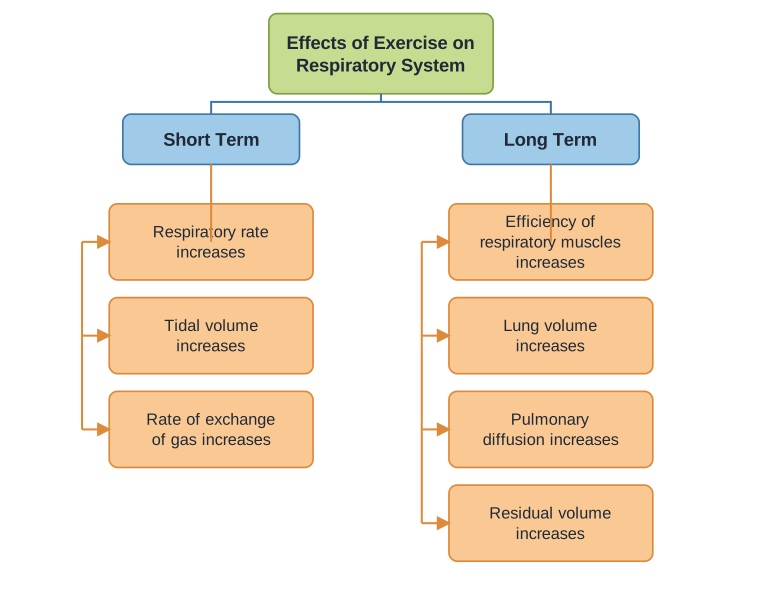
Figure 7Flow diagram of the short-term and long-term effects of exercise on the respiratory system
Drawn by us to help you understand the concept clearly, and verified to make sure it's accurate. For exams, practice from your textbook's own diagram.
A flow diagram headed 'Effects of exercise on Respiratory system' (green parent box) branching into two blue category boxes. 'Short Term' branches to three orange boxes: Respiratory rate increases; Tidal volume increases; Rate of exchange of gas increases. 'Long Term' branches to four orange boxes: Efficiency of respiratory muscles increases; Lung volume incr …
Short-term effects of exercise on the respiratory system
- Respiratory rate increases — The body needs more oxygen during exercise, so the breathing rate rises. At rest an adult breathes about 12 to 20 times per minute, but during exercise this can increase to around 40 breaths per minute.
- Tidal volume increases — Tidal volume is the amount of air inhaled and exhaled in a single breath. It increases during exercise so that more oxygen is taken in and more carbon dioxide is removed.
- Rate of exchange of gas increases — Regular exercise increases the rate at which gases are exchanged in the lungs.
Long-term effects of exercise on the respiratory system
- Increased efficiency of respiratory muscles — Regular exercise makes the respiratory muscles more efficient, so inhalation and exhalation become smoother and better able to meet the demand for oxygen.
- Increased lung volume — Sustained, long-duration exercise increases the capacity and volume of the lungs; vital capacity can rise by almost 100 per cent compared with an untrained person.
- Increased pulmonary diffusion — Pulmonary diffusion is the capacity of the lungs to let oxygen and carbon dioxide pass into and out of the blood. Regular sub-maximal training widens the scope for gas exchange, and in the process the size of the alveoli also increases. …