Physical Education · Ch 10 — Training in Sports
Circuit Training — Introduction and Importance
Circuit Training — Introduction and Importance
Circuit Training — Introduction and Importance
Circuit Training (introduction and importance) is part of the current CBSE Class 12 Physical Education (048) 'Training in Sports' syllabus. The 2022 edition of the NCERT/CBSE textbook does not devote a separate section to it, so the account below is built on well-established, widely documented principles of circuit training rather than on a single textbook passage. No norms are quoted as fixed rules — the ranges given are typical practice, meant to illustrate how a circuit works.
What Circuit Training Is
Circuit training is a method of physical conditioning in which an athlete moves through a series of exercises, called stations, arranged in a fixed order. Each station is performed for a set number of repetitions or a set time, with only a short rest before moving to the next. The word circuit describes the arrangement: the stations are laid out in a loop, and completing all of them once finishes one circuit.
The central idea is efficiency. Instead of finishing all sets of one exercise, resting, and then starting the next, the athlete does one set at each station in turn. Because the movement is almost continuous, the heart rate stays elevated, so muscular fitness and cardiovascular endurance are trained at the same time. A typical circuit has around 8 to 12 stations, and a session may involve 2 to 3 full circuits.
How a Circuit Works
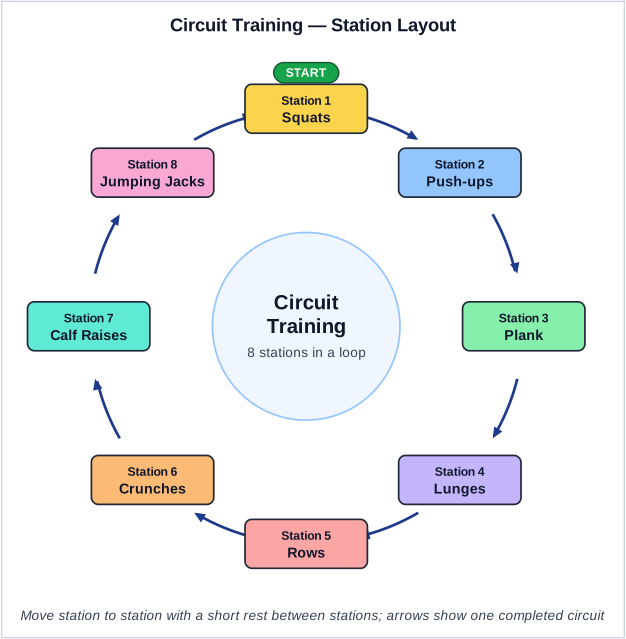
Drawn by us to help you understand the concept clearly, and verified to make sure it's accurate. For exams, practice from your textbook's own diagram.
A circuit-training station layout. Eight numbered stations are arranged around a loop (circle or rounded rectangle), connected by arrows showing the direction of movement: Station 1 'Squats' (marked START), Station 2 'Push-ups', Station 3 'Plank', Station 4 'Lunges', Station 5 'Rows', Station 6 'Crunches', Station 7 'Calf Raises', Station 8 'Jumping Jacks', with the arrow from Station 8 returning to Station 1 to sho …
The stations are set out in a loop so that the athlete flows from one to the next with minimal delay. A few design choices decide how the circuit trains the body:
- Choice of exercises. The stations should cover the major muscle groups — upper body, lower body and core — or, for a sport, mimic the movements of that sport.
- Order of stations. Consecutive stations usually work different muscle groups or body regions, so one area recovers while another works. A common loop alternates a leg exercise, an upper-body exercise and a core exercise.
- Work and rest. Each station has a fixed work duration (a repetition count such as 15 squats, or a time such as 30 seconds). The rest between stations is kept short — typically about 15 to 30 seconds — which is what keeps the heart rate up and separates circuit training from ordinary weight training. The rest between whole circuits is longer, usually one to three minutes.
- Progression. The circuit is made harder over time by lengthening the work, shortening the rest, adding stations or circuits, or using harder exercise variations — changing only one of these at a time.
A simple general-fitness loop might run: squats, push-ups, plank, lunges, bent-over rows, crunches, calf raises and jumping jacks, done for a fixed time each with a short rest, repeated for two circuits.
Importance and Advantages of Circuit Training
Circuit training is valued in physical education because it delivers several benefits from one well-planned session:
- Develops several fitness components together — muscular strength, muscular endurance and cardiovascular endurance all improve in the same session, and flexibility too if stretching stations are included.
- Time efficient — a full session can be completed in about 30 to 45 minutes, instead of separate strength and cardio workouts.
- Space efficient and low-equipment — the loop fits into a small area such as a court or a large room, and many circuits use only body-weight exercises or light equipment. …