Botany · Ch 3 — Photosynthesis in Higher Plants
What is Light Reaction?
What is Light Reaction?
Light reactions, also called the 'photochemical' phase, include several events: light absorption, water splitting, oxygen release, and the formation of the high-energy chemical intermediates ATP and NADPH. Several protein complexes are involved in these processes.
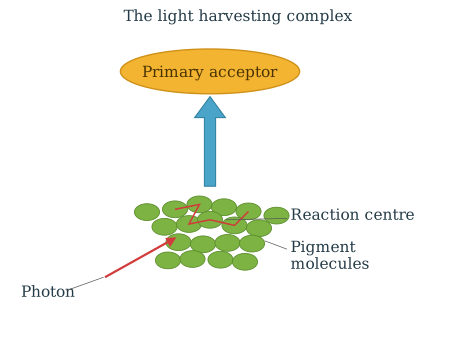
The pigments are organised into two discrete photochemical light harvesting complexes (LHC), one within Photosystem I (PS I) and the other within Photosystem II (PS II). Importantly, these photosystems are named in the sequence of their discovery, and not in the sequence in which they function during the light reaction.
Each light harvesting complex is built as follows:
- The LHC is made up of hundreds of pigment molecules bound to proteins.
- Each photosystem holds all the pigments except one molecule of chlorophyll a, forming a light harvesting system also called the antennae.
- These antenna pigments help make photosynthesis more efficient by absorbing different wavelengths of light and passing the energy inward.
The single chlorophyll a molecule that is left forms the reaction centre. The reaction centre is different in the two photosystems:
- In PS I the reaction centre chlorophyll a has an absorption peak at 700 nm, and is therefore called P700. …
Drawn by us to help you understand the concept clearly, and verified to make sure it's accurate. For exams, practice from your textbook's own diagram.
This figure depicts a light harvesting complex, the antenna of a photosystem. A large cluster of pigment molecules is bound to proteins and arranged so that they can catch light. When a photon strikes an antenna pigment, its energy is absorbed and passed from molecule to molecule until it reaches a single central chlorophyll a molecule, the reaction centre. The reaction centre then boosts an electron to a higher energy level and passes it to the primary acceptor shown above it. Having hundreds of pigments that absorb different wavelengths makes light capture far more effi …