Botany · Ch 5 — Plant Growth and Development
Development
Development
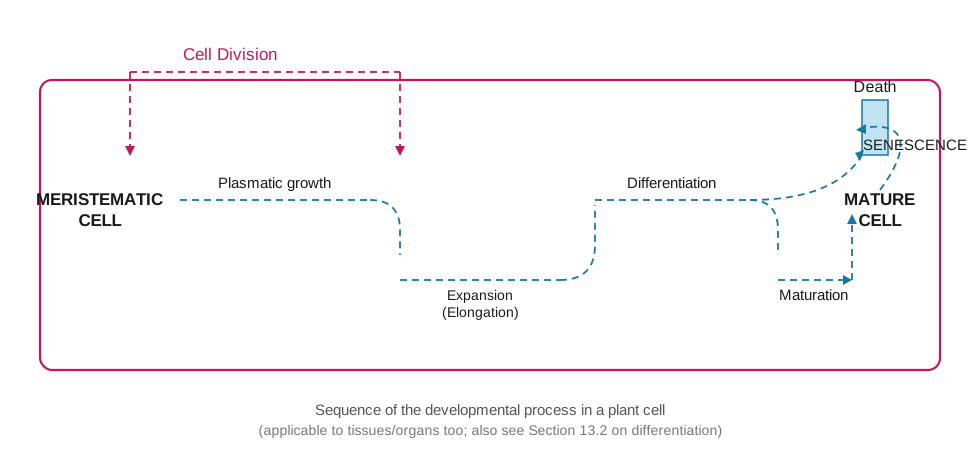
Development is a term that includes all the changes an organism goes through during its life cycle, from the germination of the seed right up to senescence. The diagrammatic representation of the sequence of processes that constitute the development of a cell of a higher plant (Figure 13.8) applies equally well to tissues and organs.
A developing plant cell typically passes from a meristematic cell through cell division, plasmatic growth, expansion (elongation), differentiation and maturation to become a mature cell, and finally through senescence to death.
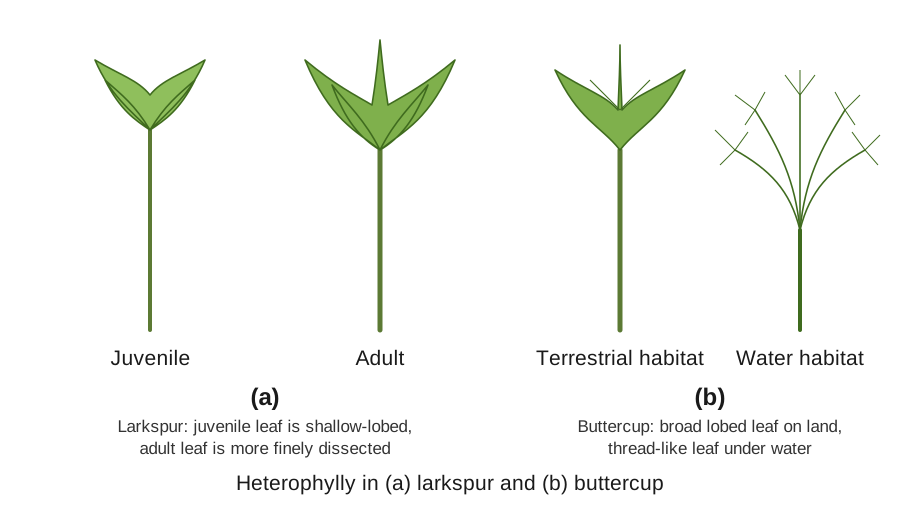
Plants also follow different pathways in response to their environment or to different phases of life, so as to form different kinds of structures. This ability is called plasticity.
- A well-known example is heterophylly, seen in cotton, coriander and larkspur, where the leaves of the juvenile plant differ in shape from those of the mature plant.
- Heterophylly also appears in the buttercup, where leaves produced in air differ in shape from those produced in water. This difference, brought about by the environment, is an example of plasticity. …
Drawn by us to help you understand the concept clearly, and verified to make sure it's accurate. For exams, practice from your textbook's own diagram.
This flow diagram sets out the orderly sequence of stages through which a plant cell develops during its life. It begins with a meristematic cell, which undergoes cell division to give new cells. These cells then pass through plasmatic growth and expansion (elongation), increasing in size, followed by differentiation and maturation, during which they take on the specific structures needed for their function and become a mature cell. Eventually the mature cell enters senescence and finally reaches death. The same sequence applies not only to a single cell but also to tissues and organs. By laying the steps out in order, the figure shows that development is the whole …
Drawn by us to help you understand the concept clearly, and verified to make sure it's accurate. For exams, practice from your textbook's own diagram.
This figure illustrates heterophylly — the occurrence of leaves of different shapes on the same kind of plant — as an example of plasticity. In part (a), the larkspur, the leaves of the juvenile plant differ in shape from those of the adult plant, showing how leaf form can change with the phase of the plant's life. In part (b), the buttercup, the difference is driven by the environment: leaves produced in the terrestrial (air) habitat are broad and lobed, whereas those produced in the water habitat are finely divided and thread-like. In both cases the plant follows different developmental pathways in response to its stage of life or its surroundings to form different kinds of leaves. The figure thus demonstrates that dev …