Botany · Ch 6 — Principles of Inheritance and Variation
Sex Determination
Sex Determination
The story of how sex is determined begins not with humans, but with insects. For a long time, the mechanism was a puzzle. The first real clue came from cytological observations — scientists literally watching what happens to chromosomes during sperm formation.
In 1891, Henking was studying spermatogenesis in a few insect species. He noticed a particular nuclear structure that appeared during the process. Crucially, after spermatogenesis was complete, only 50 per cent of the sperm received this structure; the other 50 per cent did not. Henking called it the X body, but he could not explain what it meant.
Later work by other scientists revealed that Henking’s ‘X body’ was actually a chromosome. It was renamed the X-chromosome. This discovery opened the door to understanding how sex is determined at the chromosomal level.
The XO Type of Sex Determination
In a large number of insects, the mechanism is of the XO type. Here is how it works:
- All eggs carry an X-chromosome in addition to the other chromosomes (the autosomes).
- Sperm, however, are of two kinds: some carry the X-chromosome, and some do not.
- When an egg is fertilised by a sperm that has an X-chromosome, the offspring is female.
- When an egg is fertilised by a sperm that does not have an X-chromosome, the offspring is male.
Because the X-chromosome is directly involved in deciding sex, it was designated a sex chromosome. All other chromosomes were called autosomes.
In the XO system, the male has only one sex chromosome (X) and the female has two (XX). The male is said to be heterogametic because he produces two different types of gametes (with or without X). The female is homogametic because all her eggs carry an X.
Example: The grasshopper follows the XO pattern. Males have one X-chromosome plus autosomes; females have a pair of X-chromosomes plus autosomes.
The XY Type of Sex Determination
In many other insects, and in all mammals including humans, a different system is seen: the XY type. Here, both males and females have the same total number of chromosomes.
- Males have one X-chromosome and one distinctly smaller chromosome called the Y-chromosome. Their sex chromosome composition is XY.
- Females have a pair of X-chromosomes. Their sex chromosome composition is XX.
- Both sexes have the same number of autosomes.
So, a male has autosomes + XY, and a female has autosomes + XX.
Examples: Both human beings and the fruit fly Drosophila follow the XY system. Males have one X and one Y; females have two X chromosomes.
In both the XO and XY systems, it is the male that produces two different types of gametes. This is called male heterogamety. The female produces only one type of gamete (all eggs carry an X).
The ZW Type of Sex Determination (Female Heterogamety) …
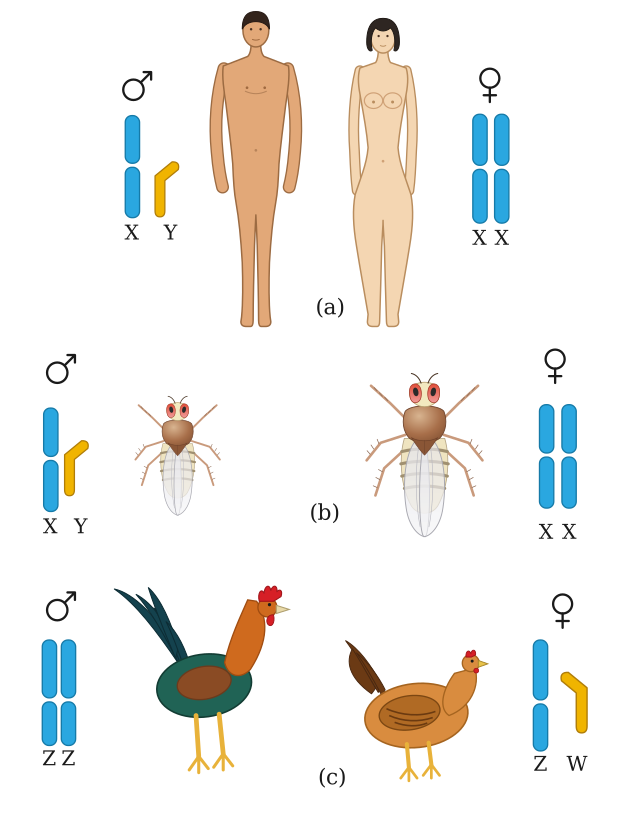
Drawn by us to help you understand the concept clearly, and verified to make sure it's accurate. For exams, practice from your textbook's own diagram.
Figure 4.12 is a three-panel diagram that contrasts the two major chromosomal sex-determination systems found in animals. Each panel shows a male and a female, with their sex chromosomes drawn alongside the autosomes (the non-sex chromosomes).
Panel (a) and (b) — The XX/XY system (humans and Drosophila)
Both panels show the same pattern: the female has two identical sex chromosomes, labelled XX (homogametic — she produces only one type of egg, each carrying an X). The male has one X and one distinctly smaller Y chromosome (heterogametic — he produces two types of sperm: X-bearing and Y-bearing). The autosomes are drawn as a matching set in both sexes, so the total chromosome number is the same in males and females. The only difference is the sex-chromosome pair. In humans, the Y is much smaller than the X; in Drosophila, the Y is also smaller but shaped differently (a rod-like X and a hooked Y). The arrows or labels in the figure indicate that the sex of the offspring is determined by which sperm fertilises the egg: an X-carrying sperm gives a female (XX), a Y-carrying sperm gives a male (XY).
Panel (c) — The ZZ/ZW system (many birds)
Here the roles are reversed. The male has two identical sex chromosomes, labelled ZZ (homogametic — he produces only Z-bearing sperm). The female has one Z and one W chromosome (heterogametic — she produces two types of eggs: Z-bearing and W-bearing). The Z is drawn larger than the W. Again, autosomes are identical in both sexes. The figure shows that the female determines the sex of the offspring: a Z-carrying egg produces a male (ZZ), a W-carrying egg produces a female (ZW). …