Question 22 of 28
Q.Explain the structure of T-even bacteriophages.
Yanam BieapTelangana Board of Intermediate Education 2018Subjective· 4mImportance★★★★★
79% · 22/28 Questions
You're viewing a preview — the full solution, concept, methods & PYQ mapping are locked.
Start your 14-day free trial to unlock the full solution →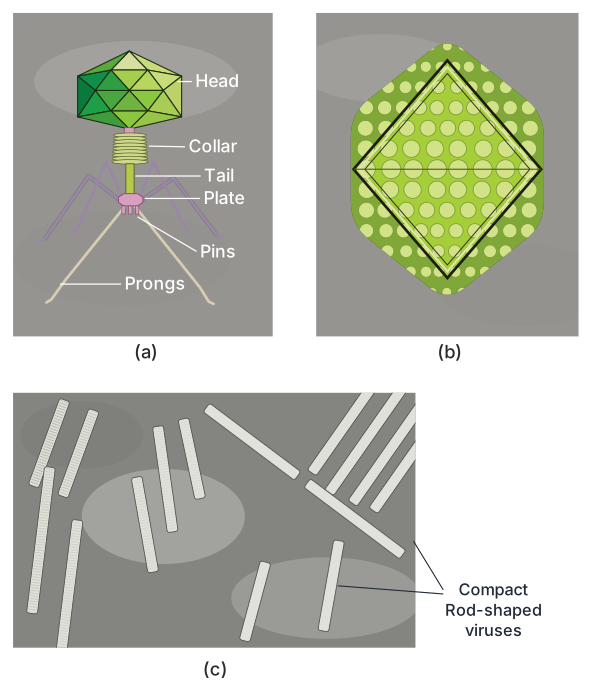
T-even bacteriophages (e.g., T2, T4, T6) have a distinctive two-part structure — a DNA-containing polyhedral head and a specialised, contractile tail used for infecting bacteria.
T-even bacteriophages are viruses that infect bacteria (e.g., E. coli), and are structurally among the most complex viruses known. Their structure has two main parts:
1. Head:
- The head is polyhedral (icosahedral) in shape.
- It encloses the phage's genetic material — double-stranded DNA, tightly packed within.
- The head is covered by a protein coat (capsid) made of capsomeres.
2. Tail:
The tail is a complex structure attached to the head, consisting of:
- A hollow core (central tube), through which the DNA is injected into the host cell during infection.
- A contractile sheath surrounding the hollow core — this sheath contracts during infection, driving the core through the bacterial cell wall.
- A collar, connecting the head to the tail.
- A hexagonal base plate at the very end of the tail, from which project several tail pins (spikes) and tail fibers. …
Unlock everything free for 14 days
- Full step-by-step solutions
- Concept-first explanations
- Methods, shortcuts & mistakes
- PYQ mapping + timed mock tests
Full access for 14 days. No credit card required.