Chemistry · Ch 5 — Coordination Compounds
Crystal Field Theory
Crystal Field Theory
Crystal Field Theory (CFT) takes a completely different starting point from VBT. It treats the metal–ligand bond as purely electrostatic (ionic), arising from the attraction and repulsion between the metal centre and the ligands, and makes no reference to orbital overlap or covalency at all. Ligands are modelled as:
- point negative charges, if they are anions, or
- point dipoles, if they are neutral molecules (with the negative end of the dipole facing the metal).
Why the d orbitals split at all
In an isolated gaseous metal atom or ion, all five orbitals are degenerate — they have exactly the same energy. This degeneracy survives even if the metal is surrounded by a perfectly spherically symmetric field of negative charge, because such a field pushes all five orbitals up in energy by the same amount.
Real ligands, however, do not surround the metal symmetrically in space — they approach from specific directions fixed by the geometry of the complex. This makes the electric field around the metal asymmetric, and it is this asymmetry that lifts the degeneracy of the orbitals, splitting them into sets of different energy. The exact pattern of splitting depends on the geometry of the ligand arrangement, so octahedral, tetrahedral, and other geometries each split the orbitals differently.
(a) Splitting in an octahedral field
In an octahedral coordination entity, six ligands approach the metal symmetrically along the , , axes. The repulsion between the electrons (or negative charge) on the ligands and the electrons in the metal's orbitals is not the same for every orbital — it depends on how directly that orbital points toward an approaching ligand:
- The and orbitals point directly along the axes, straight at the incoming ligands, so they experience the greatest repulsion and are raised in energy. Together these form the higher-energy set.
- The , , and orbitals point between the axes, away from the ligands, so they experience comparatively less repulsion and are lowered in energy relative to the average. Together these form the lower-energy set.
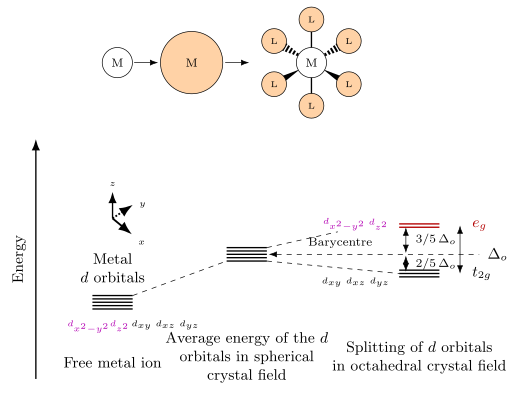
This splitting of the originally degenerate orbitals into the (lower) and (upper) sets is called crystal field splitting, and the energy gap between the two sets is denoted (the subscript stands for octahedral). Relative to the hypothetical "barycentre" — the average energy the orbitals would have in a spherical field — the set is raised by and the set is lowered by .
Drawn by us to help you understand the concept clearly, and verified to make sure it's accurate. For exams, practice from your textbook's own diagram.
The figure is an energy-level diagram that shows how the five orbitals of a metal ion change in energy when placed in an octahedral crystal field.
What the diagram shows:
- The vertical axis represents energy (increasing upward).
- On the far left, the five orbitals are drawn at the same height, labelled "Free ion" — they are degenerate (all have the same energy).
- Moving to the right, under a spherical field (a hypothetical uniform negative charge around the ion), all five orbitals rise together to a new common level called the barycentre (the average energy). This is shown as a single horizontal line.
- Finally, under the octahedral field of six ligands placed along the , , and axes, the degeneracy is lifted. The diagram splits into two distinct groups:
- Lower energy: a set of three orbitals — , , — labelled . These point between the axes and are stabilised.
- Higher energy: a set of two orbitals — and — labelled . These point along the axes and are destabilised.
The key physical idea:
The splitting arises because ligands (treated as point charges or dipoles) repel the metal's electrons. Orbitals directed straight at the ligands () feel stronger repulsion and rise in energy; orbitals directed between the ligands () feel less repulsion and drop in energy. The total energy of all five orbitals is conserved — the rise of the set is exactly balanced by the fall of the set.
The key formula(s) from the textbook:
The energy separation between the two sets is denoted by (the subscript stands for octahedral). Relative to the barycentre (taken as zero energy):
- Each orbital is stabilised by .
- Each orbital is destabilised by .
Thus, for the entire set:
This confirms that the barycentre is the energy reference.
What the figure teaches for problem-solving:
The magnitude of determines the spin state of to complexes: …
The spectrochemical series
The size of is not fixed — it depends on both the nature of the ligand and the charge on the metal ion. Some ligands produce a strong field, giving a large splitting; others produce a weak field, giving only a small splitting. Ranking common ligands by the size of the splitting they produce (determined experimentally, from how strongly complexes absorb light) gives the spectrochemical series — an ordering of ligands purely by field strength, running from the weakest field-producing ligands to the strongest.
The ligands, arranged in order of increasing field strength, form the series:
Halide ions and other simple anions sit toward the weak-field end, while ligands such as ethylenediamine, cyanide, and carbon monoxide sit toward the strong-field end.
Filling electrons into the split orbitals — weak field vs. strong field
For , , and octahedral entities, there is no ambiguity: the electrons simply occupy the lower-energy orbitals singly, following Hund's rule, since there are three orbitals available.
The interesting case arises at : the fourth electron has two possible homes, and which one it actually takes depends on a competition between two energies —
- , the crystal field splitting energy separating from , and
- , the pairing energy — the energy cost of forcing two electrons to share a single orbital.
This gives two distinct outcomes:
- If : pairing costs more than promotion, so the fourth electron avoids pairing and instead enters an orbital, giving the configuration . Ligands that produce this outcome (i.e. ) are called weak field ligands, and the resulting complexes are called high spin complexes (maximum number of unpaired electrons).
- If : promotion to costs more than pairing, so it becomes energetically favourable for the fourth electron to pair up within the set instead, giving the configuration . Ligands that produce this outcome are called strong field ligands, and the resulting complexes are called low spin complexes (minimum number of unpaired electrons, i.e. maximum pairing).
Calculations further show that, across the range to , coordination entities are generally more stable under a strong crystal field (low spin arrangement) than under a weak one.
(b) Splitting in a tetrahedral field
Tetrahedral coordination entities show the same underlying idea — asymmetric approach of the ligands lifts the degeneracy of the orbitals — but with the pattern inverted relative to the octahedral case: …
Drawn by us to help you understand the concept clearly, and verified to make sure it's accurate. For exams, practice from your textbook's own diagram.
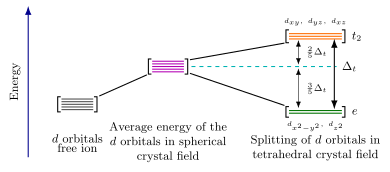
The figure is an energy-level diagram that shows how the five orbitals of a metal ion split when placed in a tetrahedral crystal field created by four ligands.
What the diagram shows:
- The vertical axis represents energy (increasing upward).
- The horizontal axis is not a spatial coordinate; it simply separates the two groups of orbitals.
- At the centre of the diagram is a horizontal line labelled the barycentre (the average energy of the orbitals in a hypothetical spherical field).
- Relative to this barycentre:
- A lower-energy, doubly degenerate set called the set (comprising and ) is placed at an energy of .
- A higher-energy, triply degenerate set called the set (comprising , , and ) is placed at an energy of .
The physical idea:
In a tetrahedral complex, the four ligands approach the metal along directions that lie between the Cartesian axes. Consequently, the , , and orbitals (which point between the axes) point more directly toward the ligands and experience greater repulsion, raising their energy. The and orbitals (which point along the axes) point away from the ligands and are therefore lowered in energy. This is the opposite ordering compared to an octahedral field.
Key formula(s) from the textbook:
The energy separation between the two sets is denoted by (the subscript stands for tetrahedral). The textbook gives the relation: …