Q.Out of the following two coordination entities which is chiral (optically active)?
You're viewing a preview — the full solution, concept, methods & PYQ mapping are locked.
Start your 14-day free trial to unlock the full solution →
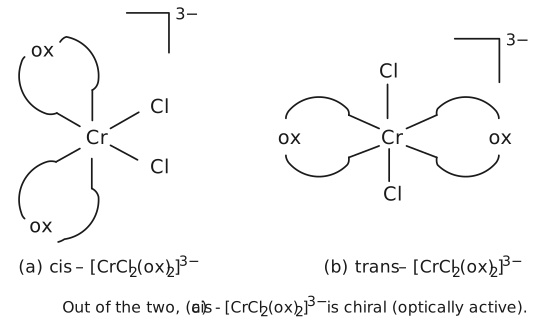
Optical activity in coordination compounds arises from the absence of a plane of symmetry. For the complex , the cis isomer lacks any symmetry plane and is chiral, while the trans isomer has a plane of symmetry and is achiral. The chiral entity is (a).
Why Chirality Matters in Coordination Chemistry
A molecule is chiral (optically active) if it is non-superimposable on its mirror image. In coordination chemistry, this usually happens when the complex lacks an improper axis of rotation — most commonly, a plane of symmetry or a centre of inversion. For octahedral complexes with bidentate ligands, chirality often appears when the arrangement of ligands creates a "handedness," like a left-handed vs. right-handed screw.
The key question here: does the cis or trans isomer of have a plane of symmetry? The oxalate ion () is a bidentate ligand — it binds through two oxygen atoms, forming a five-membered chelate ring. Chromium(III) is in the +3 oxidation state, and the complex is octahedral.
Step-by-Step Analysis
-
Draw the cis isomer.
In the cis arrangement, the two chloride ligands are adjacent (90° apart). The two oxalate ligands occupy the remaining four positions. Each oxalate spans two adjacent sites, forming a chelate ring.
Visualise the structure: imagine the two Cl atoms at, say, positions 1 and 2 of an octahedron. One oxalate can occupy positions 3 and 4, the other oxalate positions 5 and 6.
Now check for symmetry: is there any plane that cuts through the molecule and reflects one half onto the other?
- A plane containing the two Cl atoms and the metal centre? That plane would cut through the oxalate rings — but the rings are not symmetric about that plane because each oxalate is a flat, planar unit that lies at an angle.
- A plane perpendicular to the Cl–Cr–Cl axis? The two oxalates are oriented differently; one is "above" and one "below" relative to any such plane. In fact, the cis isomer has no plane of symmetry and no centre of inversion. Its mirror image cannot be superimposed on the original — it is chiral. This is analogous to the classic case of , which is optically active.
-
Draw the trans isomer.
In the trans arrangement, the two chloride ligands are opposite each other (180° apart). The two oxalate ligands then occupy the four equatorial positions in a plane.
Now look for symmetry:
- There is a plane of symmetry that contains the two Cl atoms and the metal centre, and bisects the angle between the two oxalate ligands. This plane cuts through the centre of each oxalate ring, reflecting one half of the molecule onto the other.
- Additionally, there is a centre of inversion at the chromium atom. …
Unlock everything free for 14 days
- Full step-by-step solutions
- Concept-first explanations
- Methods, shortcuts & mistakes
- PYQ mapping + timed mock tests
Full access for 14 days. No credit card required.