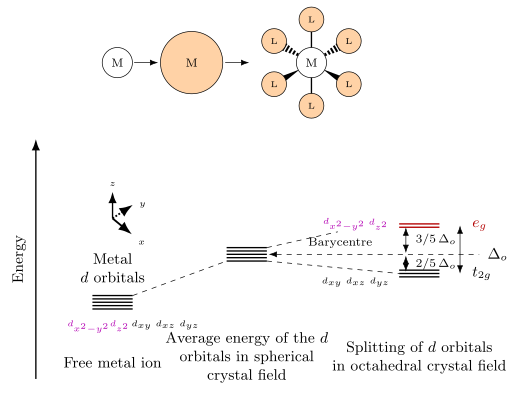
Q.Draw figure to show the splitting of d orbitals in an octahedral crystal field.
You're viewing a preview — the full solution, concept, methods & PYQ mapping are locked.
Start your 14-day free trial to unlock the full solution →In an octahedral crystal field, the five degenerate d‑orbitals split into two sets: the lower‑energy set () and the higher‑energy set (). The splitting arises because the orbitals point directly at the ligands and experience greater repulsion.
The core idea: why does splitting happen?
Imagine placing a central metal ion inside an octahedron of six negative charges (ligands). The d‑orbitals are not all shaped the same — some lobes point directly toward the ligands, others point between them. An electron in an orbital that points straight at a ligand feels a strong electrostatic repulsion, raising its energy. An electron in an orbital that points between ligands feels less repulsion, so its energy stays lower.
This difference in repulsion is the entire origin of crystal field splitting. The five originally equal‑energy d‑orbitals break into two groups.
Step‑by‑step reasoning
-
Identify the orbital shapes relative to the axes
In an octahedral complex, the ligands lie along the , , , , , and axes.
- has a lobe along the ‑axis (plus a doughnut in the ‑plane).
- has lobes along the and axes.
- , , have lobes that lie between the axes — in the planes at to the axes.
-
Which orbitals point directly at the ligands?
The and orbitals have their lobes aimed straight at the ligands on the axes. These are the set (two orbitals).
The , , orbitals point between the axes, so they avoid the ligands. These are the set (three orbitals).
-
Energy consequence
Because the orbitals experience direct repulsion from the ligand charges, their energy rises. The orbitals, pointing into empty space between ligands, stay at a lower energy. The energy gap between the two sets is called (or ).
-
The splitting diagram
On the left, the five d-orbitals of the free ion sit together at one (degenerate) energy level. On the right, in the octahedral field, they split into two groups: the pair () raised above that level, and the trio () lowered below it, separated by the gap .
In its simplest form:
     e_g (higher energy)
     ↑
     |  Δ_o
     ↓
     t_{2g} (lower energy)
``` …
Unlock everything free for 14 days
- Full step-by-step solutions
- Concept-first explanations
- Methods, shortcuts & mistakes
- PYQ mapping + timed mock tests
Full access for 14 days. No credit card required.