Skip to content
Exercises · 3.7

Q.Determine the current in each branch of the network shown in Fig. 3.20.
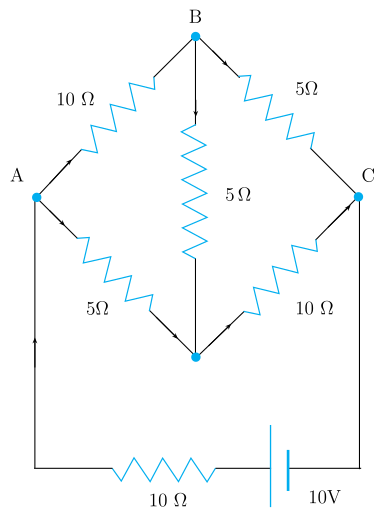
Figure 3.20
Figure 3.20
Yanam BieapTextbookSubjective· 3mImportance★★★★★
33% · 14/42 Questions
🔒 Locked · start free trial →

You're viewing a preview — the full solution, concept, methods & PYQ mapping are locked.

Start your 14-day free trial to unlock the full solution →

The network is an unbalanced Wheatstone bridge (arms AB=10 ΩAB=10\ \Omega, BC=5 ΩBC=5\ \Omega, AD=5 ΩAD=5\ \Omega, DC=10 ΩDC=10\ \Omega, bridge BD=5 ΩBD=5\ \Omega) fed by a 10 V10\ \text{V} cell in series with 10 Ω10\ \Omega across AA–CC. The bridge presents 7 Ω7\ \Omega, so the battery drives 1017 A≈0.59 A\tfrac{10}{17}\ \text{A} \approx 0.59\ \text{A}; the branch currents are 417,617,617,417\tfrac{4}{17}, \tfrac{6}{17}, \tfrac{6}{17}, \tfrac{4}{17} and 217 A\tfrac{2}{17}\ \text{A}.

The network. Nodes AA (left), BB (top), CC (right), DD (bottom) form a bridge: AB=10 ΩAB = 10\ \Omega, BC=5 ΩBC = 5\ \Omega, AD=5 ΩAD = 5\ \Omega, DC=10 ΩDC = 10\ \Omega, with a 5 Ω5\ \Omega bridge arm BDBD. The supply is a 10 V10\ \text{V} cell in series with a 10 Ω10\ \Omega resistor across AA and CC.

Is it balanced? ABBC=105=2\dfrac{AB}{BC} = \dfrac{10}{5} = 2 while ADDC=510=0.5\dfrac{AD}{DC} = \dfrac{5}{10} = 0.5; unequal, so the bridge is unbalanced and current flows in BDBD. We use mesh (loop) analysis.

Mesh equations. With clockwise mesh currents i1i_1 (loop ABDABD), i2i_2 (loop BCDBCD), i3i_3 (loop AA-DD-CC-battery):

4i1−i2−i3=0,−i1+4i2−2i3=0,−i1−2i2+5i3=2.4i_1 - i_2 - i_3 = 0,\qquad -i_1 + 4i_2 - 2i_3 = 0,\qquad -i_1 - 2i_2 + 5i_3 = 2.

Solving: i1=417i_1 = \dfrac{4}{17}, i2=617i_2 = \dfrac{6}{17}, i3=1017 Ai_3 = \dfrac{10}{17}\ \text{A}.

Branch currents.

BranchElementCurrent
ABAB10 Ω10\ \Omega417≈0.235 A\tfrac{4}{17} \approx 0.235\ \text{A}
BCBC5 Ω5\ \Omega617≈0.353 A\tfrac{6}{17} \approx 0.353\ \text{A}
ADAD5 Ω5\ \Omega617≈0.353 A\tfrac{6}{17} \approx 0.353\ \text{A}
DCDC10 Ω10\ \Omega417≈0.235 A\tfrac{4}{17} \approx 0.235\ \text{A}

Unlock everything free for 14 days

  • Full step-by-step solutions
  • Concept-first explanations
  • Methods, shortcuts & mistakes
  • PYQ mapping + timed mock tests

Full access for 14 days. No credit card required.