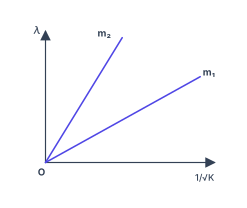
Q.de Broglie wavelength as a function of , for two particles of masses and are shown in the figure. Here, is the energy of the moving particles.
You're viewing a preview — the full solution, concept, methods & PYQ mapping are locked.
Start your 14-day free trial to unlock the full solution →The de Broglie wavelength relates to kinetic energy as , so a plot of vs is a straight line through the origin whose slope is . The steeper line corresponds to the lighter particle, so is heavier. This graph does not apply to photons because the relation is invalid for massless particles.
The core idea here is the de Broglie relation , combined with the classical expression for kinetic energy . When you eliminate momentum , you get . This is a power-law relation: , with the constant of proportionality depending on mass. Plotting against therefore gives a straight line through the origin — the slope carries the mass information.
Let’s work through each part systematically.
- Finding what the slope represents Start from the de Broglie wavelength for a massive particle:
For a non-relativistic particle, kinetic energy , so . Substituting:
This is of the form , where and .
Therefore, the slope of each line is:
The slope depends only on the particle’s mass (and Planck’s constant). A heavier particle gives a smaller slope; a lighter particle gives a larger slope.
-
Which particle is heavier?
From the graph, the line labelled is steeper than the line labelled .
Since slope , a steeper slope means a smaller mass.
So is the lighter particle, and is the heavier particle.
Watch outA common mistake is to think “steeper line = heavier particle” because a steeper line rises faster. But here the slope is inversely proportional to , so steeper actually means lighter. Always check the algebraic relation before jumping to a visual conclusion.
-
Does this graph apply to a photon? …
Unlock everything free for 14 days
- Full step-by-step solutions
- Concept-first explanations
- Methods, shortcuts & mistakes
- PYQ mapping + timed mock tests
Full access for 14 days. No credit card required.