Physics · Ch 1 — Electric Charges and Fields
Field Due to a Uniformly Charged Infinite Plane Sheet
Field Due to a Uniformly Charged Infinite Plane Sheet
Why This Field Is Special
An infinite plane sheet with uniform surface charge density creates an electric field that is constant in magnitude and perpendicular to the sheet. The field does not depend on how far you are from the sheet — it is the same at every point in space. This result follows directly from Gauss's law and symmetry.
Symmetry and Direction of the Field
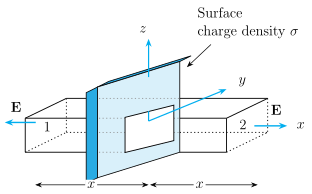
- The sheet lies in the - plane. The -axis is taken normal (perpendicular) to the sheet.
- Because the sheet is infinite and uniformly charged, the electric field cannot depend on or coordinates — it must be the same at all points with the same .
- By symmetry, the field direction at every point is parallel to the -axis.
- If , the field points away from the sheet on both sides.
- If , the field points toward the sheet on both sides.
Choosing the Gaussian Surface
We choose a rectangular parallelepiped (a box) that:
- Has cross-sectional area parallel to the sheet.
- Extends equally on both sides of the sheet (the sheet passes through the middle of the box).
Only the two faces (face 1 and face 2) that are parallel to the sheet contribute to the electric flux. The other four faces have field lines parallel to them, so their flux is zero.
- For face 1 (left side): the outward normal is in the direction.
- For face 2 (right side): the outward normal is in the direction.
- On both faces, the electric field is perpendicular to the surface and constant in magnitude.
Calculating the Flux
Flux through face 1:
Flux through face 2:
Both contributions add up because the field direction and the outward normal are aligned on each face.
Net flux through the Gaussian surface:
Charge Enclosed
The sheet has surface charge density . The area of the sheet inside the Gaussian surface is . Therefore, the total charge enclosed is:
Applying Gauss's Law
Gauss's law states:
Substitute the expressions:
Cancel (since ):
Thus:
Vector Form
The direction is given by a unit vector that is normal to the plane and pointing away from it:
- If , is directed away from the sheet. …
Drawn by us to help you understand the concept clearly, and verified to make sure it's accurate. For exams, practice from your textbook's own diagram.
The figure shows a vertical infinite plane sheet with a visible thickness, drawn as a solid slab. A dashed rectangular box (the Gaussian surface) is centered on the sheet, piercing it symmetrically — like a window cut through the sheet. The box has two end faces (labeled 1 on the left and 2 on the right) and four side faces parallel to the sheet.
Axes and labels:
- The x-axis points horizontally to the right, emerging from face 2, just below an electric field arrow.
- The z-axis rises vertically from the top edge of the sheet.
- The y-axis leaves the page up-right from the centre of the sheet.
- A label "Surface charge density σ" appears top-right, with a leader line pointing to the sheet.
- Two 'x' dimension arrows meet at the sheet, indicating the thickness of the Gaussian box along the x-direction.
- E arrows leave both end faces: one pointing left from face 1, one pointing right from face 2.
Physical idea:
By symmetry, the electric field due to an infinite uniformly charged plane must be perpendicular to the sheet (parallel to the x-axis) and independent of y and z. The Gaussian box is chosen so that only its two end faces (1 and 2) have electric flux — the side faces are parallel to the field lines, so they contribute zero flux. The field magnitude is the same on both end faces, and the flux through each is (where is the area of the end face). Since the normals point in opposite directions, the fluxes add: total flux .
Key formula derived from the figure:
The charge enclosed by the Gaussian surface is (surface charge density times area ). Applying Gauss's law:
Cancelling gives the magnitude:
In vector form:
where is a unit vector normal to the plane and pointing away from it.
- If , points away from the sheet.
- If , points toward the sheet. …