Zoology · Ch 5 — Neural Control and Coordination
Central Neural System
Central Neural System
The central neural system is made up of the brain and the spinal cord, and the brain is its most important part. The brain is the central information-processing organ of the body and works as its command and control system. Almost every activity that keeps the body running and every higher function of the mind is coordinated here.
The brain looks after a wide range of tasks, including:
- Controlling voluntary movements of the body.
- Maintaining the balance of the body.
- Regulating the working of vital involuntary organs such as the lungs, heart and kidneys.
- Thermoregulation, that is, keeping body temperature steady.
- Controlling the sensations of hunger and thirst.
- Managing the circadian rhythms of the body, the natural twenty-four-hour cycles of activity.
- Governing the activity of several endocrine glands.
- Shaping human behaviour.
Beyond these, the brain is also the site where vision, hearing and speech are processed, and where memory, intelligence, emotions and thoughts arise.
Protection of the brain
Because it is so vital, the brain is very well protected. It is housed inside the bony skull, which shields it from mechanical injury. Within the skull, the brain is further wrapped by three protective membranes called the cranial meninges. Arranged from the outside inwards, these are:
- The dura mater, the tough outer layer.
- The arachnoid, a very thin middle layer.
- The pia mater, the innermost layer, which lies in direct contact with the brain tissue itself.
Major divisions of the brain …
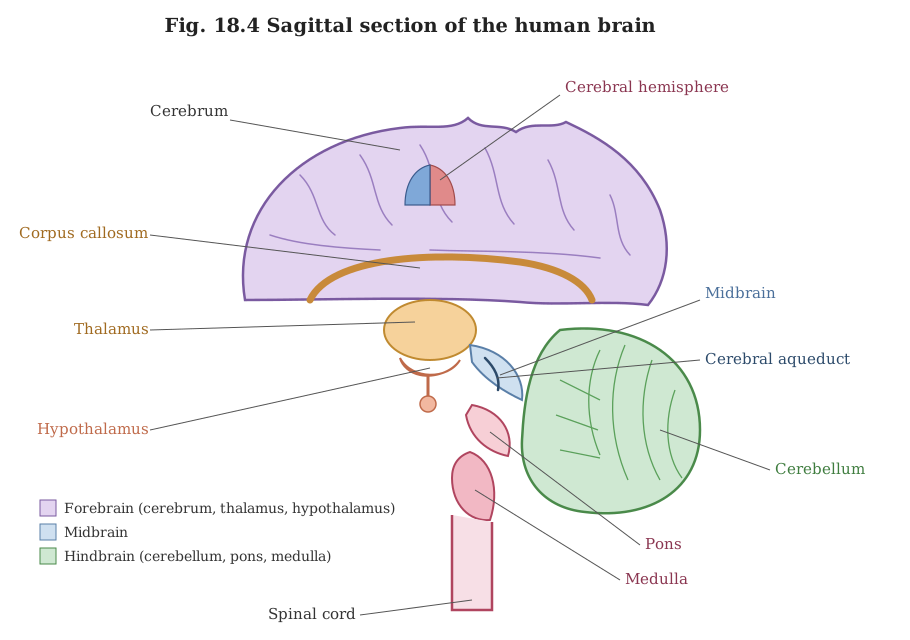
Drawn by us to help you understand the concept clearly, and verified to make sure it's accurate. For exams, practice from your textbook's own diagram.
This is a side-on (sagittal) view of the human brain cut down the middle, laying out its three great divisions and their main parts. Filling the top and front is the forebrain: the large, deeply folded cerebrum, whose surface layer (the cerebral cortex) handles thinking, sensation and voluntary action; beneath it sit the thalamus, a relay centre for sensory and motor signals, and the hypothalamus, which controls temperature, hunger, thirst and hormone release. The two cerebral hemispheres are joined across the midline by a thick band of fibres, the corpus callosum. Behind and below the forebrain lies the small midbrain. Lowest of all is the hindbrain, made up of the cerebellum — the ridged structure at the back that fine-tunes posture, balance and smooth movement — together with the pons and the medulla oblongata, the medulla continuing downward as the spinal cord. The midbrain, pons and medulla together form the …