Business Studies · Ch 4 — Business Services
e-Banking
e-Banking
The growth of the internet and e-commerce is turning the world into a digital global village, and the latest wave in information technology is internet banking — a part of virtual banking and another delivery channel for customers.
What e-banking is
- Any user with a PC and a browser can connect to the bank's website and perform virtual banking functions and avail of the bank's services — without a human operator.
- The bank keeps a centralised, web-enabled database; all permitted services appear on a menu, and the interaction that follows depends on the nature of the service chosen.
- e-banking lowers transaction cost, adds value to the banking relationship and empowers customers. In short, it is electronic banking — conducting transactions such as managing savings, checking accounts, applying for loans or paying bills over the internet using a personal computer, mobile telephone or handheld computer (PDA).
Range of e-banking services
- Automated Teller Machines (ATM) and Point of Sale (PoS)
- Electronic Data Interchange (EDI) and credit cards
- Electronic / digital cash and Electronic Fund Transfer (EFT) — done in two ways: NEFT (National Electronic Fund Transfer) and RTGS (Real Time Gross Settlement).
Benefits to customers
- Facilitates digital payments and promotes transparency in financial statements.
- Provides service 24 hours a day, 365 days a year.
- Permits some transactions from office, home or while travelling via mobile telephone.
- Instils financial discipline by recording every transaction.
- Gives greater satisfaction through unlimited access not bound by branch walls, with less risk and greater security because customers avoid travelling with cash.
Benefits to banks
- Provides a competitive advantage.
- Gives an unlimited network not limited to the number of branches — any PC with a modem and an internet connection can meet a customer's cash-withdrawal needs.
- Reduces the load on branches by using a centralised database and taking over some accounting functions.
Types of digital payments
Every transaction for goods and services is finally settled by a mode of payment, which is either cash or digital (non-cash). As covered in the CBSE Class 11 Business Studies syllabus, digital, non-cash payments fall into two broad families:
- Plastic cards — payment cards of two kinds: the debit card, which draws directly on the customer's own bank balance, and the credit card, which lets the customer spend against a bank-extended credit limit and settle the bill later.
- e-Banking channels — instruments that move money electronically without handling cash. The newer ones include:
- USSD (Unstructured Supplementary Service Data) — banking on a basic mobile phone through a short code, needing neither the internet nor a smartphone.
- Point of Sale (PoS) — paying by swiping, dipping or tapping a card at a merchant's terminal.
- AEPS (Aadhaar Enabled Payment System) — paying or withdrawing money using an Aadhaar number with fingerprint authentication.
- UPI (Unified Payments Interface) — instant, direct account-to-account transfer through a mobile app using a virtual payment address. …
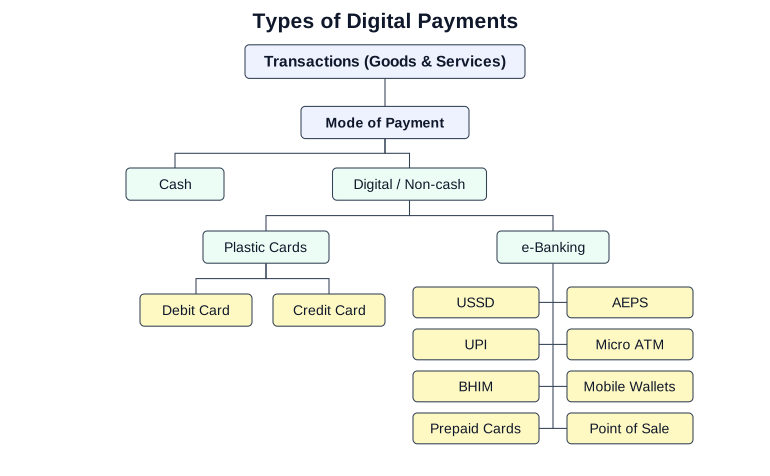
Drawn by us to help you understand the concept clearly, and verified to make sure it's accurate. For exams, practice from your NCERT textbook's own diagram.
What the Figure Shows
Our own chart of the modes of payment — cash versus the digital (non-cash) options: plastic cards (debit, credit) and e-banking channels such as UPI, BHIM, AEPS, USSD, Micro A …