Biology · Ch 10 — Cell Cycle and Cell Division
Telophase
Telophase
Telophase is the last stage of karyokinesis — the division of the nucleus. By the time telophase begins, the daughter chromosomes have already finished their journey and have gathered at their respective poles. This stage essentially reverses the packaging changes that took place earlier in mitosis, rebuilding two proper nuclei.
Once the chromosomes reach the poles, they begin to decondense — that is, they uncoil and loosen up, losing the tightly compacted form that made them visible during the earlier stages. As they unwind, the individual chromosomes can no longer be picked out as separate, distinct structures; they lose their individuality and blend back into a diffuse mass. Each cluster of this chromatin material collects together at its own pole, so the cell now has two gatherings of genetic material, one at each end.
Alongside this, the structures that had been dismantled at the start of mitosis are put back together. The key events of telophase are:
- The chromosomes cluster at the two opposite spindle poles, and their identity as separate, discrete elements is lost as they decondense into chromatin.
- A nuclear envelope forms around each cluster of chromatin, so that two daughter nuclei are created — one at each pole. …
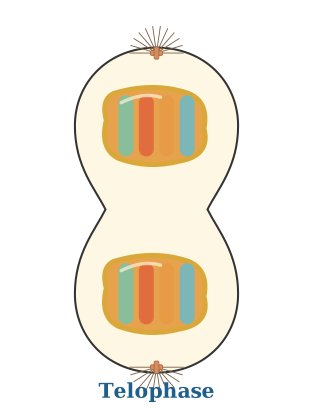
Drawn by us to help you understand the concept clearly, and verified to make sure it's accurate. For exams, practice from your NCERT textbook's own diagram.
In telophase the daughter chromosomes have reached the two poles and begin to decondense, losing their distinct rod shape and collecting into two masses of chromatin. A new nuclear envelope (gold) reforms around each cluster, producing two daughter nuclei, while the cell has started to pinch inward at the middle …