Biology · Ch 5 — Morphology of Flowering Plants
The Flower
The Flower
The flower is the reproductive unit in the angiosperms, meant for sexual reproduction. Morphologically it is a modified shoot in which the shoot apical meristem changes to a floral meristem; the internodes do not elongate and the axis gets condensed. A typical flower has four different kinds of whorls arranged successively on the swollen end of the stalk or pedicel, called the thalamus or receptacle. These whorls are the calyx, corolla, androecium and gynoecium. The calyx and corolla are accessory organs, while the androecium and gynoecium are the reproductive organs. In some flowers, like lily, the calyx and corolla are not distinct and are together termed the perianth.
A flower is described in several ways:
- Sexuality: When a flower has both androecium and gynoecium it is bisexual; a flower having either only stamens or only carpels is unisexual.
- Symmetry: A flower is actinomorphic (radial symmetry) when it can be divided into two equal radial halves in any radial plane passing through the centre, as in mustard, datura and chilli. It is zygomorphic (bilateral symmetry) when it can be divided into two similar halves only in one particular vertical plane, as in pea, gulmohur, bean and Cassia. A flower is asymmetric (irregular) if it cannot be divided into two similar halves by any vertical plane through the centre, as in canna.
- Number of parts: A flower may be trimerous, tetramerous or pentamerous when the floral appendages are in multiples of 3, 4 or 5, respectively.
- Bracts: Flowers with bracts (reduced leaf found at the base of the pedicel) are called bracteate, and those without bracts are ebracteate. …
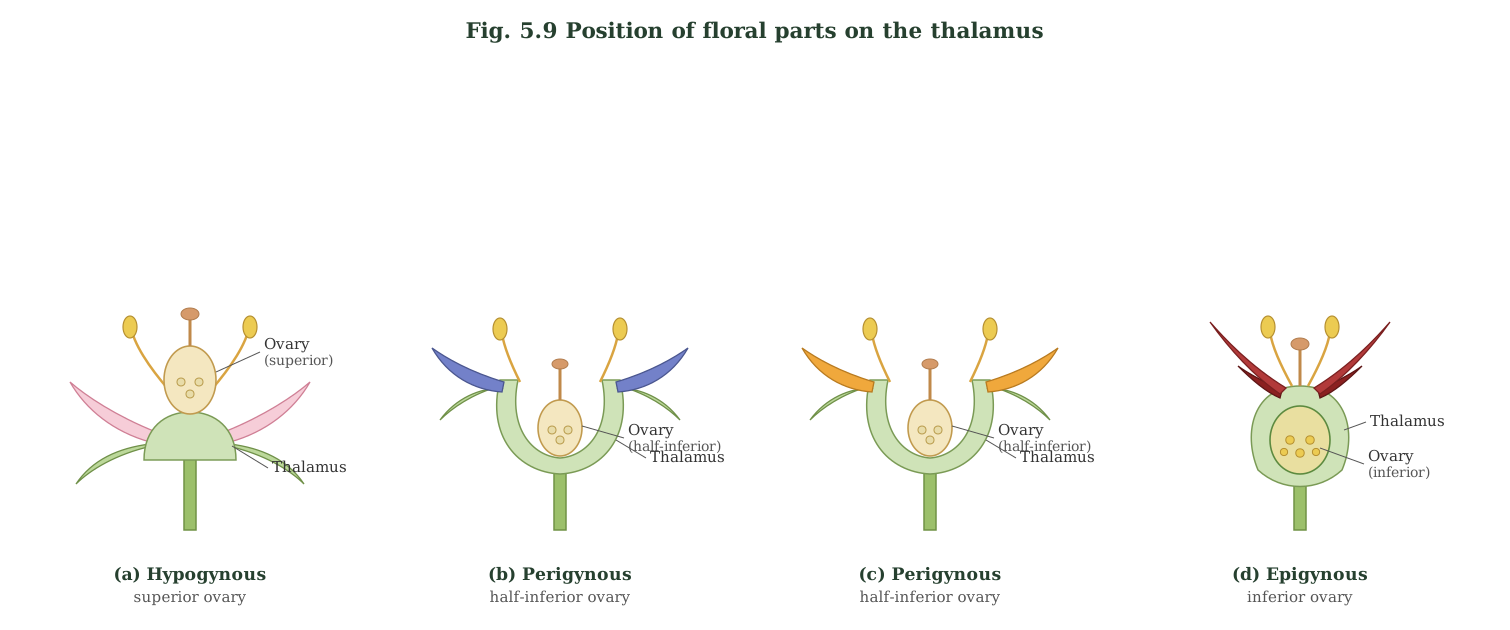
Drawn by us to help you understand the concept clearly, and verified to make sure it's accurate. For exams, practice from your NCERT textbook's own diagram.
This figure shows how the position of the ovary relative to the other floral parts on the thalamus defines three flower types. In a hypogynous flower the ovary sits on top, above the level where the sepals, petals and stamens attach, so the ovary is called superior, as in mustard and china rose. In a perigynous flower the thalamus grows up into a cup so the sepals, petals and stamens are borne on its rim, roughly at the same level as the ovary, which is then half-inferior, as in rose and plum. In an epigynous flower the thalamus completely encloses and fuses w …