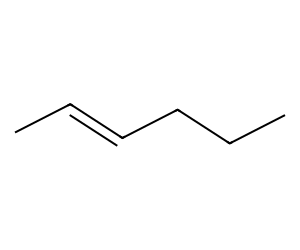
Q.Draw the cis and trans structures of hex-2-ene. Which isomer will have higher b.p. and why?
You're viewing a preview — the full solution, concept, methods & PYQ mapping are locked.
Start your 14-day free trial to unlock the full solution →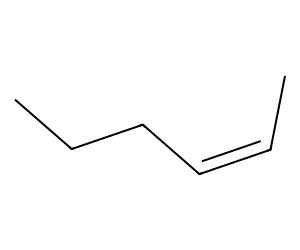
Hex-2-ene exhibits geometric (cis-trans) isomerism due to restricted rotation around the C=C bond. The cis-isomer has a higher boiling point because its bent shape allows stronger dipole-dipole interactions, while the trans-isomer's symmetry cancels its dipole moment.
Understanding Geometric Isomerism in Hex-2-ene
Hex-2-ene has a carbon-carbon double bond at the second position, which creates a rigid planar geometry. Unlike single bonds that rotate freely, the -bond in a double bond locks the molecule into a fixed arrangement. When two different groups are attached to each carbon of the double bond, we get geometric isomers—molecules with the same connectivity but different spatial arrangements.
The two isomers differ in whether the larger substituents (the alkyl chains) lie on the same side or opposite sides of the double bond.
Drawing the Structures
1. cis-Hex-2-ene
In the cis-isomer, the two alkyl groups (the methyl and the propyl ) are on the same side of the double bond:
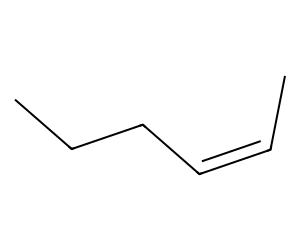
The molecule adopts a bent or "kinked" shape because the bulky alkyl chains are forced to the same side.
2. trans-Hex-2-ene
In the trans-isomer, the alkyl groups are on opposite sides:
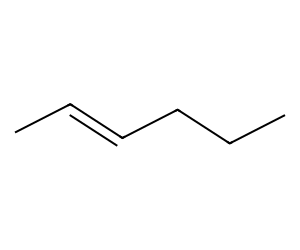
This arrangement is more linear and extended.
The systematic IUPAC names are (Z)-hex-2-ene for cis and (E)-hex-2-ene for trans, based on the Cahn-Ingold-Prelog priority rules. However, for simple alkenes like this, cis/trans nomenclature is still widely used.
Comparing Boiling Points
3. Molecular polarity and shape
Although both isomers have the same molecular formula () and similar London dispersion forces, their shapes create different dipole moments.
In cis-hex-2-ene, the two C–C bonds on the same side create a net dipole moment. The electron density is unevenly distributed, making one side of the molecule slightly more electron-rich than the other. This permanent dipole allows for dipole-dipole interactions between molecules.
In trans-hex-2-ene, the molecule is more symmetrical. The dipole moments of the C–C bonds on opposite sides largely cancel each other out, resulting in a near-zero net dipole moment. The molecule is essentially non-polar.
4. Intermolecular forces
The cis-isomer experiences both London dispersion forces and dipole-dipole interactions. The trans-isomer relies almost entirely on London dispersion forces.
Dipole-dipole interactions are stronger than dispersion forces alone, so molecules of cis-hex-2-ene attract each other more strongly.
5. Effect on boiling point …
Unlock everything free for 14 days
- Full step-by-step solutions
- Concept-first explanations
- Methods, shortcuts & mistakes
- PYQ mapping + timed mock tests
Full access for 14 days. No credit card required.