Chemistry · Ch 8 — Organic Chemistry – Some Basic Principles and Techniques
Differential Extraction
Differential Extraction
The Principle of Differential Extraction
When an organic compound is dissolved in water, you can often pull it out by shaking the aqueous solution with an organic solvent that does not mix with water. The key idea is simple: the organic compound must be more soluble in the organic solvent than it is in water. Because the two liquids are immiscible, they form two distinct layers — an aqueous layer and an organic layer — which can be separated using a separatory funnel. The organic solvent is then removed by distillation or evaporation, leaving the pure organic compound behind.
This process is called differential extraction. It relies on the difference in solubility of the compound between two immiscible solvents. The compound distributes itself between the two layers according to its partition coefficient, and by repeating the extraction with fresh solvent, you can recover nearly all of the compound.
The separatory funnel is the standard laboratory tool for this. You shake the mixture, let the layers settle, and then drain the lower layer. The organic layer is usually the upper one if the solvent is less dense than water (e.g., ether, hexane), but it can be the lower layer if a denser solvent like dichloromethane is used.
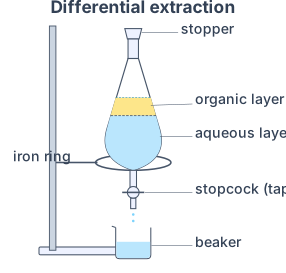
Drawn by us to help you understand the concept clearly, and verified to make sure it's accurate. For exams, practice from your NCERT textbook's own diagram.
Fig. 8.10 shows differential extraction in a pear-shaped separating funnel, drawn as two stages — before and after extraction. In each, the funnel holds two immiscible layers separated by a sharp boundary: the aqueous layer (denser, usually lower) and the organic-solvent layer (lighter, usually upper). A stopcock at the bottom lets the lower layer be drained into a flask.
The technique transfers a dissolved compound from one solvent into another immiscible solvent. When the funnel is shaken, the compound distributes itself between the two layers according to its relative solubility in each and moves preferentially into the solvent it is more soluble in. The layers are then allowed to settle, and the stopcock is opened to drain off the lower layer, separating the two phases. Repeating the shaking with fresh solvent extracts more of the compound. …
When a Large Volume of Solvent Is Needed
If the organic compound is only slightly soluble in the organic solvent, you would need a very large quantity of that solvent to extract even a small amount of the compound. This is inefficient and impractical. In such cases, a different technique is used: continuous extraction.
In continuous extraction, the same solvent is repeatedly cycled through the aqueous solution, extracting the compound bit by bit. The solvent is continuously distilled and condensed, so it flows back through the aqueous layer again and again. This allows a small volume of solvent to do the work of a much larger one, because the solvent is reused many times.
Continuous extraction is especially useful when the compound has a low partition coefficient in favour of the organic solvent. Instead of using a huge volume of solvent in one go, you let a small volume do many extractions, which is far more efficient.
The Key Quantitative Result: The Partition Law
The underlying principle is the distribution law (or partition law). When a solute distributes itself between two immiscible solvents at a constant temperature, the ratio of its concentrations in the two solvents is constant. This constant is called the partition coefficient, .
For differential extraction, this means that if you shake an aqueous solution with an organic solvent, the amount of compound that moves into the organic layer depends on and the volumes of the two layers. If is large, a single extraction may be enough. If is small, you need multiple extractions or continuous extraction.
The efficiency of extraction increases dramatically when you use several small portions of solvent rather than one large portion. This is a direct consequence of the partition law. For example, extracting three times with 10 mL of solvent each time recovers more compound than a single extraction with 30 mL.