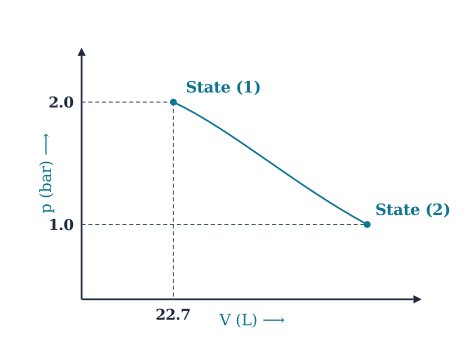
Irreversible Expansion Work – From Intuition to Precision
Imagine you have a gas trapped inside a cylinder with a piston. If you suddenly pull the piston outward, the gas expands rapidly into the newly available space. That's an irreversible expansion — the gas doesn't pass through a series of equilibrium states; it rushes, swirls, and settles only at the end.
Now, think about the work done by the gas during this process. Work, in physics, is force times displacement. For a piston, force is pressure times area, so work becomes PΔV. But here's the catch: during an irreversible expansion, the pressure of the gas is not uniform throughout the cylinder. There are pressure gradients, turbulence, and the gas near the piston face may be at a different pressure than the gas deeper inside.
So how do we calculate the work done?
The Key Insight
The work done by the gas is determined by the external pressure it pushes against — not its own internal pressure. Why? Because the piston moves only in response to the net force acting on it. That net force comes from the external pressure on the other side of the piston.
For any expansion (reversible or irreversible), the work done by the gas is:
W=∫PextdV
where Pext is the pressure exerted on the gas by the surroundings (the piston face).
During a reversible expansion, the gas is always in equilibrium with the surroundings, so Pgas=Pext at every instant. That's why you can replace Pext with Pgas and integrate using the gas's equation of state.
During an irreversible expansion, Pgas is not equal to Pext — and often, Pext is held constant (like when you suddenly release the piston against atmospheric pressure). In that case, the work simplifies dramatically:
W=PextΔV
The Intuitive Picture
Think of pushing a heavy box across a rough floor. The work you do depends on the force you apply (your "external" force), not on the internal stresses inside the box. Similarly, the gas does work against the external resistance it meets — the piston's opposing force.
If the external pressure is constant (say, 1 atm), the gas does work equal to Pext× (change in volume), regardless of how chaotically it expands. The gas might have been at 10 atm initially, but it only does work against the 1 atm it actually pushes.
A common mistake: using the gas's own pressure to calculate irreversible work. Unless the process is reversible, Pgas=Pext, and using Pgas gives the wrong answer.
The Precise Statement
Irreversible expansion work is the work done by a gas when it expands through a series of non-equilibrium states. It is calculated using the external pressure that opposes the expansion:
Wirr=∫V1V2PextdV
For the most common case — expansion against a constant external pressure (like the atmosphere or a fixed weight on the piston): …