Mathematics · Ch 10 — Conic Sections
Circle, Ellipse, Parabola and Hyperbola
Circle, Ellipse, Parabola and Hyperbola
When the Plane Cuts the Nappe: The Four Conic Sections
The shape you get when a plane cuts through a double cone depends entirely on the angle at which the plane meets the cone's axis. There are exactly four distinct possibilities, and each one produces a different conic section. The key is to compare two angles: the semi-vertical angle of the cone, denoted by , and the angle between the cutting plane and the axis of the cone, denoted by .
Think of as fixed — it's the angle the slant height of the cone makes with the vertical axis. The cutting plane can be tilted at any angle between and . The four cases below cover every possibility except when the plane passes through the vertex itself (which gives degenerate conics — a point, a line, or two intersecting lines).
In all four cases described below, the cutting plane does not pass through the vertex of the cone. The vertex is the point where the two nappes meet.
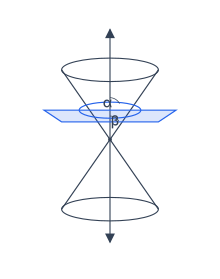
(a) Circle:
When the cutting plane is perpendicular to the axis of the cone, the section is a circle.
Here , meaning the plane is horizontal. The plane cuts entirely across one nappe of the cone, and every point on the curve is at the same distance from the axis. The result is a perfect circle.
A circle is a special case of an ellipse where the two foci coincide. The eccentricity of a circle is .
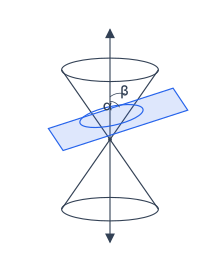
(b) Ellipse:
When the cutting plane is inclined at an angle that is greater than but less than , the section is an ellipse.
The plane still cuts entirely across one nappe of the cone — it does not reach the other nappe. Because the plane is tilted, the cross-section is stretched in one direction, producing an oval shape. The closer gets to , the more elongated the ellipse becomes. When , the ellipse becomes a circle.
You can think of an ellipse as a "squashed circle." The eccentricity of an ellipse satisfies .
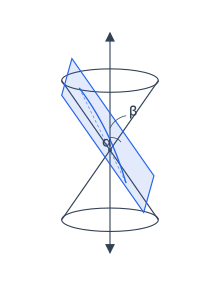
(c) Parabola:
When the cutting plane is parallel to the slant height of the cone, the section is a parabola.
Here , so the plane makes the same angle with the axis as the side of the cone does. The plane cuts entirely across one nappe, but it is just grazing the cone's surface along one line. The resulting curve is open — it never closes back on itself. A parabola has exactly one focus and one directrix, and its eccentricity is exactly .
A common mistake is to think a parabola is just "half an ellipse." They are fundamentally different: an ellipse is a closed curve, while a parabola is open and extends to infinity.
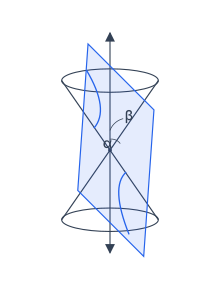
(d) Hyperbola:
When the cutting plane is inclined at an angle less than (including the case where the plane is parallel to the axis, ), the section is a hyperbola.
In this case, the plane cuts through both nappes of the cone. The result is two separate, open curves — the two branches of a hyperbola. Each branch is a mirror image of the other. The eccentricity of a hyperbola is greater than ().
When , the plane is parallel to the axis of the cone. The resulting hyperbola is called a rectangular hyperbola if the asymptotes are perpendicular.
Summary Table of Conditions
| Condition on | Conic Section | Eccentricity | Plane cuts |
|---|---|---|---|
| Circle | One nappe | ||
| Ellipse | One nappe | ||
| Parabola | One nappe | ||
| Hyperbola | Both nappes |
Key Takeaways …
Drawn by us to help you understand the concept clearly, and verified to make sure it's accurate. For exams, practice from your NCERT textbook's own diagram.
Fig. 10.4 is the first of four figures that build the geometric definition of the conic sections. It shows a double cone — two identical cones meeting at a common vertex — and a single horizontal plane slicing through one of the two nappes (the upper cone). The plane is drawn in blue, and it cuts straight across the cone, parallel to its base. The intersection curve, also drawn in blue, is a closed loop that lies flat in that horizontal plane.
The key labels are the two angles marked at the vertex. The angle is the semi-vertical angle of the cone — the angle between the axis of the cone and its slant side. The angle is the angle between the cutting plane and the axis of the cone. In this figure, , meaning the cutting plane is perpendicular to the axis. The result is a circle.
The physical idea is simple: if you slice a cone with a plane that is exactly perpendicular to its axis, the cross-section is a perfect circle. This is the most symmetric of all conic sections. The figure makes clear that the circle is not a separate shape from the ellipse — it is a special case of an ellipse where the plane is perpendicular to the axis.
The circle is the conic section obtained when . The plane cuts entirely across one nappe, and the intersection is a closed curve of constant distance from the centre.
The textbook uses this figure to establish the geometric condition that defines a circle: every point on the circle is at a fixed distance (the radius) from a fixed point (the centre). In the context of the cone, the radius of the circle depends on how far down the cone the plane cuts — the farther from the vertex, the larger the radius.
The standard equation of a circle with centre at and radius is:
Here, and are the coordinates of any point on the circle, and are the coordinates of the centre, and is the radius. When the centre is at the origin, this simplifies to . …
Drawn by us to help you understand the concept clearly, and verified to make sure it's accurate. For exams, practice from your NCERT textbook's own diagram.
Fig. 10.5 is a three-dimensional sketch of a double cone — two identical cones meeting at a common vertex, one upright and one inverted. A blue plane slices through the cone at a slant, cutting through only the upper nappe (the upright cone). The intersection of this plane with the cone’s surface is a closed, oval-shaped curve drawn in blue: an ellipse.
Two angles are marked at the vertex. The first, , is the semi-vertical angle of the cone — the angle between the axis of the cone and its slant edge. The second, , is the angle between the cutting plane and the axis of the cone. In this figure, is less than but greater than , so the plane is tilted but not steep enough to be parallel to a slant edge. The condition is the key: the plane cuts completely across one nappe, never touching the other nappe, and the resulting closed curve is an ellipse.
If , the plane is horizontal and the section is a circle — a special case of an ellipse. If , the plane is parallel to a slant edge and the section is a parabola (open, not closed). If , the plane is steep enough to cut both nappes, producing a hyperbola (two separate open curves).
The physical idea is simple: the shape of the conic section is determined entirely by the tilt of the cutting plane relative to the cone’s axis. By varying from down to , you get the full family of conics — circle, ellipse, parabola, hyperbola — in that order.
The textbook uses this geometric setup to derive the standard equation of an ellipse. For an ellipse centred at the origin with its major axis along the -axis, the equation is
where is the semi-major axis (half the length of the longest diameter) and is the semi-minor axis (half the length of the shortest diameter). The relationship between , , and the focal distance (distance from the centre to each focus) is
The eccentricity of the ellipse, defined as , satisfies . For a circle, because and .
…
Drawn by us to help you understand the concept clearly, and verified to make sure it's accurate. For exams, practice from your NCERT textbook's own diagram.
Fig. 10.6 is the geometric definition of a parabola in the language of conic sections. The figure shows a double cone (two identical cones meeting at a common vertex) and a single cutting plane. The plane is drawn in blue, and it slices through only one nappe (the upper half of the cone). The plane is oriented so that it is exactly parallel to one of the straight lines that form the cone — that line is called a generator of the cone. Because the plane is parallel to a generator, it never meets that generator; instead it cuts the cone in a curve that is open and U-shaped: the parabola, also drawn in blue.
At the vertex of the cone, two angles are marked. The angle is the half-angle of the cone — the angle between the axis of the cone and any generator. The angle is the angle between the cutting plane and the axis of the cone. In this figure, the condition is : the plane is tilted at exactly the same angle as the cone’s side. That equality is what makes the intersection a parabola rather than an ellipse or a hyperbola.
The figure also includes a dashed chord inside the parabola. This chord is the latus rectum — a line segment through the focus, perpendicular to the axis of symmetry, whose endpoints lie on the parabola. The dashed chord is a visual reminder that the parabola has a fixed geometric property: every point on the curve is equidistant from a fixed point (the focus) and a fixed line (the directrix). The latus rectum’s length is , where is the distance from the vertex to the focus.
This is the standard equation of a parabola with vertex at the origin, axis along the -axis, focus at , and directrix . Here is a positive constant: the distance from the vertex to the focus. The latus rectum is the chord through the focus perpendicular to the axis; its length is . …
Drawn by us to help you understand the concept clearly, and verified to make sure it's accurate. For exams, practice from your NCERT textbook's own diagram.
Fig. 10.7 is the visual anchor for the fourth and final case of conic sections: the hyperbola. The figure shows a double cone — two identical cones placed tip to tip, sharing the same vertex — being cut by a steep blue plane. The key detail is that this plane does not stay within one nappe (one cone half). Instead, it slices through both the upper and lower nappes simultaneously.
The plane is oriented at an angle measured from the vertical axis of the cone. The cone itself has a fixed semi-vertical angle , the angle between the cone's axis and its slant edge. In this figure, the condition is . Because is smaller than , the plane is steeper than the slant edge of the cone. As a result, the plane cuts each nappe in a separate, open curve. The figure shows two distinct blue branches — one in the upper nappe, one in the lower nappe — that are mirror images of each other. These two branches together form the hyperbola.
The physical idea is straightforward: when the cutting plane is steep enough to intersect both halves of the double cone, you get a curve with two disconnected parts. This is fundamentally different from the ellipse (one closed loop) or the parabola (one open curve). The hyperbola is the only conic that arises from a plane cutting both nappes.
The condition for a hyperbola is . The plane cuts through both nappes, producing two separate branches.
The textbook uses this geometric setup to derive the standard equation of a hyperbola. The derivation follows the same distance-based definition used for the ellipse, but with a crucial sign change. For a hyperbola, the difference of distances from two fixed points (the foci) is constant, not the sum.
Standard equation of a hyperbola (centred at origin, transverse axis along the -axis):
where , , and the foci are at with .
Here, is the constant difference of distances from any point on the hyperbola to the two foci. The parameter is related to the asymptotes — the lines the branches approach as and grow large. The asymptotes for this standard form are . The relationship replaces the ellipse's , reflecting the fact that for a hyperbola, the foci are farther from the centre than the vertices.
Do not confuse (hyperbola) with (ellipse). The plus sign is a direct consequence of the difference-of-distances definition. …