Mathematics · Ch 12 — Limits and Derivatives
Limits of Trigonometric Functions
Limits of Trigonometric Functions
Limits of Trigonometric Functions
Before we can evaluate limits involving trigonometric functions, we need two general theorems about limits of functions. These theorems are not about trigonometry themselves — they are tools that work for any functions, and they become essential when we handle trigonometric limits.
Theorem 3: Inequality Preservation Under Limits
If and are two real-valued functions defined on the same domain, and for every in that domain, then for any real number :
If both and exist, then
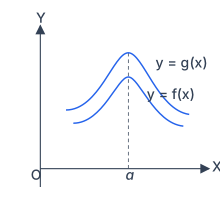
This is intuitive: if one function never exceeds another, its limit cannot exceed the other's limit either. The textbook illustrates this with Fig 12.8, where the graph of stays below the graph of near , and the limits reflect that ordering.
This theorem only applies when both limits exist. If either limit does not exist, the inequality between the functions does not guarantee anything about the limits.
Theorem 4: The Sandwich Theorem (Squeeze Theorem)
Let , , and be real functions such that
for all in their common domain of definition. For some real number , if
then
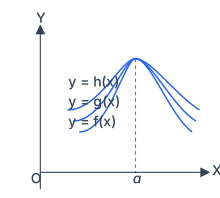
Think of it this way: if is "sandwiched" between and , and both the bottom and top functions approach the same number , then has no choice but to also approach . The textbook shows this in Fig 12.9 — the middle function is trapped between the other two near .
The Sandwich Theorem is your primary weapon for proving . You find functions that bound from above and below, both approaching 1, and the theorem does the rest.
The Fundamental Inequality: for
The textbook gives a geometric proof of this inequality, which is the foundation for the two standard trigonometric limits. Here is the complete reasoning.
›Proof
Geometric proof of for
Since and , the inequality for negative follows from the positive case. So we only need to prove it for .
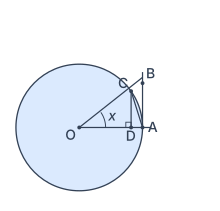
Consider a unit circle (radius ) with centre . Let radians, where . Draw perpendiculars and to . Join .
Now compare three areas:
- Area of
- Area of sector
- Area of
From the geometry, these areas satisfy:
Substituting the expressions:
Cancelling (which is positive):
From , (since ), so .
From , , so .
Substituting:
Since , divide through by :
Now means . Divide the entire inequality by :
Taking reciprocals (which reverses the inequalities because all terms are positive):
This completes the proof.
Theorem 5: The Two Fundamental Trigonometric Limits
The textbook presents these as the central results of the section.
(i)
›Proof
From the inequality we just proved:
The function is sandwiched between and the constant function .
We know (by direct substitution, since cosine is continuous).
So both the lower bound () and the upper bound () approach as .
By the Sandwich Theorem:
This limit is not obtained by direct substitution. If you plug into , you get , which is indeterminate. The Sandwich Theorem is what saves us.
(ii)
›Proof
Use the trigonometric identity .
Rewrite by multiplying numerator and denominator strategically:
As , we have . So let . Then:
The step where we replace with is valid because if approaches 0, then also approaches 0. This substitution trick — setting — is extremely common in limit problems.
--- …
Theorem 5: Two Important Trigonometric Limits
The theorem states two fundamental limits that form the backbone of evaluating limits involving trigonometric functions:
Both limits hold when is measured in radians. The first limit is the more critical one — it tells us that near zero, behaves almost exactly like itself. The second limit follows directly from the first using a trigonometric identity.
A common mistake is to think because . But the denominator also goes to zero, so the limit is an indeterminate form — it requires careful analysis, not direct substitution.
Proof of
The proof uses the Sandwich Theorem (Theorem 4 from the textbook) together with a geometric inequality.
›Proof
Step 1: Establish the inequality for
Consider a unit circle centred at . Let radians, with . Draw perpendiculars and to , and join .
From the geometry, we have:
Computing each area:
Since (unit circle), this simplifies to:
Step 2: Express and in trigonometric terms
From : , so .
From : , so .
Substituting into the inequality:
Step 3: Manipulate to get the sandwich
Since , . Divide the entire inequality by :
Taking reciprocals reverses the inequalities (all terms are positive):
Step 4: Apply the Sandwich Theorem
We know and the constant function also has limit . The function is sandwiched between and for .
Since and , the inequality also holds for (check: , and ).
Therefore, by the Sandwich Theorem:
Proof of
This proof uses the first limit together with a standard trigonometric identity.
›Proof
Step 1: Use the half-angle identity
Recall: .
Therefore:
Step 2: Rewrite to use the known limit
Multiply numerator and denominator to create the form :
Step 3: Take the limit
As , we have . Using the first limit:
And .
Hence:
…
Theorem 5: Two Important Trigonometric Limits
The theorem states two fundamental limits that form the backbone of evaluating limits involving trigonometric functions:
Both limits hold when is measured in radians. The first limit is the more critical one — it tells us that near zero, behaves almost exactly like itself. The second limit follows directly from the first using a trigonometric identity.
A common mistake is to think because . But the denominator also goes to zero, so the limit is an indeterminate form — it requires careful analysis, not direct substitution.
Proof of
The proof uses the Sandwich Theorem (Theorem 4 from the textbook) together with a geometric inequality.
›Proof
Step 1: Establish the inequality for
Consider a unit circle centred at . Let radians, with . Draw perpendiculars and to , and join .
From the geometry, we have:
Computing each area:
Since (unit circle), this simplifies to:
Step 2: Express and in trigonometric terms
From : , so .
From : , so .
Substituting into the inequality:
Step 3: Manipulate to get the sandwich
Since , . Divide the entire inequality by :
Taking reciprocals reverses the inequalities (all terms are positive):
Step 4: Apply the Sandwich Theorem
We know and the constant function also has limit . The function is sandwiched between and for .
Since and , the inequality also holds for (check: , and ).
Therefore, by the Sandwich Theorem:
Proof of
This proof uses the first limit together with a standard trigonometric identity.
›Proof
Step 1: Use the half-angle identity
Recall: .
Therefore:
Step 2: Rewrite to use the known limit
Multiply numerator and denominator to create the form :
Step 3: Take the limit
As , we have . Using the first limit:
And .
Hence:
…
Theorem 5: Two Important Trigonometric Limits
The theorem states two fundamental limits that form the backbone of evaluating limits involving trigonometric functions:
Both limits hold when is measured in radians. The first limit is the more critical one — it tells us that near zero, behaves almost exactly like itself. The second limit follows directly from the first using a trigonometric identity.
A common mistake is to think because . But the denominator also goes to zero, so the limit is an indeterminate form — it requires careful analysis, not direct substitution.
Proof of
The proof uses the Sandwich Theorem (Theorem 4 from the textbook) together with a geometric inequality.
›Proof
Step 1: Establish the inequality for
Consider a unit circle centred at . Let radians, with . Draw perpendiculars and to , and join .
From the geometry, we have:
Computing each area:
Since (unit circle), this simplifies to:
Step 2: Express and in trigonometric terms
From : , so .
From : , so .
Substituting into the inequality:
Step 3: Manipulate to get the sandwich
Since , . Divide the entire inequality by :
Taking reciprocals reverses the inequalities (all terms are positive):
Step 4: Apply the Sandwich Theorem
We know and the constant function also has limit . The function is sandwiched between and for .
Since and , the inequality also holds for (check: , and ).
Therefore, by the Sandwich Theorem:
Proof of
This proof uses the first limit together with a standard trigonometric identity.
›Proof
Step 1: Use the half-angle identity
Recall: .
Therefore:
Step 2: Rewrite to use the known limit
Multiply numerator and denominator to create the form :
Step 3: Take the limit
As , we have . Using the first limit:
And .
Hence:
…
Drawn by us to help you understand the concept clearly, and verified to make sure it's accurate. For exams, practice from your NCERT textbook's own diagram.
Fig. 12.8 is a simple but powerful visual proof of Theorem 3: if one function never goes above another, the same ordering holds for their limits.
The figure shows the first quadrant of the -plane, with axes labelled (horizontal) and (vertical). Two smooth, bell-shaped curves are drawn in blue. The upper curve is labelled ; the lower curve is labelled . At every shown, the -curve lies strictly above the -curve — that is, for all in the domain. A dashed vertical line is drawn at , cutting through both curves. The curves peak near , so the values and are close to their respective maxima, but the key point is that the entire -curve sits above the -curve.
What does this teach? If everywhere, then as approaches , the limit of cannot exceed the limit of . The dashed line at helps you visualise the limiting values: imagine the -coordinates where the curves meet that line. Even if the functions are not defined exactly at , the limits (the -values the curves approach) must obey the same inequality. The figure makes this obvious — the upper curve's limit is higher, the lower curve's limit is lower, and they cannot cross.
The central result illustrated is Theorem 3:
This theorem is the stepping stone to the far more powerful Sandwich Theorem (Theorem 4), shown in the next figure (Fig. 12.9). There, a third function is added above , so . If the outer two functions both approach the same limit , then is forced to approach as well — it is "sandwiched" between them. The inequality for is the classic example, and the Sandwich Theorem then gives . …
Drawn by us to help you understand the concept clearly, and verified to make sure it's accurate. For exams, practice from your NCERT textbook's own diagram.
Fig 12.9 is the visual statement of the Sandwich Theorem (also called the Squeeze Theorem). The axes are the standard first-quadrant pair: the horizontal axis is labelled , the vertical axis , and the origin is . Three curves are drawn in blue, each representing a different function of .
The top curve is , the middle curve is , and the bottom curve is . A dashed vertical line is drawn at . The critical visual fact is that all three curves converge to a single point directly above — that is, they meet at the same height on the -axis. After passing that point, the curves fan out again: rises above, drops below, and stays sandwiched between them.
The physical idea is straightforward. If and are two functions that "squeeze" from below and above for all near (except possibly at itself), and if both and approach the same number as approaches , then is forced to approach that same number . The figure shows this squeezing action: the three curves are distinct away from , but they are pinched together at the limit point. The dashed vertical line at marks the location where the limit is being taken — note that the curves may or may not actually pass through that point; the theorem only cares about behaviour near , not at .
The textbook uses this figure to introduce Theorem 4 (Sandwich Theorem):
Here , , are real-valued functions, is a real number, and is the common limit. The figure directly illustrates this: (bottom curve) and (top curve) both approach the same height at , so the middle curve is "squeezed" to that same height.
The textbook then applies this theorem to prove the fundamental trigonometric limit:
The proof uses the inequality for , which is exactly a sandwich: , , . Since and , the Sandwich Theorem forces . The figure in the textbook (Fig 12.9) is the generic picture of this idea; the specific trigonometric inequality is then proved geometrically using a unit circle diagram (Fig 12.10). …
Drawn by us to help you understand the concept clearly, and verified to make sure it's accurate. For exams, practice from your NCERT textbook's own diagram.
Fig 12.10 is a geometric construction inside a unit circle — a circle with centre O and radius 1. The radius OA is drawn horizontally to the right, ending at point A on the circumference. From the centre O, a second radius OC is drawn at an angle (measured anticlockwise from OA), so that the angle radians. The figure is drawn for a small positive angle, .
From point C, a perpendicular CD is dropped to OA, meeting OA at D. A right-angle mark is shown at D. The chord AC is drawn. At point A, a vertical line (the tangent to the circle at A) is drawn upward; it meets the extension of OC at point B. So AB is vertical, and OA is horizontal, making triangle OAB a right triangle with the right angle at A.
The figure contains three regions, all shaded in light blue: triangle OAC (bounded by OA, OC, and chord AC), sector OAC (the pie-slice of the circle between radii OA and OC), and triangle OAB (bounded by OA, OB, and the tangent segment AB). The key visual idea is that these three regions are nested inside each other — triangle OAC lies entirely inside the sector, which in turn lies entirely inside triangle OAB. Because area is a positive quantity, this gives the inequality chain:
Now we express each area in terms of and the radius (which is 1). For triangle OAC, base OA = 1 and height CD = (since in right triangle OCD, ). So its area is .
For sector OAC, the area of a sector of angle in a unit circle is (since full circle area corresponds to angle , so area ). So sector area .
For triangle OAB, base OA = 1 and height AB = (since in right triangle OAB, ). Its area is .
Substituting these into the inequality and multiplying through by 2 gives:
This is the fundamental inequality the figure is designed to prove. From it, by dividing by (positive in this interval) and taking reciprocals, the textbook obtains the sandwich inequality:
This inequality is the heart of the proof that , using the Sandwich Theorem (Theorem 4). As , , so the function , trapped between 1 and a function approaching 1, must also approach 1.
The figure uses a unit circle (radius = 1) so that lengths like and appear directly as segment lengths — CD and AB respectively — without scaling factors. This is why the area expressions simplify so cleanly. …