Mathematics · Ch 1 — Sets
Intersection of Sets
Intersection of Sets
Intersection of Sets
The intersection of two sets captures everything they share — the common ground between them. When you have sets A and B, their intersection is a new set containing only those elements that belong to both A and B simultaneously.
The symbol for intersection is , which looks like an upside-down cup. If union () collects everything from both sets, intersection () collects only the overlap.
Formally, we write:
Read this as: "A intersection B is the set of all x such that x belongs to A and x belongs to B."
The word "and" here is crucial — it means an element must satisfy both conditions at once. An element that belongs to only one of the sets does not make it into the intersection.
Examples That Build Understanding
Example 1: Take the sets from an earlier example where A = {2, 4, 6, 8, 10, 12, 14, 16, 18, 20} and B = {5, 10, 15, 20}. Looking through both sets, the numbers 10 and 20 appear in both. No other number is common. So:
Example 2: Consider X = {Geeta, Sita, Radha} and Y = {Geeta, Meera, Kavita}. Only "Geeta" appears in both sets. Therefore:
Example 3: Let A = {1, 2, 3, 4, 5, 6, 7, 8, 9, 10} and B = {2, 3, 5, 7}. Every element of B is also in A — B is a subset of A. When we find the intersection:
This reveals an important pattern: when one set is contained within another, the intersection equals the smaller set.
If , then . The intersection of a set with its subset always gives back the subset.
Disjoint Sets
When two sets have no elements in common, their intersection is empty. Such sets are called disjoint sets.
For example, A = {2, 4, 6, 8} and B = {1, 3, 5, 7} share nothing — they are disjoint. In a Venn diagram, disjoint sets are drawn as two separate circles that do not touch or overlap at all.
Do not confuse "disjoint" with "different." Two sets can be completely different yet still share elements. Disjoint means they share zero elements — the intersection is literally empty.
Properties of Intersection
The operation of intersection follows several important laws. Each one can be verified by thinking about what elements belong to the resulting sets.
(i) Commutative Law
The order in which you intersect two sets does not matter. Whether you ask "what is common to A and B" or "what is common to B and A," the answer is the same set of shared elements. This is obvious from the definition — the condition is symmetric.
(ii) Associative Law
When intersecting three sets, it does not matter which pair you intersect first. Both sides produce the set of elements that belong to all three sets simultaneously.
›Proof
To prove this, take any element in . By definition, and . Since , we have and . So and and . From and , we get . Together with , this gives . The reverse inclusion works the same way, so the two sets are equal.
(iii) Laws of and
The empty set has no elements, so it shares nothing with any set — the intersection is always empty. The universal set contains everything, so intersecting it with any set A simply gives back all elements of A (since every element of A is also in U).
(iv) Idempotent Law
Intersecting a set with itself gives the same set back. The elements common to A and A are precisely all elements of A — nothing is lost, nothing is gained.
(v) Distributive Law (Intersection over Union)
This is the most substantial property. It says that intersection distributes over union — you can either intersect A with the combined set, or intersect A with each part separately and then take the union of those results. Both approaches give the same set. …
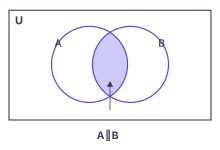
The intersection of two sets and is the set containing every element that is present in both and at the same time. Symbolically, .
Intuition: It's the "common ground" — only the items shared by both groups. …
Drawn by us to help you understand the concept clearly, and verified to make sure it's accurate. For exams, practice from your NCERT textbook's own diagram.
Fig. 1.5 is a Venn diagram inside a rectangle labelled (the universal set). Two overlapping circles are drawn: the left circle is labelled , the right circle is labelled . The region where the two circles overlap — the lens-shaped area common to both and — is shaded. An arrow points to this shaded region, and the label next to it is .
The diagram teaches the idea of intersection: the set of all elements that belong to both and at the same time. The shaded overlap is the visual representation of that common ground. If an element lies in the shaded region, it must be inside circle and inside circle . Any element that lies only in (the left crescent) or only in (the right crescent) is not part of the intersection.
A common mistake is to think the intersection includes the entire area of both circles. It does not — only the overlapping lens is . The rest of each circle belongs to alone or alone.
The central formula the textbook develops with this figure is:
Here, the symbol is read as "intersection". The set-builder notation means "the set of all such that …". The condition and forces to be in both sets simultaneously. The figure makes this abstract condition concrete: the shaded region is exactly where the membership conditions and are both true. …
Drawn by us to help you understand the concept clearly, and verified to make sure it's accurate. For exams, practice from your NCERT textbook's own diagram.
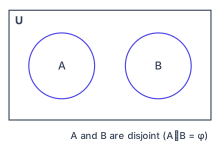
Fig 1.6 is a Venn diagram that shows two disjoint sets. A rectangle labelled (the universal set) encloses two separate circles, one labelled and the other labelled . The circles do not touch or overlap — there is a clear gap between them. No region belongs to both circles simultaneously.
The physical idea is simple: two sets that share no common element. The diagram makes the definition of disjoint sets visually immediate. Where Fig 1.5 (the previous figure in the textbook) shades the overlapping region of two intersecting circles, Fig 1.6 shows the opposite case — the intersection region is empty.
The key formula that this figure illustrates is the definition of disjoint sets:
Here and are any two sets, is the intersection operator (read as "cap" or "intersection"), and (the empty set symbol) denotes the set with no elements. The equation says: the set of elements common to both and is empty — there are none.
The textbook uses this figure immediately after giving the numerical example and . Those two sets have no element in common, so their Venn diagram looks exactly like Fig 1.6.
A common mistake is to think that disjoint sets must be drawn far apart. The only requirement is that the circles do not overlap — they can be placed anywhere inside as long as their boundaries never cross. The gap between them can be large or small; what matters is that no point lies inside both circles. …
Drawn by us to help you understand the concept clearly, and verified to make sure it's accurate. For exams, practice from your NCERT textbook's own diagram.
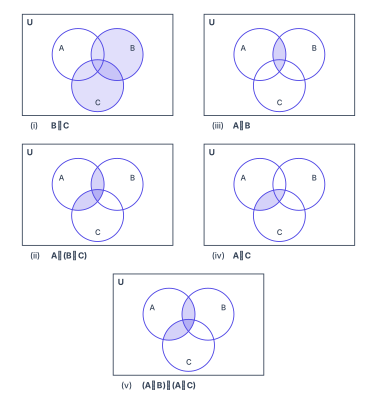
The five Venn diagrams in Fig 1.7 are a visual proof of the distributive law for sets:
Each panel shows the same universal set (a rectangle) containing three overlapping circles labelled (upper-left), (upper-right), and (bottom). The shaded region in each panel represents the result of a set operation. By comparing the shaded areas in panels (ii) and (v), you see they are identical — which is exactly why the two sides of the equation are equal.
Panel (i): — the entire region belonging to either or (or both) is shaded. This is the union of the two circles on the right and bottom.
Panel (ii): — only the parts of that also lie inside or are shaded. In other words, take the shaded area from panel (i) and keep only the portion that falls inside circle .
Panel (iii): — the overlap of circles and is shaded. This is the region common to both.
Panel (iv): — the overlap of circles and is shaded.
Panel (v): — the union of the two shaded regions from panels (iii) and (iv) is shaded. This is the combined area where overlaps with either or .
The shaded region in panel (ii) and the shaded region in panel (v) are exactly the same. This visual equality demonstrates that and always produce the same set of elements, no matter what , , and are.
The figure is placed in the textbook right after the statement of the distributive law (property v of intersection). It is not a proof in the formal sense, but a geometric intuition: if you shade the region described by the left-hand side, then shade the region described by the right-hand side, you get the same picture. That is why the law holds.
The distributive law works both ways: distributes over (as shown here), and also distributes over : . That second law can be verified with a similar set of Venn diagrams. …