Mathematics · Ch 1 — Sets
Intervals as Subsets of R
Intervals as Subsets of R
Intervals as Subsets of
When we work with real numbers, we often need to talk about all numbers that lie between two given numbers. The concept of an interval gives us a clean, compact way to do this. Instead of writing every time, we can simply write . This notation is not just a shortcut — it is a precise language for describing connected chunks of the real number line.
Let and be real numbers with . The set of all real numbers between and can be described in several ways, depending on whether we include the endpoints and themselves.
Open Interval
The set is called an open interval and is denoted by . Every point strictly between and belongs to this interval, but the endpoints and themselves do not belong to it.
The word "open" refers to the fact that the endpoints are excluded. On the number line, we draw an open interval with a hollow circle (or "open dot") at and to show they are not included.
Closed Interval
The set is called a closed interval and is denoted by . Here, both endpoints and are included.
The square bracket [ or ] always means "include this endpoint." The round parenthesis ( or ) means "exclude this endpoint."
Half-Open (or Semi-Closed) Intervals
We can also have intervals that are closed at one end and open at the other.
- : — includes , excludes .
- : — excludes , includes .
These are sometimes called half-open intervals or semi-closed intervals.
Infinite Intervals
The real number line extends without bound in both directions. We use the symbols (negative infinity) and (infinity) to describe intervals that go on forever. These are not real numbers — they are just symbols indicating that the interval has no finite bound in that direction.
- = — the set of all non-negative real numbers.
- = — the set of all negative real numbers.
- = — the entire set of real numbers.
Infinity is never included as an endpoint. We always use a parenthesis ( or ) next to or , never a square bracket. So is incorrect notation.
Length of an Interval
For any of the intervals , , , or , the number is called the length of the interval. This is simply the distance between the two endpoints.
Intervals as Subsets
Because intervals are sets of real numbers, we can compare them using subset notation. For example, if and , then every element of is also an element of , so .
When checking if one interval is a subset of another, it often helps to draw them on a number line. If the entire first interval lies within the second, the subset relation holds.
Converting Between Set-Builder and Interval Notation
These two notations are interchangeable. You must be comfortable moving from one to the other.
- Set-builder to interval: becomes .
- Interval to set-builder: becomes . …
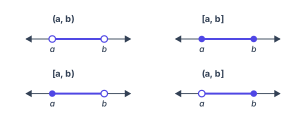
Drawn by us to help you understand the concept clearly, and verified to make sure it's accurate. For exams, practice from your NCERT textbook's own diagram.
The figure is a visual summary of the four fundamental types of intervals on the real number line. It consists of four separate number-line panels arranged in a grid. Each panel shows a horizontal axis with arrows at both ends (indicating the line extends infinitely in both directions), and two labelled points, and , with . A thick indigo segment connects and on each line, and the endpoints are marked with either a hollow circle (open dot) or a filled circle (solid dot) to show whether that endpoint is included in the interval.
The four panels correspond to the four interval types described in the textbook:
- Top-left: — Both and have hollow circles. The thick segment runs between them, but the endpoints themselves are not part of the shaded region. This represents the open interval, containing all real numbers strictly between and , but excluding and themselves.
- Top-right: — Both and have filled circles. The thick segment includes the endpoints. This is the closed interval, containing all real numbers from to , including both and .
- Bottom-left: — The circle at is filled, and the circle at is hollow. The thick segment includes but stops just before . This is a half-open (or half-closed) interval, closed at and open at .
- Bottom-right: — The circle at is hollow, and the circle at is filled. The thick segment starts just after and includes . This is the other half-open interval, open at and closed at .
The physical idea is simple: the number line is a continuous picture of all real numbers. An interval is a connected chunk of that line. The figure makes the distinction between "including the boundary" and "excluding the boundary" visually immediate — a filled dot means "this point belongs to the set", a hollow dot means "this point does not belong". The thick indigo segment itself represents the infinitely many points between and , which is why the textbook notes that an interval contains infinitely many points.
The key formulas that the textbook develops directly from this figure are the set-builder definitions of each interval type. These are the precise mathematical statements of what the figure shows:
In each formula, and are real numbers with . The curly braces mean "the set of all". The colon is read as "such that". The variable inside ( or ) is a dummy variable representing any element of the set. The inequality after the colon is the condition that element must satisfy. So, for example, reads as "the set of all real numbers such that is greater than or equal to and strictly less than ". The figure's filled dot at corresponds to the sign (including ), and the hollow dot at corresponds to the sign (excluding ). …