Physics · Ch 6 — System of Particles and Rotational Motion
Linear Momentum of a System of Particles
Linear Momentum of a System of Particles
Linear Momentum of a System of Particles
The idea of linear momentum extends naturally from a single particle to a collection of particles. For a system, the total linear momentum is simply the vector sum of the momenta of all the individual particles that make up the system.
Consider a system of particles. Let the -th particle have mass and velocity . Its linear momentum is . The total linear momentum of the system is:
This definition is straightforward, but its real power comes from its connection to the centre of mass.
Relating Total Momentum to the Centre of Mass
Recall that the velocity of the centre of mass, , is defined by:
where is the total mass of the system. The numerator in this expression is exactly the total linear momentum of the system. Therefore:
This is a powerful result. It tells us that the total linear momentum of a system of particles is exactly the same as if the entire mass of the system were concentrated at the centre of mass and moving with the centre of mass velocity. This is not an approximation — it is an exact equivalence.
This relation holds for any system of particles, whether they are rigidly connected or moving freely relative to each other. The total momentum depends only on the total mass and the velocity of the centre of mass.
Newton's Second Law for a System of Particles
We can now extend Newton's second law to a system of particles. Differentiate the expression for total momentum with respect to time:
Here is the acceleration of the centre of mass. But from the previous section, we know that , where is the net external force acting on the system. Therefore:
The time rate of change of the total linear momentum of a system of particles is equal to the net external force acting on the system. Internal forces between particles cancel out in pairs (by Newton's third law) and do not affect the total momentum.
Conservation of Total Linear Momentum
The most important consequence follows immediately. If the net external force on a system is zero, then:
If , then .
This is the law of conservation of linear momentum for a system of particles. When no external force acts, the total linear momentum of the system remains constant in both magnitude and direction, regardless of any internal interactions.
Conservation of momentum is a vector law. If the net external force is zero, each component of the total momentum is separately conserved. If the external force is non-zero but has a zero component in some direction, then the momentum component in that direction is conserved.
Practical Implications
The conservation of total momentum is one of the most fundamental and widely applicable principles in physics. It holds true even in situations where Newton's laws themselves become difficult to apply directly — for example, during collisions or explosions where internal forces are large and complicated. …
Drawn by us to help you understand the concept clearly, and verified to make sure it's accurate. For exams, practice from your NCERT textbook's own diagram.
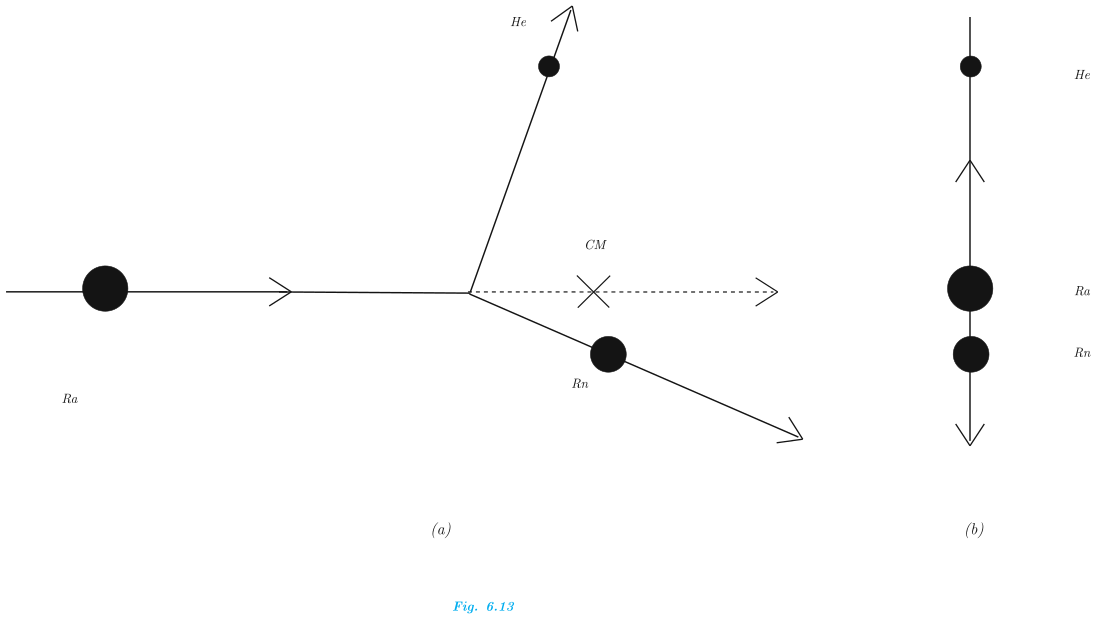
The figure shows two snapshots of a radioactive decay — radium splitting into radon and an alpha particle — to illustrate how the centre of mass behaves when no external force acts on the system.
In panel (a), the radium nucleus is moving to the right before it decays. After the split, the alpha particle (helium nucleus) flies upward, the radon nucleus flies downward, and the centre of mass (marked with a cross, ×) continues moving to the right in a straight line at constant speed. The key point: the internal forces of the decay cannot change the motion of the centre of mass. Even though the two fragments go in opposite vertical directions, the CM keeps its original horizontal velocity unchanged.
Panel (b) shows the same decay but from a different reference frame — one in which the centre of mass is initially at rest. Here the radium is stationary before splitting. After the decay, the alpha particle and radon nucleus fly directly away from each other along the same straight line, in opposite directions. The CM stays exactly where it was, at rest. This is the back-to-back motion you would see if you were riding along with the centre of mass.
The physical idea is the law of conservation of momentum applied to the centre of mass. For a system of particles, the total momentum equals the total mass times the velocity of the centre of mass:
where is the total mass of the system and is the velocity of the centre of mass. If no external force acts on the system, is constant, so is constant. In the decay, the internal forces between the fragments are equal and opposite — they cancel out when summed over the whole system. Therefore the centre of mass continues with whatever velocity it had before the split.
Internal forces cannot change the velocity of the centre of mass. Only an external force can accelerate the CM.
The textbook uses this figure to develop the formula for the position of the centre of mass for a system of particles:
Here is the position vector of the centre of mass, is the mass of the -th particle, and is its position vector. For the radium decay, if you take the origin at the initial position of the radium nucleus, the CM remains at that point in panel (b) because the two fragments have equal and opposite momenta — their masses and velocities satisfy . …
Drawn by us to help you understand the concept clearly, and verified to make sure it's accurate. For exams, practice from your NCERT textbook's own diagram.
Two panels, two different ways of seeing the same thing.
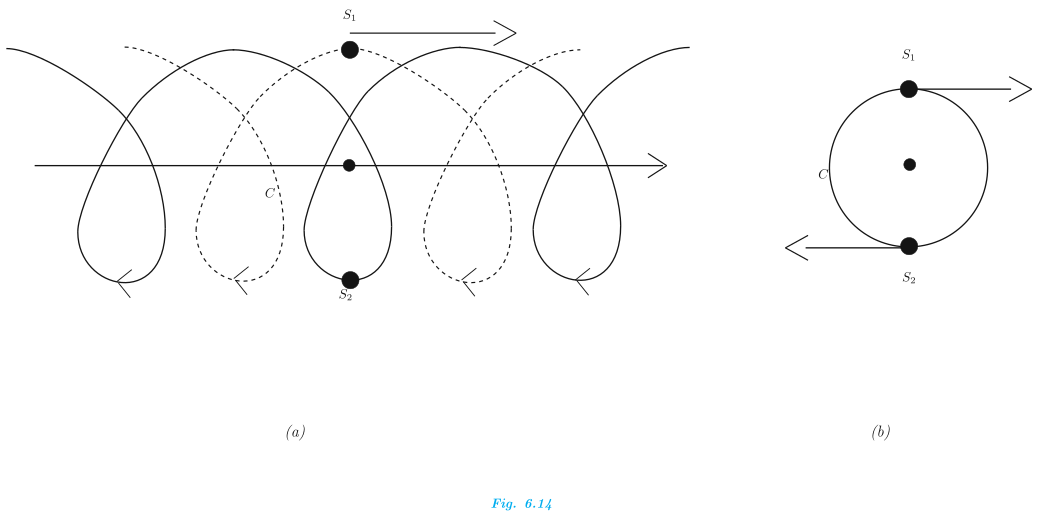
Panel (a) shows the actual paths of two stars in a binary system as seen from a laboratory on Earth. The centre of mass (labelled C) moves in a straight line to the right at constant speed — uniform motion. Star S₁, shown with a dotted trajectory, and star S₂, shown with a solid trajectory, trace out interleaved looping paths around this moving centre. Neither star moves in a simple circle; each path is a wavy, looping curve because the whole system is drifting while the stars orbit each other.
Panel (b) removes that drift. The centre of mass C is now fixed at rest. In this frame, the two stars move on a single circle centred at C. S₁ is at the top of the circle, S₂ at the bottom, and they have velocities of equal magnitude but opposite direction — one clockwise, the other anticlockwise. This is the clean, symmetric picture that reveals the underlying physics.
The key idea: the motion of a system of particles separates into two independent parts — the motion of the centre of mass (which behaves like a single particle of total mass , acted on by the net external force) and the motion of the particles relative to the centre of mass. Panel (a) shows the full motion; panel (b) isolates the relative motion.
The central formula the textbook develops with this figure is the position of the centre of mass for a two-particle system:
Here is the position vector of the centre of mass, and are the masses of the two stars, and and are their position vectors from the same origin. For the binary in the figure, the centre of mass lies on the line joining the two stars, closer to the more massive star. In panel (b), where the CM is at rest, the distances of the stars from C are inversely proportional to their masses: , where and are the distances of S₁ and S₂ from C.
A common mistake is to think the centre of mass is always at the geometric centre of the system. It is not — it is the mass-weighted average position. In a binary with unequal masses, the CM is closer to the heavier star, and the heavier star traces a smaller orbit around the CM than the lighter one does.
The velocity of the centre of mass is given by:
…