Economics · Ch 2 — National Income Accounting
GDP and Welfare
GDP and Welfare
2.5 GDP and Welfare
Can a country’s GDP be taken as an index of the welfare of its people? At first glance, the answer seems yes. A person with higher income can buy more goods and services, so material well-being improves. GDP is the total value of all final goods and services produced within a country’s geographical boundary in a year. This total gets distributed among people as incomes (except for retained earnings). So it is tempting to treat a higher GDP — especially real GDP, which adjusts for price changes — as a sign of greater well-being.
But there are at least three reasons why this may not be correct.
1. Distribution of GDP — How Uniform Is It?
A rising GDP does not guarantee rising welfare for everyone. The increase may be concentrated in the hands of very few individuals or firms, while the rest may actually see their incomes fall. In such a case, the welfare of the entire country cannot be said to have increased.
The textbook gives a concrete numerical example. Consider an imaginary country with 100 individuals, each earning Rs 10 in the year 2000. The GDP of the country in 2000 is:
In 2001, suppose the same country has 90 individuals earning Rs 9 each, and the remaining 10 individuals earning Rs 20 each. Assume no change in prices between the two years. The GDP in 2001 is:
Compared to 2000, GDP in 2001 is higher by Rs 10. But look at what happened to people: 90 per cent of the population saw their real income drop by 10 per cent (from Rs 10 to Rs 9), while only 10 per cent benefited from a 100 per cent rise (from Rs 10 to Rs 20). Ninety per cent of the people are worse off, even though GDP has gone up. If we relate welfare improvement to the percentage of people who are better off, then GDP is clearly not a good index.
A rising GDP can mask worsening inequality. The aggregate number tells you nothing about who got what share.
2. Non-Monetary Exchanges
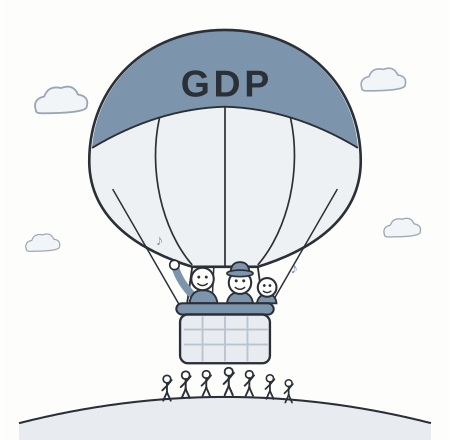
Drawn by us to help you understand the concept clearly, and verified to make sure it's accurate. For exams, practice from your NCERT textbook's own diagram.
A rising GDP can lift only a few while most stay on the ground: the aggregate figure says nothing about who gains. This is why a higher GDP does not automatically mea …
Many economic activities are not evaluated in monetary terms. For example, the domestic services that women perform at home are not paid for. Exchanges that take place in the informal sector without the use of money — called barter exchanges — involve goods or services being directly exchanged against each other. Since money is not used, these exchanges are not registered as part of economic activity.
In developing countries, many remote regions are underdeveloped, and such barter exchanges do take place. But they are generally not counted in GDP. This leads to an underestimation of GDP. Hence, GDP calculated in the standard manner may not give a clear indication of the productive activity and well-being of a country.
The omission of non-monetary work — especially unpaid domestic labour — is a significant limitation. It means that a large part of what sustains households and communities is invisible in national accounts.
3. Externalities
Externalities refer to the benefits (or harms) that a firm or an individual causes to another, for which they are not paid (or penalised). Externalities have no market in which they can be bought and sold.
Consider an oil refinery that refines crude petroleum and sells it in the market. Its output is the amount of oil it refines. The value added of the refinery is calculated by deducting the value of intermediate goods (crude oil) from the value of its output. This value added is counted as part of GDP.
But in carrying out production, the refinery may also be polluting a nearby river. This harms people who use the river water — their well-being falls. Pollution may kill fish or other organisms on which fish survive, causing fishermen to lose their livelihood. Such harmful effects that the refinery inflicts on others, for which it bears no cost, are called negative externalities. GDP does not take these into account. If we take GDP as a measure of welfare, we overestimate actual welfare.
There can also be positive externalities. For example, a firm that trains its workers may benefit other firms when those workers change jobs, without being compensated for that benefit. In such cases, GDP underestimates actual welfare.
GDP measures only market transactions. It does not subtract the cost of pollution or add the value of unpaid benefits. Therefore, GDP and welfare can move in opposite directions.
The Circular Flow and the Three Methods of Measuring GDP
At a fundamental level, the macroeconomy works in a circular way. Firms employ inputs supplied by households and produce goods and services to be sold to households. Households receive remuneration from firms for the services they render, and they buy goods and services produced by firms.
The aggregate value of goods and services produced in the economy can be calculated by any of three methods:
- Income method — measuring the aggregate value of factor payments (wages, rent, interest, profit). …