Computer Science · Ch 11 — Data Communication
Simplex Communication
Simplex Communication
Simplex communication is the simplest form of data flow between two devices. It is strictly one-way or unidirectional — one device is always the sender, and the other is always the receiver. The roles never swap during the communication.
Because the data travels in only one direction, the sender can use the entire capacity of the transmission link. There is no need to share bandwidth for a return path, so the full channel is dedicated to sending data from the source to the destination.
A helpful analogy is a one-way street: vehicles (data) can move in only one direction. You cannot drive back the other way on the same road.
Real-world examples given in the textbook:
- Data entered through a keyboard into a computer — the keyboard sends signals, the computer only receives them.
- Audio sent to a speaker — the amplifier sends the signal, the speaker only receives and reproduces sound.
- With the rise of the Internet of Things (IoT) , controlling home appliances from a remote location (e.g., from an office or while driving a car) is cited as a modern example. You send a command to turn on a fan, light, fridge, or oven, and the appliance simply receives and executes that command — it does not send any data back to you. …
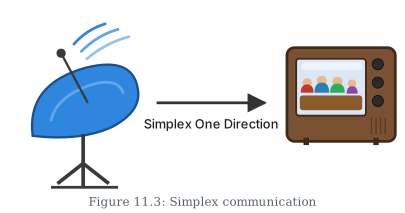
Drawn by us to help you understand the concept clearly, and verified to make sure it's accurate. For exams, practice from your NCERT textbook's own diagram.
Simplex is the simplest possible communication mode: data flows in only ONE direction, and never back. Here, a satellite dish broadcasts a TV signal to a television — the dish sends, the TV only ever receives. The television can never send anything back to the dish. …