Physical Education · Ch 8 — Biomechanics and Sports
Newton's Second Law of Motion (Law of Momentum)
Newton's Second Law of Motion (Law of Momentum)
Newton's Second Law of Motion (the Law of Momentum) states that the rate of change of momentum of a body is proportional to the resultant force applied, and that this change takes place in the direction of the force. Momentum itself is the product of an object's mass and its velocity — a heavier athlete moving at the same speed as a lighter one, or the same athlete moving faster, carries more momentum. When a net force acts on an object, the acceleration it produces is:
- directly proportional to the size of the net force,
- in the same direction as that force, and
- inversely proportional to the mass of the object.
The greater the mass, the more force is needed to move it by a given amount. If you push a car and a truck with the same force, the car accelerates more because it has less mass. This relationship is captured by the formula F = m × a (force = mass × acceleration) — a direct, simplified form of the rate-of-change-of-momentum statement for a body whose mass stays constant during the motion.
Why this matters for performance
Second-law thinking underlies almost every strength-and-power training programme. Since acceleration equals force divided by mass, an athlete can increase acceleration either by producing more force through strength training, or by reducing the mass that has to be moved — relevant in weight-category sports, or in choosing lighter equipment such as running shoes or a lighter vaulting pole. It also explains why identical technique produces different outcomes for different athletes: a stronger athlete applying the same technique as a weaker one generates more force, and therefore more acceleration, on the same mass of ball, shot or body.
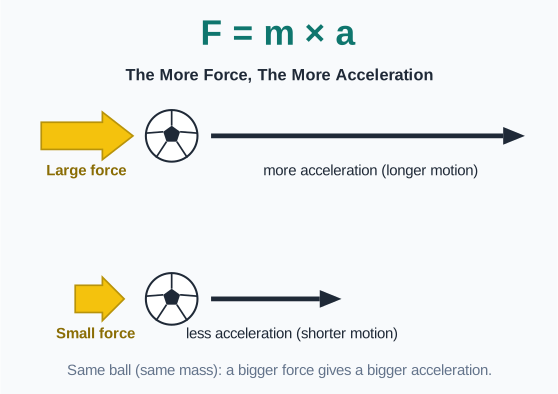
Drawn by us to help you understand the concept clearly, and verified to make sure it's accurate. For exams, practice from your NCERT textbook's own diagram.
Two stacked scenarios comparing force and acceleration. A large force arrow pushing a ball produces a long motion arrow (more acceleration); a small force arrow pushing an identical ball produces a short …