Physical Education · Ch 2 — Children and Women in Sports
Female Athlete Triad
Female Athlete Triad
Female Athlete Triad
Taking part in sport and physical activity brings many physical and social rewards — leadership, teamwork, a longer and better quality of life, and a lower risk of many diseases. Regular activity that begins in childhood improves bone health and helps prevent osteoporosis, a condition that mainly affects females.
Sport, however, is not free of health risks. Events such as judo, boxing, wrestling and taekwondo place heavy pressure on athletes to control their shape and weight, while endurance events such as distance running, cycling and cross country demand very high energy and a large dietary intake. When these pressures are not managed well, an athlete's health can suffer, leading to the Female Athlete Triad.
The term triad was first described by the American College of Sports Medicine in 1992, with three components:
- (a) disordered eating,
- (b) amenorrhoea, and
- (c) osteoporosis.
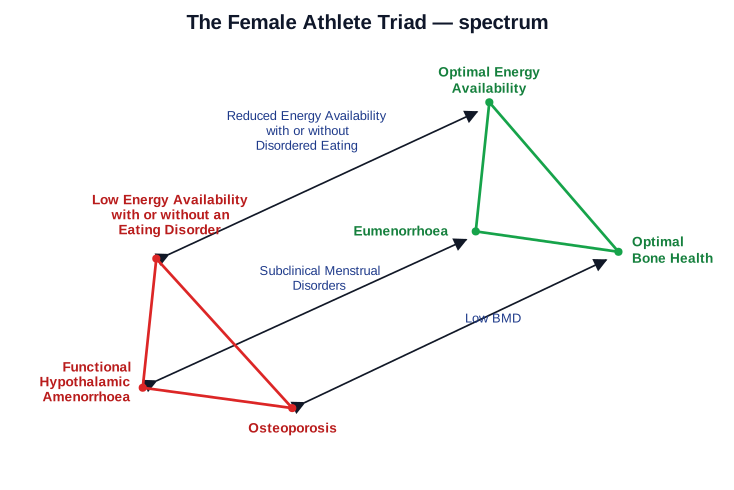
Drawn by us to help you understand the concept clearly, and verified to make sure it's accurate. For exams, practice from your NCERT textbook's own diagram.
Two triangles joined by three parallel double-headed spectrum lines. The top-right GREEN triangle (healthy extreme) is labelled Optimal Energy Availability, Eumenorrhea and Optimal Bone Health. The bottom-left RED triangle (unhealthy extreme) is labelled Low Energy Availability with or without an Eating Disorder, Functional Hypothalamic Amenorrhea and Osteoporosis. The three connecting spectrum lines are labelled Reduced Energy Availability w …
These terms have since been revised. The newer terms used to describe the same three problems are:
- (a) low energy availability, with or without an eating disorder,
- (b) dysfunction of menstruation, and
- (c) low bone density.
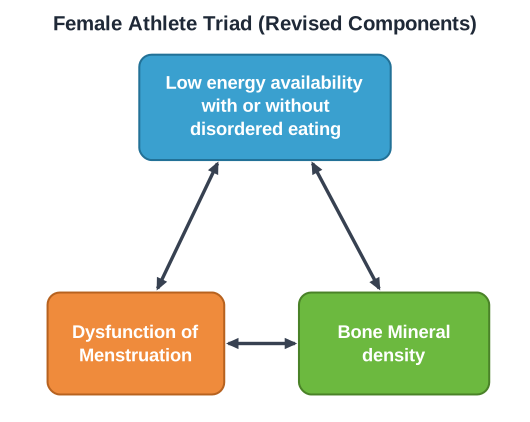
Drawn by us to help you understand the concept clearly, and verified to make sure it's accurate. For exams, practice from your NCERT textbook's own diagram.
Three rounded coloured boxes joined by double-headed arrows to show that all three components are interlinked: a blue box 'Low energy availability with or without disordered eating' at the top, an orange box 'Dysfunction of Menstruation' at the bottom-left, and a green …
…