Chemistry · Ch 8 — Aldehydes, Ketones and Carboxylic Acids
Preparation of Aldehydes
Preparation of Aldehydes
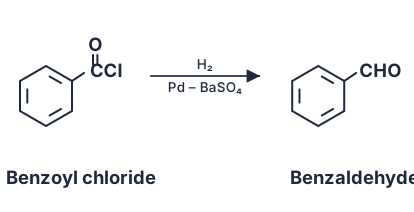
1. From Acyl Chloride (Acid Chloride) — the Rosenmund Reduction
An acyl (acid) chloride can be hydrogenated directly to the corresponding aldehyde using hydrogen gas over a palladium catalyst that has been partially deactivated by depositing it on barium sulphate. This partial poisoning of the catalyst is deliberate: an ordinary, fully active palladium catalyst would keep reducing the product all the way to the alcohol, whereas the poisoned catalyst is just active enough to stop cleanly at the aldehyde. This reaction is named the Rosenmund reduction.
Drawn by us to help you understand the concept clearly, and verified to make sure it's accurate. For exams, practice from your NCERT textbook's own diagram.
Redrawn from the NCERT page with the structures, printed labels (C, Cl, CHO) and reagent placement exactly as the textbook prints them. Every element of this display was checked against the printed page during the sweep's blind-judge verification pass, so what …
Benzoyl chloride is reduced by this method to benzaldehyde.
2. From Nitriles and Esters
A nitrile can be reduced with stannous chloride in the presence of hydrochloric acid; this first gives an imine, which is then hydrolysed to the aldehyde. This sequence is called the Stephen reaction.
Alternatively, a nitrile can be reduced selectively with diisobutylaluminium hydride (DIBAL-H) to the imine stage, which is then hydrolysed to the aldehyde. "Selectively" matters here too: the reduction is controlled so it stops at the imine rather than running on to the amine.
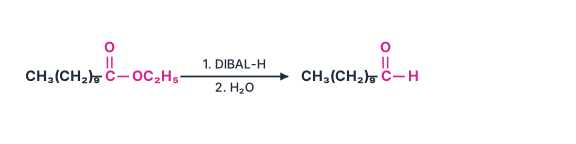
Esters can be reduced the same way — DIBAL-H reduces an ester to the aldehyde stage, stopping short of the alcohol that a stronger reducing agent would give.
Drawn by us to help you understand the concept clearly, and verified to make sure it's accurate. For exams, practice from your NCERT textbook's own diagram.
Redrawn from the NCERT page with the structures, printed labels (CH₃(CH₂)₉, C, OC₂H₅, H) and reagent placement exactly as the textbook prints them. Every element of this display was checked against the printed page during the sweep's blind-judge verification pass, so wh …
3. From Hydrocarbons — Aromatic Aldehydes
Aromatic aldehydes, such as benzaldehyde and its ring-substituted derivatives, are built up from aromatic hydrocarbons by three distinct routes.
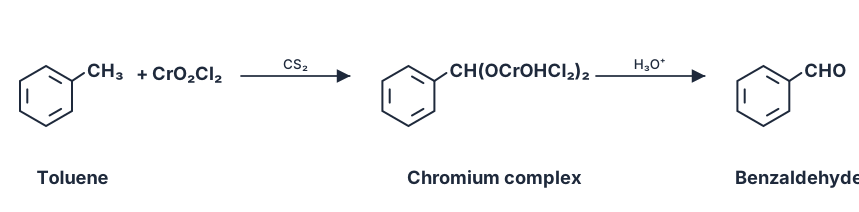
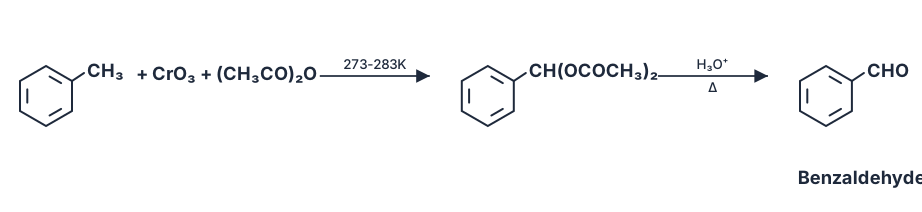
(i) Oxidation of methylbenzene. A strong oxidising agent applied to toluene would normally carry the oxidation all the way to benzoic acid, so this route instead converts the methyl group into an intermediate that resists further oxidation, then hydrolyses that intermediate back to the aldehyde. Two reagents are used for this:
- Chromyl chloride () oxidises the methyl group of toluene, in carbon disulphide as solvent, to a chromium complex; hydrolysing this complex with aqueous acid gives benzaldehyde. This sequence is the Etard reaction.
Drawn by us to help you understand the concept clearly, and verified to make sure it's accurate. For exams, practice from your NCERT textbook's own diagram.
Redrawn from the NCERT page with the structures, printed labels (CH₃, CH(OCrOHCl₂)₂, CHO) and reagent placement exactly as the textbook prints them. Every element of this display was checked against the printed page during the sweep's blind-judge verification pass, so wh …
- Chromic oxide () in acetic anhydride converts toluene (or a substituted toluene), at 273–283 K, into benzylidene diacetate; hydrolysing this diacetate with aqueous acid on warming gives benzaldehyde.
Drawn by us to help you understand the concept clearly, and verified to make sure it's accurate. For exams, practice from your NCERT textbook's own diagram.
Redrawn from the NCERT page with the structures, printed labels (CH₃, CH(OCOCH₃)₂, CHO) and reagent placement exactly as the textbook prints them. Every element of this display was checked against the printed page during the sweep's blind-judge verification pass, so wh …
…
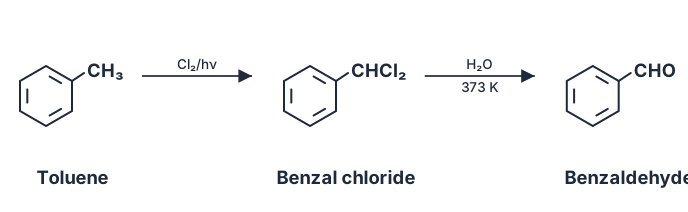
Drawn by us to help you understand the concept clearly, and verified to make sure it's accurate. For exams, practice from your NCERT textbook's own diagram.
Redrawn from the NCERT page with the structures, printed labels (CH₃, CHCl₂, CHO) and reagent placement exactly as the textbook prints them. Every element of this display was checked against the printed page during the sweep's blind-judge verification pass, so wha …
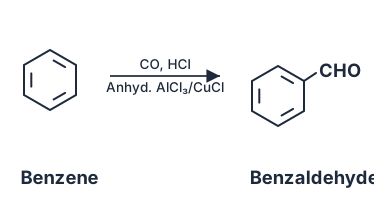
Drawn by us to help you understand the concept clearly, and verified to make sure it's accurate. For exams, practice from your NCERT textbook's own diagram.
Redrawn from the NCERT page with the structures, printed labels (CHO) and reagent placement exactly as the textbook prints them. Every element of this display was checked against the printed page during the sweep's blind-judge verification pass, so what …