Q.Find the maximum and minimum values of , if any, of the function given by .
![Graph of a continuous function on a closed interval [a, d] showing local and absolute extrema](/figures/application-of-derivatives/graph-continuous-function-closed-interval-local-fig-6-19.svg)
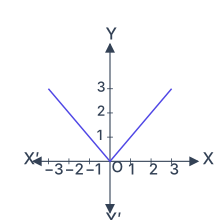
The function is V-shaped with a sharp corner at . It has an absolute minimum value of at , but no maximum value because it grows without bound as .
Concept and Intuition
The absolute value function is one of the simplest piecewise-defined functions. Its graph is two rays meeting at the origin: for , (a line with slope ), and for , (a line with slope ). The key feature is the sharp corner at — the function is not differentiable there, but it is continuous everywhere.
When we talk about "maximum and minimum values" of a function on its entire domain (here, all real numbers), we are looking for global (absolute) extrema. A function can have:
- A global minimum at a point where is the smallest value over the whole domain.
- A global maximum at a point where is the largest value over the whole domain.
For , the value is always non-negative. The smallest possible value is , achieved at . But can it ever be the largest? No — because as you move farther from zero in either direction, keeps increasing without any upper bound.
A common mistake is to think that because has a "corner" at , it cannot have a minimum there. In fact, a function can have a global extremum at a point where it is not differentiable — the derivative test is sufficient but not necessary. The definition of a minimum is purely about values: for all , which holds here.
For functions defined on (the whole real line), a global maximum exists only if the function is bounded above. Since is unbounded above, no maximum exists. Similarly, a global minimum exists only if the function is bounded below and attains that lower bound — here it does, at .
Step-by-Step Solution
-
Understand the domain and range.
The domain is , all real numbers. The range of is — every non-negative real number appears as an output.
-
Check for a global minimum.
For any , we have . The equality holds exactly when .
Therefore, is less than or equal to every other function value.
So is the global minimum value, attained at .
-
Check for a global maximum.
Suppose there were a global maximum value . Then for all , . But pick (if ) or (if , which is impossible since ). Then , a contradiction.
More simply: as , , so no finite upper bound exists.
Hence, no global maximum exists.
-
Summarise the findings.
- Minimum value: (at ).
- Maximum value: none.
For on :
The function has a minimum value of at , and no maximum value.
Unlock everything free for 14 days
- Full step-by-step solutions
- Concept-first explanations
- Methods, shortcuts & mistakes
- PYQ mapping + timed mock tests
Full access for 14 days. No credit card required.