Mathematics · Ch 10 — Vector Algebra
Scalar (or Dot) Product of Two Vectors
Scalar (or Dot) Product of Two Vectors
10.6.1 Scalar (or Dot) Product of Two Vectors
The Fundamental Idea
The scalar product (also called the dot product) produces a real number — a scalar — from two vectors. It measures how much of one vector points in the direction of the other.
For two nonzero vectors and , with an angle between them (where ), the scalar product is defined as:
If either or , the angle is not defined, and we define . The result is always a real number — never a vector.
Key Observations
Observation 1: The Result is a Real Number
is always a real number (a scalar), whether the vectors are nonzero or zero vectors.
Observation 2: Perpendicular Vectors
Let and be two nonzero vectors. Then:
Why? When , , so . Conversely, if with both vectors nonzero, then , which forces .
The dot product being zero is the algebraic test for perpendicularity between two nonzero vectors.
Observation 3: Parallel Vectors (Same Direction)
If , then , so:
In particular, for any vector :
This gives a direct way to find the magnitude of a vector: .
Observation 4: Opposite Direction Vectors
If , then , so:
In particular:
Observation 5: Dot Products of Unit Vectors
For the mutually perpendicular unit vectors , , along the , , axes (each of magnitude 1):
- Same direction ():
- Perpendicular ():
These results are the foundation for computing dot products in component form.
Observation 6: Finding the Angle Between Two Vectors
The angle between two nonzero vectors is:
Observation 7: Commutativity
The scalar product is commutative:
This holds because multiplication of real numbers is commutative, and the angle between and is the same as between and .
Two Important Properties of the Scalar Product
Property 1: Distributivity of Scalar Product Over Addition
For any three vectors , , and :
›Proof
The projection of onto equals the sum of the projections of and onto . Since the dot product equals times the projection of the second vector onto , and vector addition is linear, the distributive property follows. It can also be verified algebraically using components (developed below).
Property 2: Scalar Multiplication
For any vectors , and any scalar :
›Proof
. Since , and points the same way as (if ) or opposite (if ), the angle between and is or .
For :
For :
The same reasoning gives .
Dot Product in Component Form
Let:
Using Property 1 (distributivity) and Property 2 (scalar multiplication), the product expands into nine terms: …
Definition
The scalar (or dot) product of two nonzero vectors and , denoted by , is defined as:
where is the angle between and (with ).
If either or , then is not defined. In this case, we define .
Key Observations
- The result is a real number (a scalar), not a vector.
- For nonzero vectors: if and only if and are perpendicular ().
- If , then . In particular, .
- If , then .
- For the standard unit vectors :
- The angle between two nonzero vectors is given by .
- The scalar product is commutative: .
Intuition …
Let and be any two vectors, and let be any scalar. Then the scalar (dot) product satisfies:
This means a scalar can be pulled out of either vector before taking the dot product without changing the result. It is used when simplifying expressions involving scalar multiplication inside a dot product, especially when vectors are …
Let and be any two vectors, and let be any scalar. Then the scalar (dot) product satisfies:
This means a scalar can be pulled out of either vector before taking the dot product without changing the result. It is used when simplifying expressions involving scalar multiplication inside a dot product, especially when vectors are …
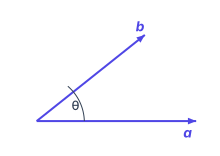
Drawn by us to help you understand the concept clearly, and verified to make sure it's accurate. For exams, practice from your NCERT textbook's own diagram.
Fig 10.19 is a simple but essential diagram: it shows two vectors, a and b, drawn from the same starting point. Vector a is a horizontal arrow pointing to the right. Vector b is an arrow pointing up and to the right. Between them, a thin slate-coloured arc marks the smaller angle, labelled . That is all the figure contains — no axes, no grid, no extra labels.
The entire purpose of this drawing is to give a visual definition of the angle between two vectors. In the scalar (dot) product, is not just any angle; it is the smaller of the two angles formed when the vectors are placed tail-to-tail. The figure makes this concrete: you see the two arrows, you see the arc, and you understand that is the measure of the turn needed to align the direction of a with the direction of b (or vice versa).
From this picture, the textbook defines the scalar product:
Here, and are the magnitudes (lengths) of the vectors, and is the angle between them, exactly as shown in Fig 10.19. The formula tells you that the dot product is a real number, not a vector. If , the vectors point in the same direction and . If , the vectors are perpendicular and . If , they point opposite and the dot product is .
A common mistake is to think can be any angle, like . The figure shows the smaller angle between the two directions, so is always between and (or and radians). For , the smaller angle is actually , and is negative — that is the correct value to use.
The diagram also grounds the idea that the dot product is commutative: . Swapping the vectors does not change the angle between them, so the formula gives the same result. This is obvious from the picture — the arc between the two arrows is the same regardless of which vector you name first. …