Mathematics · Ch 10 — Vector Algebra
Vector Joining Two Points
Vector Joining Two Points
Concept: The Vector from One Point to Another
In coordinate geometry, every point in space is represented by its position vector relative to the origin. For two points and , the vector that starts at and ends at is the vector joining to , denoted .
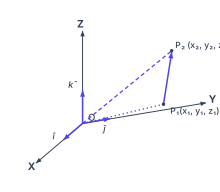
Draw the position vectors and from the origin . In triangle , the vector is the third side, going from to .
By the triangle law, .
Deriving the Formula for
Rearranging the triangle law:
Substituting the position vectors in component form:
Vector Joining Two Points
Magnitude of
The magnitude equals the distance between and :
This is the distance formula in three-dimensional space, derived directly from vector algebra.
Direction Matters: Initial and Terminal Points …
Drawn by us to help you understand the concept clearly, and verified to make sure it's accurate. For exams, practice from your NCERT textbook's own diagram.
The figure shows a three-dimensional right-handed coordinate system with origin . The axes are labelled: the -axis points vertically upward, the -axis points to the right, and the -axis points down and to the left. Along each axis, the unit vectors , , and are drawn, pointing in the positive , , and directions respectively.
Two points are plotted in space. is located in the middle-right region of the diagram, and is higher up and to the right. From the origin , a dotted indigo arrow reaches — this is the position vector . A dashed indigo arrow reaches — this is . A solid indigo arrow, starting at and ending at , represents the vector joining the two points, . The three arrows together form triangle .
The physical idea is simple: the vector from one point to another is the difference of their position vectors. If you know where each point is relative to the origin, you can find the displacement between them by subtracting the starting point's position from the ending point's position.
Writing the position vectors in component form:
Applying the triangle law from the figure gives:
The magnitude of this vector — the straight-line distance between and — follows from the distance formula in three dimensions:
…