Q.Which of the following molecules is chiral in nature ? (A) 1-chloropropane (B) 2-chloropropane (C) 1-chlorobutane (D) 2-chlorobutane
You're viewing a preview — the full solution, concept, methods & PYQ mapping are locked.
Start your 14-day free trial to unlock the full solution →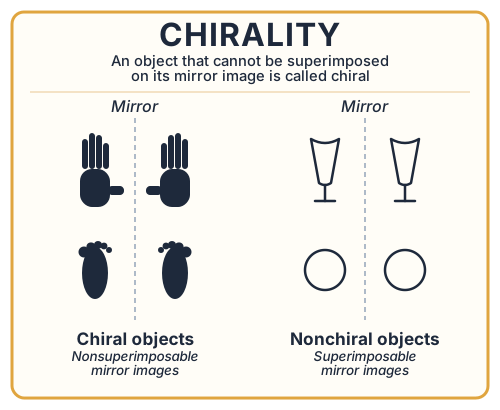
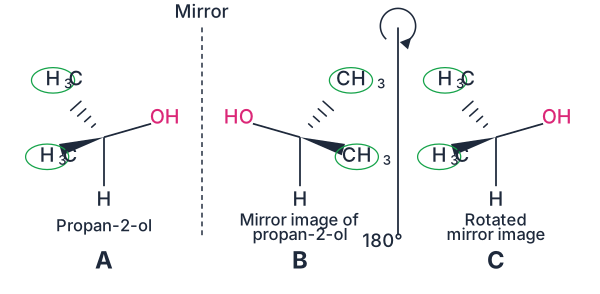
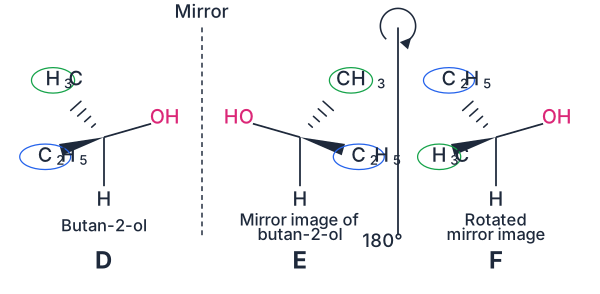
A molecule is chiral if it has a carbon atom bonded to four different groups. Among the given options, only 2-chlorobutane has such a carbon, making it the chiral molecule.
The key idea is the chirality centre (also called an asymmetric carbon or stereocentre). A carbon is chiral if it is sp³-hybridised and carries four different substituents. If any two substituents are the same, the molecule is achiral (it can be superimposed on its mirror image).
Let’s check each option systematically.
-
1-chloropropane ()
The carbon atoms are:
- C1 (bonded to Cl, H, H, CH₂CH₃) — two H atoms → not chiral.
- C2 (bonded to H, H, CH₃, CH₂Cl) — two H atoms → not chiral.
- C3 (bonded to H, H, H, CH₂CH₂Cl) — three H atoms → not chiral. No carbon has four different groups. Achiral.
-
2-chloropropane ()
The central carbon (C2) is bonded to Cl, H, CH₃, and CH₃. Two of the groups are identical methyl groups. So it has a plane of symmetry and is achiral.
-
1-chlorobutane ()
All carbons are either primary or secondary with at least two identical substituents (usually two H atoms). No carbon has four different groups. Achiral.
-
2-chlorobutane ()
Look at C2: it is bonded to
- Cl
- H
- CH₃ (methyl)
- CH₂CH₃ (ethyl) …
Unlock everything free for 14 days
- Full step-by-step solutions
- Concept-first explanations
- Methods, shortcuts & mistakes
- PYQ mapping + timed mock tests
Full access for 14 days. No credit card required.