Q.What is meant by hybridisation? Compound CH2=C=CH2 contains sp or sp2 hybridised carbon atoms? Will it be a planar molecule?
🔒You're viewing a preview — the full solution, concept, methods & PYQ mapping are locked.
🔒 Start your 14-day free trial to unlock the full solution →Concept understanding — Orbital Hybridization Theory
Orbital Hybridization Theory – From Intuition to Precision
The Problem That Started It All
Imagine you are looking at a methane molecule, CH4. Carbon has four valence electrons: two in the 2s orbital and two in the 2p orbitals. If carbon used its pure atomic orbitals to bond, you would expect two bonds from the 2s (identical, but one direction) and two from the 2p (at 90∘ to each other). That would give you three different bond types and bond angles of 90∘ and something else.
But experiment says methane is perfectly tetrahedral: all four bonds are identical in length, strength, and energy, and the bond angle is 109.5∘, not 90∘. Something is fundamentally wrong with the "pure orbital" picture.
This is the puzzle that hybridization theory solves.
The Core Intuition
Think of atomic orbitals as shapes that an electron can occupy. The s orbital is a sphere. The p orbitals are dumbbells along the x, y, and z axes. When an atom forms bonds, it wants to mix these shapes together to create new, hybrid shapes that point in directions that maximise bond strength and minimise repulsion.
It is like mixing primary colours to get new colours. You don't have to use red, blue, and yellow separately — you can blend them to get green, orange, or purple. Similarly, an atom can blend its s and p orbitals to get new hybrid orbitals that are better suited for bonding.
The key insight: hybridization is a mathematical mixing of atomic orbitals on the same atom to produce an equal number of new, equivalent hybrid orbitals. The number of hybrid orbitals formed always equals the number of atomic orbitals mixed.
The Precise Statement
Orbital Hybridization Theory: When an atom forms covalent bonds, its valence atomic orbitals (one s and up to three p orbitals) can linearly combine to form an equal number of new, equivalent hybrid orbitals. These hybrid orbitals have specific directional properties that match the observed molecular geometry.
The theory rests on three pillars:
- Conservation of orbitals: Mixing n atomic orbitals gives exactly n hybrid orbitals. No orbitals are created or destroyed.
- Energy averaging: The hybrid orbitals have energies that are intermediate between the original s and p energies.
- Directionality: Hybrid orbitals point in specific directions to minimise electron pair repulsion, which directly determines molecular shape.
The Three Common Hybridizations
| Hybridization | Orbitals Mixed | Number of Hybrids | Geometry | Bond Angle | Example |
|---|---|---|---|---|---|
| sp | one s + one p | 2 | Linear | 180∘ | BeCl2 |
| sp2 | one s + two p | 3 | Trigonal planar | 120∘ | BF3 |
| sp3 | one s + three p | 4 | Tetrahedral | 109.5∘ | CH4 |
The superscript in sp2 or sp3 tells you how many p orbitals were mixed. sp3 means one s and three p orbitals were blended. It does not mean there are three s orbitals — there is only one s orbital per shell.
How It Works: The Methane Example
Carbon in its ground state has the configuration 1s22s22px12py1. Only two unpaired electrons — it should form only two bonds. But we know carbon forms four bonds.
Step 1: Promotion. One electron from the 2s orbital is promoted (excited) to the empty 2pz orbital. This costs a small amount of energy, but it is more than compensated by the energy released when four strong bonds form instead of two.
Step 2: Hybridization. The one 2s orbital and three 2p orbitals mix to form four equivalent sp3 hybrid orbitals. Each hybrid has 25% s character and 75% p character.
Step 3: Bonding. Each sp3 hybrid overlaps with the 1s orbital of a hydrogen atom, forming four identical σ bonds. The hybrids point to the corners of a tetrahedron, giving the 109.5∘ angle. …
Concept: Orbital Hybridization Theory – mixing of atomic orbitals to form equivalent hybrid orbitals for bonding.
Reasoning:
- In CH2=C=CH2 (allene), the central carbon is bonded to two other carbons via two double bonds. It uses two sp hybrid orbitals for sigma bonds and two unhybridised p orbitals for the two perpendicular pi bonds.
- Each terminal carbon is bonded to two hydrogens and one carbon via a double bond. Each uses three sp2 hybrid orbitals (for three sigma bonds) and one unhybridised p orbital for the pi bond. …
Hybridisation is the mixing of atomic orbitals to form equivalent hybrid orbitals for bonding. In CH2=C=CH2 (allene), the central carbon is sp-hybridised and the terminal carbons are sp2-hybridised. The molecule is not planar — the two CH2 groups lie in perpendicular planes.
The Concept: Why Hybridisation Exists
Hybridisation is not a real physical event — it is a mathematical model that explains observed molecular geometry. Carbon in its ground state has the configuration 1s22s22p2, which would suggest only two unpaired electrons and thus only two bonds. But carbon almost always forms four bonds. The theory says: one 2s orbital and three 2p orbitals mix (hybridise) to form four equivalent sp3 orbitals, each with one electron, pointing to the corners of a tetrahedron. The number and type of hybrid orbitals depend on how many p orbitals are mixed in — sp uses one p, sp2 uses two, sp3 uses all three.
The key insight: the geometry of the hybrid orbitals determines the shape of the molecule. sp gives linear (180°), sp2 gives trigonal planar (120°), sp3 gives tetrahedral (109.5°). You can identify the hybridisation of an atom by counting the number of atoms bonded to it plus the number of lone pairs — this is the steric number.
Step-by-Step Analysis of CH2=C=CH2 (Allene)
-
Draw the structure. Allene has three carbon atoms in a chain: H2C=C=CH2. The central carbon is doubly bonded to each terminal carbon. Each terminal carbon is also bonded to two hydrogen atoms.
-
Find hybridisation of the central carbon. The central carbon forms two double bonds — that means it is bonded to two atoms (the two terminal carbons). It has no lone pairs. Steric number = 2. This requires sp hybridisation. The two sp hybrid orbitals lie 180° apart, giving a linear C=C=C backbone.
-
Find hybridisation of each terminal carbon. Each terminal carbon is bonded to the central carbon (one double bond) and to two hydrogen atoms (two single bonds). That is three atoms bonded, no lone pairs. Steric number = 3. This requires sp2 hybridisation. The three sp2 hybrid orbitals lie in a plane at 120° to each other.
-
What about the remaining p orbitals? In sp hybridisation, two p orbitals remain unhybridised (pure p). In sp2 hybridisation, one p orbital remains unhybridised. These unhybridised p orbitals form the π bonds. The central carbon has two pure p orbitals, perpendicular to each other. One of these p orbitals overlaps with a p orbital from the left terminal carbon to form one π bond; the other p orbital overlaps with a p orbital from the right terminal carbon to form the second π bond. …
Showing the 12 most recent of 60 on this concept.
- AP EAPCET 2026Set eng-2026-05-12-FN1 markMCQQ.BCl3 on hydrolysis gives a complex ion X. AlCl3 in acidified aqueous solution forms a complex ion Y. The hybridization of central atoms in X and Y are respectively (A) sp3,sp3 (B) sp3,sp3d (C) sp2,sp3d2 (D) sp3,sp3d2
›Reveal solutionSolution
X=[B(OH)4]− is tetrahedral (sp3 boron); Y=[Al(H2O)6]3+ is octahedral (sp3d2 aluminium). Answer: sp3,sp3d2.
Concept and Intuition
Both boron and aluminium halides are electron-deficient Lewis acids that hydrolyse in water and then continue to act as Lewis acids toward additional water/hydroxide, because the central atom still has an empty low-lying orbital (or in Al's case, can expand its coordination number using d-orbitals, unlike period-2 boron). This is why boric acid's "acidity" in water is not proton donation but hydroxide-ion acceptance, and why Al3+ readily forms a hexa-aqua octahedral complex rather than stopping at a simple hydroxide.
Step-by-Step Solution
- BCl3+3H2O→B(OH)3+3HCl gives boric acid, B(OH)3.
- Boric acid is a Lewis acid: it doesn't ionise to release H+ itself; instead it accepts a hydroxide ion from a water molecule: B(OH)3+H2O⇌[B(OH)4]−+H+.
- In X=[B(OH)4]−, boron is surrounded by 4 OH groups tetrahedrally — boron uses sp3 hybrid orbitals (boron is a period-2 element, no d-orbitals available, so it cannot exceed 4-coordination).
- In acidified aqueous solution, Al3+ (from hydrolysed AlCl3) is strongly hydrated, forming the octahedral complex Y=[Al(H2O)6]3+. …
- AP EAPCET 2026Set eng-2026-05-12-AN1 markMCQQ.The pair of molecules with same type of hybridisation is (A) H3BO3, H3PO3 (B) NO2, SO3 (C) XeO3, BF3 (D) PCl3, ClF3
›Reveal solutionSolution
This tests assigning hybridisation from electron-domain count (bond pairs + lone pairs); only the NO2/SO3 pair shares the same (sp²) hybridisation.
Concept and Intuition
Hybridisation of the central atom is fixed by the number of σ-bonds plus lone pairs around it (VSEPR electron-domain count): 2→sp, 3→sp², 4→sp³, 5→sp³d, 6→sp³d². Matching hybridisation across two different molecules means checking each central atom's true electron-domain count, not just guessing from formula similarity.
Step-by-Step Solution
- H3BO3: boron is bonded to 3 –OH groups, no lone pair on B → 3 domains → sp² (trigonal planar). H3PO3: phosphorous acid is HP(=O)(OH)2; P is bonded to 1 H, 2 –OH, and a double-bonded O → 4 σ-domains → sp³. Different from B. ✗
- NO2: N has 2 σ-bonds to O plus one unpaired (non-bonding) electron → effectively 3 domains → sp² (bent, ~134°). SO3 (gaseous, monomeric): S has 3 σ-bonds, no lone pair → 3 domains → sp² (trigonal planar). Same as NO2. ✓
- XeO3: Xe has 3 σ-bonds + 1 lone pair → 4 domains → sp³ (pyramidal). …
- AP EAPCET 2026Set eng-2026-05-14-FN1 markMCQQ.How many of the following molecules are linear with no lone pairs of electrons on the central atom? BeCl2,O3,SCl2,XeF2,SnCl2,PbCl2,HgCl2 (A) 2 (B) 3 (C) 4 (D) 1
›Reveal solutionSolution
Only molecules that are BOTH linear AND have zero lone pairs on the central atom count. That's just BeCl2 and HgCl2 — answer 2.
Concept and Intuition
Linear geometry can arise two different ways: either the central atom has exactly 2 bonding domains and no lone pairs (sp hybridisation, e.g. BeCl2, HgCl2), or it has 2 bonding domains plus lone pairs arranged so the lone pairs occupy equatorial positions and the bonds end up 180° apart (e.g. XeF2, sp3d with 3 lone pairs). The question specifically asks for the first kind — linear and lone-pair-free — so a molecule like XeF2, though geometrically linear, must be excluded because Xe does carry lone pairs.
Step-by-Step Solution
- BeCl2: Be has 2 bond pairs, 0 lone pairs → sp, linear. Qualifies.
- O3: central O has 1 lone pair → bent (~117°). Excluded.
- SCl2: S has 2 lone pairs → bent (~103°), like water. Excluded.
- XeF2: Xe has 3 lone pairs (sp3d) → shape is linear, but lone pairs are present on the central atom, so it fails the "no lone pairs" condition. Excluded.
- SnCl2: Sn(II) has a lone pair (inert pair effect) → bent, like SO2. Excluded.
- PbCl2: similarly, Pb(II) has a lone pair → bent as a discrete molecule. Excluded. …
- AP EAPCET 2026Set eng-2026-05-14-AN1 markMCQQ.Observe the following set of reactions YNa/NH3(l)ΔC2H2H2/PtX Hybridization of carbon in X and Y respectively is (A) sp2,sp2 (B) sp3,sp3 (C) sp2,sp3 (D) sp3,sp2
›Reveal solutionSolution
Acetylene reduced by Na/NH3(l) gives the alkene ethylene (Y, sp2 carbon), while full catalytic hydrogenation with H2/Pt gives the alkane ethane (X, sp3 carbon).
Concept and Intuition
Alkynes can be partially reduced to alkenes using dissolving-metal conditions (Na in liquid ammonia), which adds only one equivalent of H2 across the triple bond (typically giving the trans alkene for internal alkynes). Alternatively, catalytic hydrogenation over a metal catalyst like Pt with excess H2 adds two equivalents of H2, fully saturating the triple bond all the way to the alkane. The degree of saturation directly determines the carbon hybridisation: triple bond carbon is sp, double bond carbon is sp2, and fully single-bonded (saturated) carbon is sp3.
Step-by-Step Solution
- Start: C2H2 (acetylene, HC≡CH), carbon here is sp-hybridised (not asked, but the starting point).
- Path to Y: Na/NH3(l),Δ performs a partial (dissolving-metal) reduction, adding one H2 equivalent across the triple bond to give the alkene CH2=CH2 (ethylene) as Y. Each carbon here has 3 σ-bonds (to 2 H and 1 C) plus one π-bond, i.e., sp2 hybridised. …
- AP EAPCET 2026Set eng-2026-05-14-AN1 markMCQQ.The number of chlorine atoms attached to sp2 carbon in the structure of DDT is X. The number of chlorine atoms attached to sp3 carbon in chloramphenicol is Y. What are X and Y respectively? (A) 3, 2 (B) 2, 3 (C) 5, 2 (D) 2, 2
›Reveal solutionSolution
DDT has 2 chlorines on aromatic (sp2) carbons (one on each chlorophenyl ring) and 3 on the sp3 −CCl3 carbon; chloramphenicol has exactly 2 chlorines, both on its sp3 dichloromethyl carbon. So X = 2, Y = 2.
Concept and Intuition
DDT (dichlorodiphenyltrichloroethane) has the structure (4-ClC6H4)2CH−CCl3 — two para-chlorophenyl rings joined to a central CH carbon, which is itself joined to a −CCl3 group. Its five chlorine atoms split into two structurally distinct sets: the two ring-chlorines (on aromatic sp2 carbons) and the three trichloromethyl chlorines (on one aliphatic sp3 carbon).
Chloramphenicol's structure is a p-nitrophenyl group attached to −CH(OH)−CH(NHCOCHCl2)−CH2OH; the antibacterial-active dichloroacetyl group −COCHCl2 carries both of the molecule's chlorine atoms on one sp3 carbon.
Step-by-Step Solution
- Draw DDT: Cl3C−CH(C6H4Cl)2.
- Each chlorophenyl ring contributes 1 Cl bonded to a ring (sp2) carbon → 2 such chlorines total (X = 2).
- The −CCl3 carbon (sp3) carries the other 3 chlorines — not what's being asked (that's for a different sub-question), so it doesn't affect X. …
- AP EAPCET 2026Set eng-2026-05-13-AN1 markMCQQ.The conjugate base of hydrogen carbonate ion is X. The hybridization of central atom in X is (A) sp (B) sp2 (C) sp3 (D) sp3d
›Reveal solutionSolution
This tests conjugate acid-base pairs and hybridisation from molecular geometry.
Concept and Intuition
A conjugate base is formed when a species donates (loses) a proton (H+). HCO3− losing a proton gives CO32−. The carbonate ion is a classic trigonal-planar, resonance-stabilised oxyanion (three equivalent C–O bonds, bond order 4/3 each), which is only possible if the central carbon is sp2 hybridised, leaving one unhybridised p orbital for the delocalised π system.
Step-by-Step Solution
- HCO3− (hydrogen carbonate/bicarbonate ion) loses H+: HCO3−→CO32−+H+.
- So X=CO32− (carbonate ion), the central atom being carbon.
- CO32− has three C–O bonds arranged symmetrically at 120° (trigonal planar), with delocalised π bonding shown by three resonance structures. …
- AP EAPCET 2026Set eng-2026-05-15-AN1 markMCQQ.Identify the correct set of molecules / ions in which hybridization of central atom is not same (A) H2O, NH3, CH4 (B) H3O+, NH4+, ClO4− (C) CH3+, BF3, SO2 (D) SF4, XeF4, SO3
›Reveal solutionSolution
This tests hybridization assignment via steric number (bond pairs + lone pairs) for several common species. Only the set SF4,XeF4,SO3 has three different hybridizations at the central atom.
Concept and Intuition
Hybridization of a central atom is determined by its steric number = (number of sigma bonds) + (number of lone pairs). Matching steric numbers across a molecular family (VSEPR) tells us whether their central-atom hybridizations agree, even though the molecules look chemically different.
Step-by-Step Solution
- (A) H2O: O has 2 bond pairs + 2 lone pairs = steric number 4 → sp3. NH3: N has 3 bond pairs + 1 lone pair = 4 → sp3. CH4: C has 4 bond pairs = 4 → sp3. All same.
- (B) H3O+: O has 3 bond pairs + 1 lone pair = 4 → sp3. NH4+: N has 4 bond pairs = 4 → sp3. ClO4−: Cl has 4 sigma bonds = 4 → sp3. All same.
- (C) CH3+: C has 3 bond pairs + 0 lone pair (empty p-orbital) = 3 → sp2. BF3: B has 3 bond pairs = 3 → sp2. SO2: S has 2 bond pairs + 1 lone pair = 3 → sp2. All same. …
- AP EAPCET 2026Set eng-2026-05-15-FN1 markMCQQ.Observe the following reaction Na2B4O7H2OAcid+alkali The hybridisation of central atom of acid is (A) sp3 (B) sp2 (C) dsp2 (D) sp3d2
›Reveal solutionSolution
Borax hydrolyses to give sodium hydroxide (alkali) and orthoboric acid H3BO3 (acid); boron in H3BO3 is sp2 hybridised.
Concept and Intuition
Borax, Na2B4O7⋅10H2O, is the sodium salt of a weak acid (boric acid) and behaves as a salt of a strong base + weak acid, so in water it hydrolyses to release both an alkali and the free weak acid. The key structural fact you need is the shape of boric acid: it is a planar molecule, B(OH)3, with boron surrounded by three −OH groups arranged in a trigonal plane and an empty p-orbital perpendicular to that plane (which is why boric acid is a Lewis acid, not a Bronsted acid — it accepts OH− from water rather than donating a proton).
Step-by-Step Solution
- Write the hydrolysis of borax: Na2B4O7+7H2O→2NaOH+4H3BO3.
- Identify the acid: H3BO3 (orthoboric acid); the alkali is NaOH.
- Determine boron's hybridisation in H3BO3: boron forms 3 σ-bonds to oxygen (of the 3 −OH groups) and has no lone pair on boron itself — 3 bonding regions, planar arrangement. …
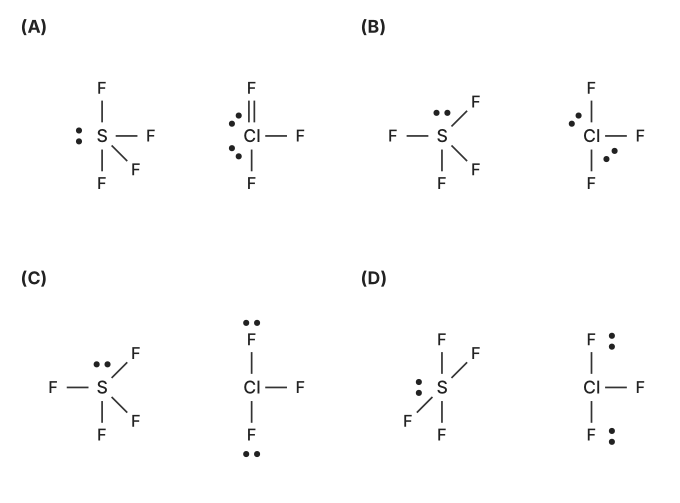
- AP EAPCET 2026Set ap-2026-05-19-AN1 markMCQQ.Which of the following represent the most stable structures of SF4 and ClF3 respectively? [FIGURE] (Lewis structures pairing SF4 (S bonded to 4 F atoms) with ClF3 (Cl bonded to 3 F atoms); the four options differ only in where the lone pair(s) -- one on S, two on Cl -- are drawn relative to the fluorine atoms, testing the correct VSEPR seesaw (SF4) / T-shape (ClF3) lone-pair placement) (A) [FIGURE] (SF4: lone pair drawn on the left side of S, with F atoms up, right, lower-right and down; ClF3: one F drawn up via a double bond line, one F right, one F down, with both lone pairs drawn on the left side, upper-left and lower-left) (B) [FIGURE] (SF4: lone pair drawn at the top of S (axial), with F atoms left, upper-right, right and down; ClF3: lone pair drawn near the top F (upper area) and the other lone pair drawn near the bottom F (lower area)) (C) [FIGURE] (SF4: lone pair drawn at the top of S (axial), with F atoms left, upper-right, right and down -- same skeleton as option B; ClF3: both lone pairs drawn on the same (left) side, upper-left and lower-left) (D) [FIGURE] (SF4: lone pair drawn upper-left of S, with F atoms up, right, lower-right and down; ClF3: lone pairs drawn upper-left and lower-left, with F atoms upper-left, right and lower-left)
›Reveal solutionSolution
This tests VSEPR lone-pair placement in trigonal-bipyramidal-derived shapes: the most stable SF4 (seesaw) has its lone pair equatorial, and the most stable ClF3 (T-shape) has both lone pairs equatorial and adjacent to each other — only one option draws both correctly.
Concept and Intuition
Both SF4 and ClF3 derive their geometry from an underlying trigonal bipyramidal (5 electron-domain) arrangement, which has two distinct kinds of positions: two axial positions (180° apart, perpendicular to the equatorial plane) and three equatorial positions (120° apart from each other, 90° from the axial positions). Lone pairs are more diffuse and repel more strongly than bonding pairs, so the most stable arrangement is the one that minimises the number of 90° (strongest) repulsions involving lone pairs.
For SF4: sulfur has 4 bonding pairs (to F) and 1 lone pair. If the lone pair were axial, it would have three 90° interactions with the three equatorial bonding pairs — high repulsion. If the lone pair is equatorial instead, it has only two 90° interactions (with the two axial bonding pairs) and two 120° interactions (with the other two equatorial bonding pairs) — much lower net repulsion. So the stable/observed "seesaw" geometry places the lone pair equatorially.
For ClF3: chlorine has 3 bonding pairs and 2 lone pairs. To minimise 90° lone-pair interactions, both lone pairs should occupy equatorial positions (there are 3 equatorial slots; 2 are taken by lone pairs, 1 by an F atom, and the remaining 2 F atoms occupy the two axial positions). Because the two lone pairs are both equatorial, they sit adjacent to each other (120° apart) rather than being split between an axial and an equatorial slot (which would create additional 90° lone-pair/bond-pair repulsions) or being placed to bracket the axial fluorines. This equatorial-equatorial adjacent placement is exactly what gives the familiar bent "T-shape" molecular geometry (bond angles slightly less than 90° and 180°).
Step-by-Step Solution
- Recognise SF4 has 5 electron domains (4 bond pairs + 1 lone pair) → trigonal bipyramidal electron geometry, seesaw molecular geometry.
- Apply the rule: lone pairs prefer equatorial positions in TBP geometry to minimise 90° repulsions → the correct SF4 picture has its lone pair drawn to the side (equatorial), not at the "top"/axial position.
- Recognise ClF3 has 5 electron domains (3 bond pairs + 2 lone pairs) → trigonal bipyramidal electron geometry, T-shaped molecular geometry.
- Apply the same equatorial-preference rule twice: both lone pairs should be equatorial, and since there are only 3 equatorial slots, they end up adjacent to each other on the same side, with the two axial slots taken by F atoms. …
- AP EAPCET 2026Set eng-2026-05-18-AN1 markMCQQ.Observe the following statements Statement – I: The correct order of O – O bond length in O2,H2O2 and O3 is H2O2>O3>O2 Statement – II: Hybridisation of carbon in graphite and pyridine is same The correct answer is (A) Both statements I and II are correct (B) Statement I is correct, but statement II is not correct (C) Statement I is not correct, but statement II is correct (D) Both statements I and II are not correct
›Reveal solutionSolution
Both statements check out: O–O bond length really is H2O2>O3>O2 (bond order 1, 1.5, 2 respectively — longer bond ↔ lower bond order), and carbon is sp2 in both graphite and pyridine.
Concept and Intuition
Bond length is inversely related to bond order: more shared electron pairs (higher bond order) pull the nuclei closer together, shortening the bond. In O2 the O–O bond order is 2 (double bond); in O3, resonance delocalizes one π bond over two O–O linkages giving each an effective bond order of 1.5; in H2O2 the O–O bond is a pure single bond (order 1). So bond length should increase as bond order decreases: O2<O3<H2O2, i.e. H2O2>O3>O2 — exactly Statement I.
For hybridization, both graphite and pyridine are built from planar, hexagonally-arranged sp2 carbons with a delocalized π-electron system: graphite is stacked sheets of fused six-membered all-carbon aromatic-like rings, and pyridine is a six-membered aromatic ring (isoelectronic with benzene, N replacing one CH). Both give trigonal-planar, sp2-hybridized ring carbons.
Step-by-Step Solution
- Identify O–O bond order in each species: O2→2, O3→1.5 (per O–O bond, due to resonance), H2O2→1.
- Apply bond-order–bond-length inverse relation: lower bond order → longer bond. So length ranks H2O2(1)>O3(1.5)>O2(2) — matches Statement I exactly.
- Recall graphite's structure: fused six-membered rings of sp2 carbon, each carbon σ-bonded to three neighbours plus one delocalized p-orbital electron in the π system — hybridization sp2. …
- AP EAPCET 2026Set ap-2026-05-20-AN1 markMCQQ.Aluminium carbide on reaction with heavy water gives a carbon compound X. The hybridization in X is (A) sp (B) sp2 (C) sp3 (D) dsp2
›Reveal solutionSolution
Al4C3 reacts with D2O to give deutero-methane (CD4), whose carbon is sp3 hybridised.
Concept and Intuition
Aluminium carbide is the carbide of a highly electropositive metal and hydrolyses readily in water (or heavy water) to release a hydrocarbon — methane (or its deuterated analogue) — along with the metal hydroxide. Isotopic substitution (H → D) changes mass and bond vibrational frequency but not the electronic structure or geometry, so hybridisation is unaffected.
Step-by-Step Solution
- Write the hydrolysis reaction with heavy water: Al4C3+12D2O→4Al(OD)3+3CD4.
- The carbon compound X formed is CD4 (methane-d4).
- Carbon in CD4 forms four equivalent σ bonds to D atoms arranged tetrahedrally, exactly as in CH4. …
- AP EAPCET 2026Set ap-2026-05-20-AN1 markMCQQ.Acrolein, formaldehyde and peroxy acetyl nitrate are the main compounds present in photochemical smog. The total number of sp2 carbons present in these three compounds is (A) 2 (B) 3 (C) 4 (D) 5
›Reveal solutionSolution
Counting sp2 carbons in acrolein, formaldehyde and PAN — the three characteristic photochemical-smog compounds — gives a total of 5.
Concept and Intuition
Any carbon involved in a C=C or C=O double bond is sp2 hybridised (trigonal planar, one unhybridised p orbital for the π bond). Carbons bonded only by single bonds (like a methyl group) remain sp3.
Step-by-Step Solution
- Acrolein, CH2=CH−CHO: three carbons — C1(=CH2), C2(=CH−) both part of the C=C double bond (sp2), and C3 (the aldehyde carbon, C=O) also sp2. Total = 3.
- Formaldehyde, HCHO: one carbon, the carbonyl carbon, sp2. Total = 1. …
🎓Unlock everything free for 14 days
- ✓Full step-by-step solutions
- ✓Concept-first explanations
- ✓Methods, shortcuts & mistakes
- ✓PYQ mapping + timed mock tests
Full access for 14 days. No credit card required.