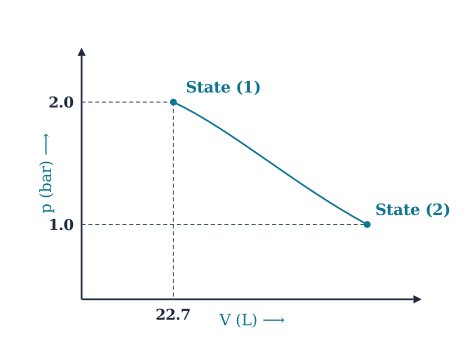
Q.1.0 mol of a monoatomic ideal gas is expanded from state
🔒You're viewing a preview — the full solution, concept, methods & PYQ mapping are locked.
🔒 Start your 14-day free trial to unlock the full solution →Concept understanding — Irreversible Expansion Work
Irreversible Expansion Work – From Intuition to Precision
Imagine you have a gas trapped inside a cylinder with a piston. If you suddenly pull the piston outward, the gas expands rapidly into the newly available space. That's an irreversible expansion — the gas doesn't pass through a series of equilibrium states; it rushes, swirls, and settles only at the end.
Now, think about the work done by the gas during this process. Work, in physics, is force times displacement. For a piston, force is pressure times area, so work becomes PΔV. But here's the catch: during an irreversible expansion, the pressure of the gas is not uniform throughout the cylinder. There are pressure gradients, turbulence, and the gas near the piston face may be at a different pressure than the gas deeper inside.
So how do we calculate the work done?
The Key Insight
The work done by the gas is determined by the external pressure it pushes against — not its own internal pressure. Why? Because the piston moves only in response to the net force acting on it. That net force comes from the external pressure on the other side of the piston.
For any expansion (reversible or irreversible), the work done by the gas is:
W=∫PextdV
where Pext is the pressure exerted on the gas by the surroundings (the piston face).
During a reversible expansion, the gas is always in equilibrium with the surroundings, so Pgas=Pext at every instant. That's why you can replace Pext with Pgas and integrate using the gas's equation of state.
During an irreversible expansion, Pgas is not equal to Pext — and often, Pext is held constant (like when you suddenly release the piston against atmospheric pressure). In that case, the work simplifies dramatically:
W=PextΔV
The Intuitive Picture
Think of pushing a heavy box across a rough floor. The work you do depends on the force you apply (your "external" force), not on the internal stresses inside the box. Similarly, the gas does work against the external resistance it meets — the piston's opposing force.
If the external pressure is constant (say, 1 atm), the gas does work equal to Pext× (change in volume), regardless of how chaotically it expands. The gas might have been at 10 atm initially, but it only does work against the 1 atm it actually pushes.
A common mistake: using the gas's own pressure to calculate irreversible work. Unless the process is reversible, Pgas=Pext, and using Pgas gives the wrong answer.
The Precise Statement
Irreversible expansion work is the work done by a gas when it expands through a series of non-equilibrium states. It is calculated using the external pressure that opposes the expansion:
Wirr=∫V1V2PextdV
For the most common case — expansion against a constant external pressure (like the atmosphere or a fixed weight on the piston): …
Concept: Reversible Isothermal Expansion Work
For a reversible isothermal process, the gas does maximum work because it expands against an external pressure that is infinitesimally smaller than the internal pressure at every instant. The work is given by:
w=−nRTln(V1V2)=−nRTln(p2p1)
The negative sign reflects the convention that work done by the system is negative (energy leaves the system).
Calculation:
Given n=1.0 mol, T=298 K, p1=2 bar, p2=1 bar, and R=8.314 J K⁻¹ mol⁻¹: …
For a reversible isothermal expansion of an ideal gas, the work done by the gas equals nRTln(V2/V1) because temperature (and hence internal energy) stays constant. Here w=−1718J (negative because the gas does work on the surroundings).
Why this approach works
In an isothermal process the temperature remains fixed, so for an ideal gas the internal energy U does not change (ΔU=0). The first law then tells us that all the heat absorbed goes entirely into doing work: q=−w.
For a reversible path the external pressure tracks the gas pressure infinitesimally closely at every instant, pext=p=VnRT. The work is then the integral of pdV from the initial to the final volume, and because T is constant we can pull nRT out front and integrate VdV to get a logarithm. That logarithm can be written in terms of the volume ratio V2/V1 or equivalently the pressure ratio p1/p2 (since pV=const. at fixed T).
Step-by-step calculation
1. Recognize the process type.
The expansion is both reversible and isothermal at T=298K. We have n=1.0mol, p1=2bar, p2=1bar, so V1V2=p2p1=2.
2. Write the work formula for reversible isothermal expansion.
The work done by the gas (our sign convention: work done by the system is negative) is
w=−∫V1V2pextdV=−∫V1V2VnRTdV.
Because T is constant,
w=−nRT∫V1V2VdV=−nRTln(V1V2).
w=−nRTln(V1V2)=−nRTln(p2p1).
3. Substitute the numbers.
Take R=8.314J mol−1K−1, n=1.0mol, T=298K, and ln(2)≈0.693.
w=−(1.0)(8.314)(298)ln(2)=−2477.6×0.693≈−1717J. …
- AP EAPCET 2026Set eng-2026-05-15-AN1 markMCQQ.At 27°C, 1.6 g of O2 exerting a pressure of 5 atm is allowed to expand isothermally against a constant pressure of 1 atm. What is the work done (in J)? (1 L−atm=100J, R=0.082 LatmK−1mol−1) (A) −49.2 (B) −98.4 (C) +98.4 (D) +49.2
›Reveal solutionSolution
This tests irreversible isothermal expansion work against a constant external pressure, w=−PextΔV, requiring volumes from the ideal gas law at both states. The work done by the gas is −98.4 J.
Concept and Intuition
When a gas expands against a constant external pressure (irreversible expansion), the work is simply w=−Pext(V2−V1) — not the reversible/isothermal-integral formula w=−nRTln(V2/V1), because the opposing pressure doesn't change as the gas expands. The negative sign reflects that the gas does work on the surroundings (loses energy).
Step-by-Step Solution
- Moles of O2: n=321.6=0.05 mol.
- Initial volume (at P1=5 atm, T=300 K): V1=P1nRT=50.05×0.082×300=51.23=0.246 L.
- Final volume (after expanding until pressure equals the opposing 1 atm, still at T=300 K since isothermal): V2=P2nRT=11.23=1.23 L.
- ΔV=V2−V1=1.23−0.246=0.984 L. …
- AP EAPCET 2026Set eng-2026-05-15-FN1 markMCQQ.At constant temperature, one mole of an ideal gas of volume 2L expanded to 100 L against an external pressure of 1 atm under reversible conditions. What is the work done (in J)? (1 L atm = 101.3 J; log 5 = 0.7) (A) −163.3 (B) −793.2 (C) +793.2 (D) +326.6
›Reveal solutionSolution
Using the initial pressure (1 atm, matching the external pressure) to fix nRT=P1V1, the reversible isothermal work comes out to −793.2 J using log5=0.7.
Concept and Intuition
For a reversible isothermal expansion of an ideal gas, the work done by the gas is w=−nRTln(V1V2)=−2.303nRTlog(V1V2). Here we aren't told T directly, but the phrase "against an external pressure of 1 atm" tells us the gas starts in mechanical equilibrium with 1 atm at the initial volume — i.e. P1=1atm at V1=2L, so nRT=P1V1 (valid at constant T, from the ideal gas law).
Step-by-Step Solution
- nRT=P1V1=(1 atm)(2 L)=2 L⋅atm (works in L·atm units directly, no need for R or T separately).
- w=−2.303nRTlog(V1V2)=−2.303×2×log(2100)=−2.303×2×log(50).
- log(50)=log(5)+log(10)=0.7+1=1.7.
- w=−2.303×2×1.7=−7.830 L⋅atm.
- Convert to joules: w=−7.830×101.3 J/(L⋅atm)≈−793.2 J. …
- AP EAPCET 2026Set ap-2026-05-19-AN1 markMCQQ.The work done (in J) when 13 g of Zn (At. wt: 65 u) reacts with dil. HCl in an open beaker at 298 K is (R=8.3 J K−1mol−1) (A) +494.68 (B) −494.68 (C) −247.34 (D) −347.43
›Reveal solutionSolution
Gas evolved at constant (atmospheric) pressure does expansion work on the surroundings; w=−ΔngRT gives −494.68 J.
Concept and Intuition
In an open beaker the reaction occurs at constant (atmospheric) pressure, and any gas produced pushes back the atmosphere, doing P-V work. By the IUPAC convention w=−PextΔV, work done by the system (expansion) is recorded as negative work done on the system. For an ideal gas at constant T, PΔV=ΔngasRT.
Step-by-Step Solution
- Reaction: Zn(s)+2HCl(aq)→ZnCl2(aq)+H2(g).
- Moles of Zn =6513=0.2 mol.
- From stoichiometry, moles of H2(g) produced =0.2 mol, so Δngas=0.2 (only the gas phase moles matter; solid Zn disappears, solute ions don't count). …
- AP EAPCET 2024Set eng-2024-05-19-AN1 markMCQQ.Given below are two statements Statement - I: For isothermal irreversible change of an ideal gas, q=−w=Pext(Vfinal−Vinitial) Statement - II: For adiabatic change, ΔU=wadiabatic The correct answer is (A) Both Statement-I and statement-II are correct (B) Both Statement-I and statement-II are not correct (C) Statement-I is correct but statement-II is not correct (D) Statement-I is not correct but statement-II is correct
›Reveal solutionSolution
This tests two standard first-law-of-thermodynamics results for isothermal irreversible and adiabatic processes. The answer is (A) -- both statements are correct.
Concept and Intuition
For an ideal gas, internal energy depends only on temperature. In an isothermal process, ΔT=0 so ΔU=0, meaning all the heat absorbed exactly balances the work done (q=−w). In an adiabatic process, no heat is exchanged with the surroundings (q=0), so the entire change in internal energy shows up as work.
Step-by-Step Solution
- Statement I: For an isothermal irreversible expansion of an ideal gas against a constant external pressure, w=−Pext(Vf−Vi). Since ΔU=0 (isothermal, ideal gas) and ΔU=q+w, we get q=−w=Pext(Vf−Vi). This exactly matches the given statement. Correct.
- Statement II: For an adiabatic process, q=0 by definition. The first law ΔU=q+w then reduces to ΔU=wadiabatic. Correct. …
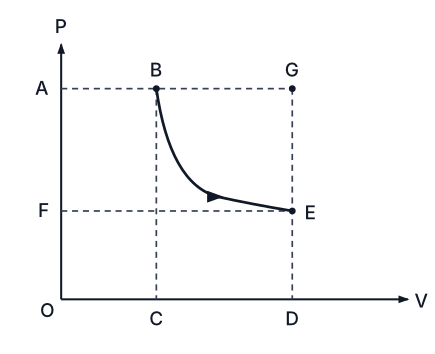
- AP EAPCET 2024Set eng-2024-05-19-AN1 markMCQQ.A thermodynamic process (B→E) was completed as shown below. The work done is equal to area under the limits [FIGURE] (a P-V diagram: axes P (vertical) and V (horizontal), with points labelled A on the P-axis, B directly right of A at the top of a curve, G at the same height as B further right (dashed line A-B-G), the curve descends from B through an arrow to E, F on the P-axis at the height of E (dashed line F-E), and C, D on the V-axis below B and E respectively (dashed lines B-C and E-D), with O at the origin) (A) A→B→E→F (area under the curve bounded by the bracket from A to F) (B) A→B→E→D→O (area under the curve bounded by the bracket from A to O) (C) B→C→D→E (area under the curve bounded by the bracket from B to E) (D) B→G→E (area under the curve bounded by the bracket from B to E)
›Reveal solutionSolution
This tests the standard graphical definition of thermodynamic work as the area under a P-V curve. The answer is (C).
Concept and Intuition
The work done during a process from one state to another on a P-V diagram equals the area enclosed between the process curve and the volume axis, over the volume range spanned by the process -- not any wider or narrower region. To find this area, drop perpendiculars (vertical lines) from the start and end points of the curve down to the V-axis; the enclosed region between those two verticals, the curve, and the V-axis segment between them is exactly the work done.
Step-by-Step Solution
- The process of interest is from B to E along the given curve.
- To find the work done for this specific process, drop a vertical line from B down to the V-axis (reaching point C) and a vertical line from E down to the V-axis (reaching point D).
- The area representing the work done is bounded by: the curve from B to E (top), the vertical line E-D (right side), the V-axis segment D-C (bottom), and the vertical line C-B (left side) -- i.e., the region B to C to D to E. …
- AP EAPCET 2023Set ap-2023-05-22-AN1 markMCQQ.Which one of the following options is correct for q = -ve and w = +ve (A) Isothermal irreversible expansion of an ideal gas with constant external pressure. (B) Isothermal irreversible compression of an ideal gas with constant external pressure (C) Isothermal reversible expansion of an ideal gas against constant external pressure (D) Irreversible expansion of an ideal gas into vacuum
›Reveal solutionSolution
For an isothermal ideal gas, q=−w; compression (work done ON the system, w>0) automatically means heat is released (q<0) — this only happens for option (B).
Concept and Intuition
By the IUPAC sign convention: w=−PextΔV, and work done on the system is positive. For an isothermal process on an ideal gas, internal energy doesn't change (ΔU=0 since U depends only on T), so q=ΔU−w=−w. This means the signs of q and w are always exactly opposite in an isothermal ideal-gas process — so we just need to identify which process has w>0 (i.e., compression).
Step-by-Step Solution
- Isothermal irreversible expansion (A): Gas expands, ΔV>0, so w=−PextΔV<0 (system does work, work is NOT done on it). Then q=−w>0. Doesn't match (need q<0).
- Isothermal irreversible compression (B): Gas is compressed, ΔV<0, so w=−PextΔV>0 (work done on system, e.g. by an external agent pushing the piston in). Then q=−w<0 (heat is released to keep T constant while the gas is compressed). This matches q=−ve,w=+ve.
- Isothermal reversible expansion (C): Expansion again gives w<0; doesn't match. …
- AP EAPCET 2023Set eng-2023-05-17-AN1 markMCQQ.If 5 L of an ideal gas at a constant external pressure of 2 atm expands isothermally to a final volume of 'X' L, the system does a work of -2,026.4 J. 'X' (in L) is (1 L.atm=101.32 J) (A) 25 (B) 20 (C) 15 (D) 10
›Reveal solutionSolution
This tests the formula for work done during isothermal expansion against constant external pressure. Answer: X = 15 L.
Concept and Intuition
When a gas expands against a constant external pressure, the work done (using the convention w=−PextΔV, work done ON the system, negative for expansion) depends only on the external pressure and the volume change — not on the path taken by the gas internally (unlike a reversible process).
Step-by-Step Solution
- Convert given work to L·atm: w=−2026.4 J×101.32 J1 Latm=−20.0 L·atm.
- Apply w=−Pext(V2−V1): −20.0=−2(X−5). …
- AP EAPCET 2023Set eng-2023-05-17-FN1 markMCQQ.11.0 L of an ideal gas at constant external pressure of 5 atm is compressed isothermally to a final volume of one liter. The heat absorbed and work done respectively, during this compression (in L atm) are (A) -50, -50 (B) 50, -50 (C) -50, 50 (D) 50, 50
›Reveal solutionSolution
Constant-external-pressure isothermal compression: work done on the gas is +50 L·atm, and since ΔU=0 for an isothermal ideal gas, heat absorbed is −50 L·atm (i.e. 50 L·atm is released).
Concept and Intuition
This is an irreversible process (compression against a single constant external pressure, not a reversible quasi-static path), so work must be computed as w=−PextΔV, not via the reversible integral −nRTln(Vf/Vi). Since the gas is ideal and the process is isothermal, internal energy doesn't change, so all the work done on the gas must leave as heat.
Step-by-Step Solution
- Identify Pext=5 atm (constant, since it's an irreversible one-step compression), Vi=11 L, Vf=1 L.
- Work done on the gas: w=−Pext(Vf−Vi)=−5×(1−11)=−5×(−10)=+50 L·atm.
- For an ideal gas at constant T, ΔU=0, so q=ΔU−w=0−50=−50 L·atm. …
- AP EAPCET 2022Set eng-2022-07-04-FN1 markMCQQ.State 1 ⇌ State 2 ⇌ State 3. State 1: T=300K, P=15bar, 1mole. State 2: T=300K, P=10bar, 1mole. State 3: T=300K, P=5bar, 1mole. Above shows a cyclic process. Calculate the total work done during one complete cycle. (Assume a single step to reach the next state). (A) 25/3 L bar (B) -25/3 L bar (C) 50/3 L bar (D) -50/3 L bar
›Reveal solutionSolution
A cyclic single-step (irreversible) isothermal process: compute w=−PextΔV for each leg using the arrival-state pressure as the constant external pressure, then sum over the full round trip.
Concept and Intuition
All three states lie on the same isotherm (T=300 K throughout, n=1 mol), so V=RT/P at each state. A "single step" process moves the gas directly between two states against a CONSTANT external pressure (taken as the pressure of the state being moved into), so its work is w=−PextΔV — this is NOT the same as the (zero) net work of a reversible cycle traced along a single isotherm, because each irreversible leg follows a straight P–V path rather than the curve, so forward and backward legs enclose a net nonzero area.
Step-by-Step Solution
- Volumes: V1=15RT, V2=10RT, V3=5RT, with RT≈25 L bar (using R≈0.0833 L·bar·mol−1K−1, T=300 K).
- Cycle goes 1→2→3→2→1 (out and back through the same states), each leg a single step against the pressure of the arriving state.
- Leg 1→2 (Pext=10): w1=−Pext(V2−V1)=RT(P1P2−1)=RT(1510−1)=−3RT.
- Leg 2→3 (Pext=5): w2=RT(P2P3−1)=RT(105−1)=−2RT.
- Leg 3→2 (Pext=10): w3=RT(P3P2−1)=RT(510−1)=RT. …
- AP EAPCET 2021Set eng-2021-08-19-AN1 markMCQQ.When the temperature of 2 moles of an ideal gas is increased by 20 ∘C at constant pressure, find the work involved in the process. (A) 5R (B) 40R (C) 15R (D) 20R
›Reveal solutionSolution
For an ideal gas heated at constant pressure, the work of expansion is simply w=nRΔT. With n=2 and ΔT=20 K, w=40R.
Concept and Intuition
At constant pressure, work done during a volume change is w=PΔV. Since PV=nRT at both the initial and final states (constant P, n), PΔV=nRΔT — a clean shortcut that avoids needing P or V individually.
Step-by-Step Solution
- Constant-pressure work: w=PΔV.
- From the ideal gas law at constant P,n: PΔV=nRΔT.
- A temperature change of 20∘C is the same magnitude as ΔT=20 K (since the Celsius and Kelvin scales have equal-sized degrees). …
- AP EAPCET 2021Set eng-2021-08-20-AN1 markMCQQ.When an ideal gas expands isothermally from 5 m3 to 10 m3 at 25 ∘C against a constant pressure of 107 N.m−2, then the work done on the gas is ________ (A) −100 MJ (B) −50 MJ (C) −0.5 MJ (D) −105 MJ
›Reveal solutionSolution
Irreversible expansion work against a constant external pressure is PextΔV; the work done ON the gas is −50 MJ.
Concept and Intuition
When a gas expands against a constant opposing (external) pressure, the work exchanged is w=−PextΔV (work done ON the system, by the standard thermodynamic sign convention: expansion does negative work on the system since the system does positive work on surroundings). This does not require the reversible/integral formula since Pext is constant, not varying with volume.
Step-by-Step Solution
- ΔV=V2−V1=10−5=5 m3.
- Pext=107 N.m−2 (constant, since it's an irreversible expansion against fixed external pressure).
- Work done by the gas on the surroundings =PextΔV=107×5=5×10⁷ J=50 MJ. …
- AP EAPCET 2021Set eng-2021-08-25-FN1 markMCQQ.An ideal gas expanded irreversibly against 10 bar pressure from 20 L to 30 L. Calculate Q if the process is Isoenthalpic. 1 L.bar=100 J (A) 0 (B) 100 J (C) -100 J (D) 10 kJ
›Reveal solutionSolution
Isoenthalpic + ideal gas ⇒ ΔT=0 ⇒ ΔU=0; apply the first law to the irreversible expansion work to get Q=10 kJ.
Concept and Intuition
For an ideal gas, enthalpy and internal energy both depend only on temperature. So "isoenthalpic" (ΔH=0) immediately forces ΔT=0, which in turn forces ΔU=0 as well. With ΔU pinned to zero, the first law directly links the heat absorbed to the (irreversible, constant-external-pressure) work done.
Step-by-Step Solution
- Ideal gas + isoenthalpic ⇒ΔH=0⇒ΔT=0⇒ΔU=0 (since U of an ideal gas depends only on T).
- Irreversible expansion against constant Pext=10 bar, ΔV=30−20=10 L: work done by the gas =PextΔV=10×10=100 L·bar =100×100=10,000 J. …
🎓Unlock everything free for 14 days
- ✓Full step-by-step solutions
- ✓Concept-first explanations
- ✓Methods, shortcuts & mistakes
- ✓PYQ mapping + timed mock tests
Full access for 14 days. No credit card required.