Q.A fully loaded Boeing aircraft has a mass of 3.3×10⁵ kg. Its total wing area is 500 m2. It is in level flight with a speed of 960 km/h.
🔒You're viewing a preview — the full solution, concept, methods & PYQ mapping are locked.
🔒 Start your 14-day free trial to unlock the full solution →Concept understanding — Bernoulli's Principle
Bernoulli's Principle: From Intuition to Precision
Imagine you're standing on a railway platform as an express train roars past. You feel a strange pull — a gentle but definite tug — drawing you toward the train. That's not your imagination. It's Bernoulli's Principle at work in the real world.
The Core Intuition
Here's the simplest way to think about it: fast-moving fluid (air or water) exerts less pressure than slow-moving fluid.
When the train rushes by, it drags the air next to it along. That air moves fast. The air on the other side of you, far from the train, is nearly still. The still air pushes harder than the fast air, so you feel a net push toward the train.
This isn't magic — it's a direct consequence of how energy is conserved in a flowing fluid.
The Precise Statement
P+21ρv2+ρgh=constant
Where:
- P = pressure of the fluid
- ρ = density of the fluid
- v = speed of the fluid
- g = acceleration due to gravity
- h = height above a reference level
Bernoulli's Principle states: For an ideal fluid (incompressible, non-viscous, flowing steadily along a streamline), an increase in the fluid's speed occurs simultaneously with a decrease in pressure or a decrease in the fluid's potential energy.
Breaking It Down Piece by Piece
The equation has three terms, each representing a form of "energy per unit volume":
- P — Pressure energy. Think of it as the "push" the fluid has stored.
- 21ρv2 — Kinetic energy per unit volume. Faster flow means more of this.
- ρgh — Gravitational potential energy per unit volume. Higher elevation means more of this.
The sum stays constant along a streamline. So if one term goes up, at least one other must go down.
A common mistake is to think Bernoulli's Principle says "fast flow always means low pressure." That's only true when height doesn't change. If a fluid flows uphill, it can slow down and still have lower pressure — the height term eats up the energy.
A Concrete Example: The Garden Hose
Put your thumb over the end of a garden hose. The water shoots out faster — but the pressure at the nozzle drops. You can feel it: the hose feels "softer" near your thumb. The water's speed increased, so its pressure decreased. That's Bernoulli in your hands.
When Does Bernoulli's Principle Apply?
It works perfectly for:
- Ideal fluids — water, air at moderate speeds (below about 0.3 times the speed of sound)
- Steady flow — no turbulence or sudden changes
- Along a single streamline — you can't compare two different streamlines unless they start from the same reservoir
| Condition | Applies? | Why |
|-----------|----------|-----|
| Water flowing in a pipe | Yes | Incompressible, low viscosity | …
Lift balances weight, giving the pressure difference; Bernoulli's equation then converts that into the fractional speed difference between the wing surfaces.
(a) ΔP=Amg=500(3.3×10⁵)(9.8)≈6.5×10³ Pa. …
The lift on the wings must equal the aircraft's weight, giving a pressure difference of about 6.5×10³ Pa between the lower and upper wing surfaces. Applying Bernoulli's equation, this pressure difference corresponds to the air over the upper surface moving about 7.6% faster than the air below.
(a) Pressure difference across the wings
In level flight, the total lift force balances the aircraft's weight: L=mg, and lift is the pressure difference times the wing area, L=ΔP⋅A. With m=3.3×10⁵ kg, A=500 m2, g=9.8 m/s2:
ΔP=Amg=500(3.3×10⁵)(9.8)=5003.234×106≈6.5×10³ Pa
(b) Fractional increase in speed on the upper surface
Convert the cruise speed to SI units:
v=960 km/h=3600960×1000≈266.7 m/s
Bernoulli's equation for horizontal flow (no height difference between the wing surfaces) gives
ΔP=21ρ(vu2−vl2)
so
vu2−vl2=ρ2ΔP=1.22×6.5×103≈1.083×10⁴ m2/s2 …
deltaP=mg/A=(3.3e59.8)/500~=6.5e3 Pa. Bernoulli: v_u^2-v_l^2=2deltaP/rho. Approx v_u+v_l~=2v: (v_u-v_l)/v~=deltaP/(rho*v^ …
- AP EAPCET 2026Set eng-2026-05-14-FN1 markMCQQ.A large tank filled with water to a height 'h' is to be emptied through a small hole at the bottom. The ratio of times taken for the level of water to fall from h to 2h and from 2h to zero is (A) 2 (B) 21 (C) 2−1 (D) 2−11
›Reveal solutionSolution
This tests Torricelli's law of efflux and integrating the resulting differential equation for the falling water level. The answer is 2−1.
Concept and Intuition
By Torricelli's law, water escapes a small hole at the bottom of a tank with speed v=2gh when the level is at height h. Using continuity (area of tank A, area of hole a), the rate of fall of the level is dtdh=−Aa2gh=−kh for a constant k=Aa2g. As h decreases, the level falls more slowly (since h decreases), so the tank takes longer to drain the lower portion than an equal height of the upper portion — the ratio should come out less than 1, consistent with 2−1≈0.414.
Step-by-Step Solution
- From dtdh=−kh, separate variables: hdh=−kdt.
- Integrating between height h1 (start) and h2 (end) gives the time: t=k2(h1−h2).
- Time to fall from h to h/2: t1=k2(h−h/2)=k2h(1−21). …
- AP EAPCET 2026Set ap-2026-05-20-AN1 markMCQQ.The dynamic lift due to the spinning of a ball in a fluid can be explained by ________ (A) Bernoulli's Principle (B) Pascal Law (C) Archimede's Principle (D) Magnus effect
›Reveal solutionSolution
The lift generated purely by a ball's spin as it moves through a fluid is the Magnus effect. Answer: (D).
Concept and Intuition
When a ball spins while moving through air (or any fluid), it drags a thin layer of fluid around with it due to viscosity. On the side where the ball's surface motion adds to the oncoming flow, the relative fluid speed is higher; on the opposite side it's lower. By Bernoulli's principle, higher local flow speed corresponds to lower local pressure, so a net pressure difference — and hence a net force perpendicular to the direction of travel — arises. While Bernoulli's principle is the underlying pressure-speed relation used to explain why it happens, the named physical phenomenon of spin-induced deflection is specifically the Magnus effect (seen in curving cricket/football/baseball trajectories).
Step-by-Step Solution
- A spinning ball moving through a fluid creates asymmetric relative flow speeds on its two sides due to the combination of translational and spin motion.
- Faster relative flow on one side → lower pressure there (Bernoulli); slower relative flow on the other side → higher pressure. …
- AP EAPCET 2025Set eng-2025-05-22-AN1 markMCQQ.An aeroplane of mass 4.5×10⁴ kg and total wing area of 600 m2 is travelling at a constant height. The pressure difference between the upper and lower surfaces of its wings is (Acceleration due to gravity = 10 ms−2) (A) 500 Nm−2 (B) 825 Nm−2 (C) 600 Nm−2 (D) 750 Nm−2
›Reveal solutionSolution
Bernoulli's principle applied to an aircraft wing: the lift force (equal to weight in level flight) divided by the wing area gives the pressure difference across the wings, 750 N/m².
Concept and Intuition
An aeroplane's wings are shaped so that air flows faster over the top surface than the bottom, creating a pressure difference (Bernoulli's principle) that produces an upward lift force. In steady, constant-height (level) flight, this lift force exactly balances the plane's weight. The lift force is just this pressure difference multiplied by the total wing area, so dividing the required lift (weight) by the area recovers the pressure difference.
Step-by-Step Solution
- In level flight, lift = weight: Flift=mg=4.5×104×10=4.5×10⁵ N. …
- AP EAPCET 2024Set ap-2024-05-16-AN1 markMCQQ.The reading of a pressure-meter attached to a closed pipe (with water) is 3.5×10⁵ Nm−2. On opening the valve of the pipe the reading is reduced to 3.0×10⁵ Nm−2. The speed of the water flowing out the pipe is (A) 10 ms−1 (B) 0.1 ms−1 (C) 1 ms−1 (D) 5 ms−1
›Reveal solutionSolution
Applying Bernoulli's equation between the static (closed) and flowing (open) states gives the outflow speed as 10 m/s.
Concept and Intuition
With the valve closed, water is static and the gauge reads the full static pressure. Opening the valve lets water flow; part of the pressure energy converts into kinetic energy, so the measured pressure at the same point drops. Bernoulli's equation (same height, same point) relates this pressure drop directly to flow speed.
Step-by-Step Solution
- Bernoulli (same elevation): P1=P2+21ρv2, so ΔP=P1−P2=21ρv2. …
- AP EAPCET 2024Set eng-2024-05-22-FN1 markMCQQ.Water is flowing in streamline manner in a horizontal pipe. If the pressure at a point where cross-sectional area is 10 cm2 and velocity 1 ms−1 is 2000 Pa, then the pressure of water at another point where the cross-sectional area 5 cm2 is (A) 2500 Pa (B) 2000 Pa (C) 1000 Pa (D) 500 Pa
›Reveal solutionSolution
Use continuity to find the new speed, then Bernoulli's equation (horizontal pipe) to find the new pressure — it comes out to 500 Pa.
Concept and Intuition
For streamline flow of an incompressible fluid, the equation of continuity (Av=const) fixes speed changes as the pipe narrows, and Bernoulli's equation (constant total energy per unit volume along a streamline) then trades that speed change for a pressure change. In a horizontal pipe there's no elevation term, so pressure and kinetic energy per unit volume trade off directly.
Step-by-Step Solution
- Continuity equation: A1v1=A2v2. Here A1=10 cm2, v1=1 ms−1, A2=5 cm2.
v2=A2A1v1=510×1=2 ms−1
- Bernoulli's equation for a horizontal pipe (same height, so gravitational PE terms cancel): P1+21ρv12=P2+21ρv22 …
- AP EAPCET 2022Set eng-2022-07-04-AN1 markMCQQ.A steady flow of a liquid of density ρ is shown in figure. At point 1, the area of cross-section is 2A and the speed of flow of liquid is 2ms−1. At point 2, the area of cross-section is A. Between the points 1 and 2, the pressure difference is 100Nm−2 and the height difference is 10 cm. The value of ρ is (Acceleration due to gravity =10ms−2) [FIGURE] (A stepped horizontal pipe: point 1 is on the upper, wider section and point 2 is on the lower, narrower section, connected by a vertical step of height h; the pipe carries liquid flowing steadily from point 1 to point 2.) (A) 25kgm−3 (B) 30kgm−3 (C) 50kgm−3 (D) 70kgm−3
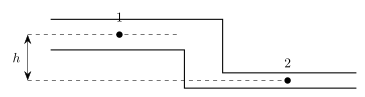
›Reveal solutionSolution
Use Bernoulli’s equation for steady, incompressible flow between two points at different heights and cross-sections, combined with the continuity equation to relate speeds. Solving gives density ρ=50kgm−3, which corresponds to option (C).
We have a steady flow of an ideal liquid (incompressible, non‑viscous). The pipe changes both cross‑section and height, so both kinetic and gravitational potential energy terms matter. Bernoulli’s principle tells us that along a streamline, the sum of pressure energy, kinetic energy per unit volume, and gravitational potential energy per unit volume is constant. That’s the natural tool here.
Let’s work through it step by step.
- Write Bernoulli’s equation between point 1 (upper, wider section) and point 2 (lower, narrower section).
P1+21ρv12+ρgh1=P2+21ρv22+ρgh2
Rearranging to isolate the pressure difference:
P1−P2=21ρ(v22−v12)+ρg(h2−h1)
We are told the pressure difference P1−P2=100Nm−2 (positive, so pressure at 1 is higher). The height difference is given as 10cm=0.1m, with point 1 higher than point 2, so h1−h2=0.1m. Hence h2−h1=−0.1m.
- Use continuity to find v2. For steady flow of an incompressible fluid, A1v1=A2v2. Here A1=2A, A2=A, and v1=2m/s.
(2A)(2)=Av2⇒v2=22m/s
- Substitute into Bernoulli’s equation.
100=21ρ[(22)2−(2)2]+ρ(10)(−0.1)
Compute the squares:
(22)2=4×2=8, (2)2=2. So v22−v12=8−2=6.
Then: …
- AP EAPCET 2021Set ap-2021-09-03-AN1 markMCQQ.A wind with a speed 40 m.s−1 blows parallel to the roof of a house. Area of the roof is 250 m2. Assuming that the pressure inside the house is atmospheric pressure, the force exerted by the wind on the roof and direction of the force will be ______ (ρair=1.2 kg.m−3) (A) 4.8×10⁵ N, downwards (B) 4.8×10⁵ N, upwards (C) 2.4×10⁵ N, upwards (D) 2.4×10⁵ N, downwards
›Reveal solutionSolution
Wind blowing over a roof lowers the pressure above it (Bernoulli), producing a net upward force of 2.4×10⁵ N that can lift the roof off.
Concept and Intuition
Bernoulli's equation says that along a streamline, P+21ρv2+ρgh is constant. Fast-moving air just above the roof has high v, so its pressure Pout is lower than the pressure of the still air Pin trapped inside the house (approximately atmospheric, since it isn't moving). This pressure imbalance pushes the roof upward from inside — the same physics as lift on an aircraft wing.
Step-by-Step Solution
- Apply Bernoulli between still air inside (speed ≈0) and moving air just outside (speed 40 m.s−1), same height: Pin−Pout=21ρv2=21(1.2)(40)2=21(1.2)(1600)=960 Pa.
- This is the net outward (upward, since the roof is horizontal and wind blows over its top) pressure difference pushing the roof up. …
- AP EAPCET 2021Set ap-2021-09-07-FN1 markMCQQ.The pressure of water in a pipe when tap is closed is 5.5×10⁵ N.m−2. When the tap is opened, water pressure reduces to 5×10⁵ N.m−2. The velocity with which the water comes out when tap is opened is ________. (Density of water is 1000 kg m−3) (A) 10 m.s−1 (B) 5 m.s−1 (C) 20 m.s−1 (D) 15 m.s−1
›Reveal solutionSolution
Using Bernoulli's equation, the drop in static pressure when the tap opens is converted into kinetic energy of the flowing water, giving v=10 ms−1.
Concept and Intuition
Bernoulli's principle says that along a streamline, P+21ρv2+ρgh stays constant for an ideal fluid. With the tap closed, water is static (v=0) and its pressure is entirely "static" pressure. When the tap opens, some of that pressure converts into kinetic energy of the moving water (at the same height, so the ρgh term is unchanged). The pressure reading drops because part of it now shows up as motion.
Step-by-Step Solution
- Bernoulli's equation (same height, comparing closed vs open tap): Pclosed=Popen+21ρv2.
- So ΔP=Pclosed−Popen=21ρv2. …
- AP EAPCET 2021Set ap-2021-10-05-FN1 markMCQQ.An aero plane is in a level flight, at a constant speed and each of its wings has an area of 25 m2. If the speed of air on the upper and lower surfaces of the wing are 270 kmph and 234 kmph respectively, then find the mass of the plane. (density of air = 1 kg.m−3) (A) 1000 kg (B) 2500 kg (C) 4500 kg (D) 3500 kg
›Reveal solutionSolution
Bernoulli's principle gives the pressure difference across the wings from the given air speeds; multiplying by total wing area gives the lift force, and dividing by g gives the plane's mass — 3500 kg.
Concept and Intuition
An aeroplane wing generates lift because air moves faster over the curved upper surface than along the flatter lower surface. By Bernoulli's equation (applied along a streamline at roughly the same height), faster-moving air has lower pressure, so the lower surface (slower air) has higher pressure than the upper surface (faster air). This pressure difference, multiplied by the wing area, produces the net upward lift force. For level flight at constant speed, this lift exactly balances the weight of the plane.
Step-by-Step Solution
- Convert speeds to SI units: vupper=270 kmph=3600270×1000=75 m/s; vlower=234 kmph=3600234×1000=65 m/s.
- Apply Bernoulli's equation (same height, so no gravitational PE term): Plower−Pupper=21ρ(vupper2−vlower2).
- Compute: vupper2−vlower2=752−652=5625−4225=1400.
- ΔP=21×1×1400=700 Pa.
- Total wing area (both wings, each 25 m2): Atotal=2×25=50 m2. …
- AP EAPCET 2021Set eng-2021-08-20-AN1 markMCQQ.Assertion (A): The upper surface of the wing of an aeroplane is made convex and the lower surface is made concave. Reason (R): The air currents at the top have smaller velocity and thus less pressure at the bottom than at the top. (A) Both A and R are true and R is a correct explanation for A (B) Both A and R are true but R is not a correct explanation for A (C) A is true, R is false (D) A is false, R is false
›Reveal solutionSolution
The aerofoil shape (Assertion) is correctly described, but the Reason inverts Bernoulli's principle — air moves faster (not slower) over the curved top, giving lower (not higher) pressure there, so A is true but R is false.
Concept and Intuition
An aerofoil (wing cross-section) is shaped with a more curved (convex) upper surface and a flatter (or concave) lower surface. Air flowing over the top must travel a longer path in the same time as air flowing under the flatter bottom, so by continuity the air moves FASTER over the top. By Bernoulli's principle, faster-moving fluid exerts LOWER pressure. So the pressure above the wing is lower than the pressure below, and this pressure difference produces the net upward force — lift.
Step-by-Step Solution
- Assertion: "upper surface convex, lower surface concave" — this correctly describes the classic aerofoil cross-section. True.
- Reason as stated: "air currents at the top have smaller velocity and thus less pressure at the bottom than at the top."
- Check velocity claim: actual physics says top velocity is GREATER, not smaller — so the reason's premise is wrong. …
🎓Unlock everything free for 14 days
- ✓Full step-by-step solutions
- ✓Concept-first explanations
- ✓Methods, shortcuts & mistakes
- ✓PYQ mapping + timed mock tests
Full access for 14 days. No credit card required.