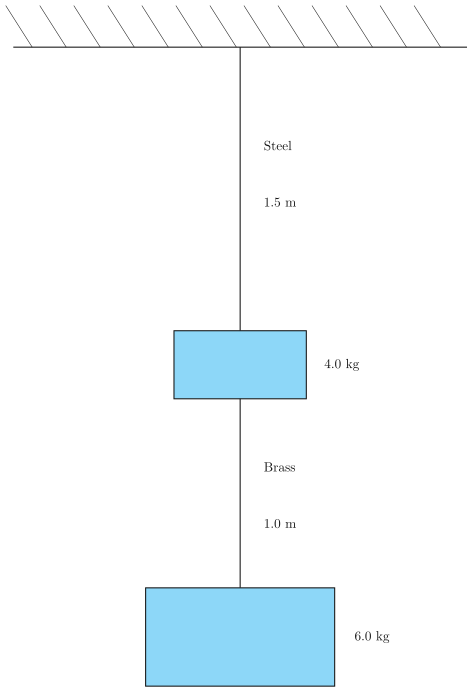
Q.Two wires of diameter 0.25 cm, one made of steel and the other made of brass are loaded as shown in Fig. 8.11. The unloaded length of steel wire is 1.5 m and that of brass wire is 1.0 m. Compute the elongations of the steel and the brass wires.
🔒You're viewing a preview — the full solution, concept, methods & PYQ mapping are locked.
🔒 Start your 14-day free trial to unlock the full solution →Concept understanding — Youngs Modulus
Young’s Modulus: The Stretchiness of a Solid
When you pull on a rubber band, it stretches easily. When you pull on a steel rod of the same size, it barely moves. Both are elastic — they return to their original shape when you let go — but they resist stretching very differently. Young’s modulus is the number that tells you exactly how much a material resists being stretched or compressed lengthwise.
The Intuition: Stiffness per Unit Size
Think of a spring. A stiff spring requires a large force to stretch it a little. A soft spring stretches a lot with a small force. Young’s modulus is like the “stiffness” of a material, but it’s cleverly designed to be independent of the object’s shape and size.
If you take a thick steel rod and a thin steel wire of the same length, the rod is harder to stretch. That’s because you’re pulling on more material. Young’s modulus removes this size effect — it tells you the stiffness of the material itself, not the particular piece you’re holding.
The Precise Definition
Young’s modulus (E or Y) is defined as the ratio of tensile stress to tensile strain, as long as the material obeys Hooke’s law (the deformation is reversible and proportional to the force).
Y=Tensile StrainTensile Stress
Let’s break down the two parts.
Tensile Stress (σ) is the force per unit area. If you pull with a force F on a rod of cross-sectional area A, the stress is:
σ=AF
Stress has units of pressure — pascals (Pa) or N/m2. It tells you how “intense” the pulling is, regardless of the rod’s thickness.
Tensile Strain (ε) is the fractional change in length. If the original length is L0 and it stretches by ΔL, the strain is:
ε=L0ΔL
Strain is a pure number — it has no units. A strain of 0.01 means the rod stretched by 1% of its original length.
Putting it together:
Y=ΔL/L0F/A=AΔLFL0
What the Number Tells You
A high Young’s modulus means the material is very stiff — it takes a huge stress to produce even a tiny strain. Steel has Y≈200×109 Pa. A low Young’s modulus means the material is easily stretched. Rubber has Y≈0.01×10⁹ Pa — about 20,000 times smaller than steel.
Young’s modulus is only valid in the elastic region — where the material returns to its original shape after the force is removed. If you stretch too far (past the elastic limit), the material deforms permanently or breaks, and Young’s modulus no longer applies.
A Worked Example
A steel wire of length 2.0 m and cross-sectional area 1.0×10⁻⁶ m2 is pulled by a force of 100 N. How much does it stretch? (Young’s modulus of steel = 2.0×10¹¹ Pa)
From Y=AΔLFL0, rearrange:
ΔL=AYFL0=(1.0×10−6)×(2.0×1011)100×2.0=2.0×105200=1.0×10⁻³ m=1.0 mm …
The steel wire supports both masses (10 kg) while the brass wire supports only the 6 kg mass; applying ΔL=FL/(AY) with A=4.91×10⁻⁶ m2 gives about 1.5×10⁻⁴ m for steel and 1.3×10⁻⁴ m for brass. …
The steel wire carries both masses (a total of 10 kg) and the brass wire carries only the lower 6 kg mass. Using ΔL=FL/(AY) with equal cross-sections gives an elongation of about 1.5×10⁻⁴ m for the steel wire and about 1.3×10⁻⁴ m for the brass wire.
Concept and set-up
For a stretched wire, stress =Y× strain, i.e. AF=YLΔL, so the elongation is
ΔL=AYFL.
Both wires have the same diameter d=0.25 cm=2.5×10⁻³ m, so the same cross-sectional area:
A=4πd2=4π(2.5×10⁻³)2=4.91×10⁻⁶ m2.
Tension (load) in each wire
Working from the bottom up:
- The brass wire supports only the lowest 6.0 kg mass: Fb=6.0×9.8=58.8 N.
- The steel wire supports the 4.0 kg mass plus everything hanging below it (the brass wire and the 6.0 kg mass), i.e. an effective 10.0 kg: Fs=(4.0+6.0)×9.8=98 N.
Elongations
Steel wire (Ls=1.5 m, Ysteel=2.0×10¹¹ N m−2): …
Step 1: F_brass=6.0*9.8=58.8N (supports only 6kg); F_steel=(4.0+6.0)9.8=98N (supports everything below). Step 2: A=pid^2/4~=4.91e-6 m^2 (same for both). Step …
Showing the 12 most recent of 66 on this concept.
- AP EAPCET 2026Set eng-2026-05-12-FN1 markMCQQ.A rubber hose 50 cm long and internal diameter 1 cm is stretched to 60 cm. The internal diameter of stretched hose is (Poisson's ratio of the rubber σ=0.5) (A) 8 mm (B) 9 mm (C) 10 mm (D) 7 mm
›Reveal solutionSolution
Stretching a rubber hose lengthwise causes it to contract sideways — the amount is governed by Poisson's ratio, which links the lateral (diameter) strain to the longitudinal (length) strain. Answer: (B) 9 mm.
Concept and Intuition
When a material is stretched along its length, it typically becomes thinner in the perpendicular directions — this is a nearly universal elastic effect, quantified by Poisson's ratio σ=−longitudinal strainlateral strain (the negative sign reflects that the two strains have opposite signs: length increases, diameter decreases). A larger σ (up to a maximum of 0.5 for an incompressible material like rubber) means more sideways contraction per unit of stretch.
Step-by-Step Solution
- Longitudinal strain: the hose stretches from 50 cm to 60 cm, so
εlong=LΔL=5060−50=5010=0.2.
- Lateral strain from Poisson's ratio:
εlat=−σεlong=−0.5×0.2=−0.1.
(The diameter shrinks by 10%.)
3. New diameter:
d′=d(1+εlat)=1 cm×(1−0.1)=0.9 cm=9 mm. …
- AP EAPCET 2026Set eng-2026-05-12-AN1 markMCQQ.A book of dimension 4 cm × 1.5 cm × 10 cm is kept in a way that the 10 cm edge is vertical. A horizontal force of 3 N is applied at the top face. If the shear modulus of the book is 2×10⁵ Nm−2, then the horizontal displacement of the top face will be (A) 0.5 mm (B) 2.5 mm (C) 5 mm (D) 10 mm
›Reveal solutionSolution
This is a straightforward shear-modulus computation: identify the shear area (the horizontal cross-section, 4 cm × 1.5 cm) and the shear length (the vertical height, 10 cm), then solve Δx=FL/(AG) to get 2.5 mm.
Concept and Intuition
Shear modulus G relates a tangential (shearing) stress to the resulting shear strain: G=shear strainshear stress=Δx/LF/A, where A is the area of the face parallel to the applied force (the face across which layers slide relative to each other), and L is the distance perpendicular to that sliding, over which the shear angle builds up. Picture the book as a stack of horizontal layers, glued at the bottom; pushing the top layer sideways shears every layer relative to the one below it.
Step-by-Step Solution
- The book's three edges are 4 cm, 1.5 cm, and 10 cm. It's held with the 10 cm edge vertical, so the base (bottom, fixed) and top (where the force is applied) faces are each 4 cm×1.5 cm.
- Shear area: A=4×1.5=6 cm2=6×10⁻⁴ m2.
- The height over which the shear deformation develops (bottom fixed, top displaced) is the vertical edge: L=10 cm=0.1 m. …
- AP EAPCET 2026Set eng-2026-05-13-FN1 markMCQQ.A copper wire of negligible mass, length 1 m and area of cross-section 10−6m2 is kept on a smooth horizontal table. One end of the wire is fixed and other end of the wire attached with a ball of mass 1 kg. If the ball and wire are rotating with 20 rads−1, an elongation of 10−3m is observed in the wire, find its Young's modulus (A) 4×10¹¹Nm−2 (B) 8×10¹¹Nm−2 (C) 4×10⁸Nm−2 (D) 400 Nm−2
›Reveal solutionSolution
Tests combining circular-motion (centripetal force) with the definition of Young's modulus. Answer: 4×10¹¹ Nm−2.
Concept and Intuition
The wire, being massless, only needs to supply the centripetal force required to keep the ball moving in a circle — this force IS the tension in the wire, and it is this tension that stretches the wire elastically. Once we know the tension, the elongation observed lets us back out the material's Young's modulus via Y=strainstress=ΔL/LT/A.
Step-by-Step Solution
- Centripetal force needed for the ball: Fc=mω2r, where r is the radius of the circular path, essentially equal to the wire's length L=1 m (elongation of 10−3 m is negligible compared to 1 m).
- Fc=1×(20)2×1=400 N. This is the tension T in the (massless) wire.
- Young's modulus: Y=ΔL/LT/A=AΔLTL. …
- AP EAPCET 2026Set eng-2026-05-14-FN1 markMCQQ.The elastic behavior of a material for linear stress to linear strain is given in the figure (graph: Strain on the y-axis vs Stress in Nm−2 on the x-axis, a straight line through the origin passing through the points (20,10×10⁻¹¹), (40,20×10⁻¹¹) and (60,30×10⁻¹¹)). The energy density for a linear strain of 4×10⁻⁴ is (material is elastic upto linear strain of 4×10⁻⁴) (A) 20000 Jm−3 (B) 16000 Jm−3 (C) 12000 Jm−3 (D) 8000 Jm−3
›Reveal solutionSolution
This tests reading Young's modulus off a strain-vs-stress graph and using the elastic energy density formula. The answer is 16000 Jm−3.
Concept and Intuition
Elastic potential energy stored per unit volume in a strained material is u=21×stress×strain=21Y(strain)2, where Y is Young's modulus (stress/strain). Since the given graph plots strain on the y-axis against stress on the x-axis, its slope directly gives 1/Y (the reciprocal of Young's modulus), not Y itself — a detail worth watching for.
Step-by-Step Solution
- From the graph, slope =Δ(stress)Δ(strain)=20−010×10−11−0=5×10⁻¹² m2/N.
- Since strain =Y1×stress, the slope equals Y1: so Y=5×10−121=2×10¹¹ Nm−2.
- Energy density for strain ε=4×10⁻⁴ (material still elastic here, as given): u=21Yε2. …
- AP EAPCET 2026Set eng-2026-05-13-AN1 markMCQQ.A spring is stretched by applying a load to its free end. The strain produced in the spring is (A) Volumetric (B) Shear (C) Longitudinal and shear (D) Volumetric and longitudinal
›Reveal solutionSolution
When a spring is stretched, the wire experiences both longitudinal strain (due to axial tension) and shear strain (due to twisting of the coils), so the correct answer is (C).
The key to this question is understanding that a spring is not a simple straight rod — it’s a coiled wire. When you pull on a spring, the wire itself undergoes a combination of deformations. Let’s break down why both longitudinal and shear strain appear.
-
First, recall what strain types mean.
- Longitudinal strain is the change in length per unit length along the direction of the applied force.
- Shear strain is the angular distortion caused by forces parallel to a face.
- Volumetric strain is the change in volume per unit volume, which occurs under uniform pressure (hydrostatic stress), not uniaxial tension.
-
Consider the geometry of a spring.
A typical helical spring is made of wire wound into a helix. When you apply a load along the axis of the spring, each small segment of the wire is not simply pulled straight — it is also twisted. This is because the coils are at an angle to the axis.
-
Identify the dominant stress in the wire.
The applied axial load creates a torque on each cross-section of the wire. This torque produces shear stress (and thus shear strain) in the wire. At the same time, the axial component of the load also stretches the wire along its own length, producing longitudinal strain. So the wire experiences both.
-
Why not volumetric strain? …
-
- AP EAPCET 2026Set eng-2026-05-15-AN1 markMCQQ.When a wire of length 'L' and radius 'r', fixed at one end is stretched by a force F, the increase in its length is 'x'. If another wire made of same material of length '2L' and radius '2r' is stretched by force '2F', the increase in its length will be (A) x (B) 2x (C) 2x (D) 4x
›Reveal solutionSolution
Tests the dependence of elastic extension on length, area and force via Young's modulus. All three scale factors (length ×2, area ×4, force ×2) cancel exactly, so the extension is unchanged: x′=x.
Concept and Intuition
Young's modulus relates stress and strain: Y=x/LF/A, so the extension is
x=AYFL
This tells us extension grows with force and original length, but shrinks with cross-sectional area (a thicker wire stretches less for the same force). Since area depends on r2, doubling the radius has a much stronger (quadrupling) effect on reducing the extension than doubling the force or length has on increasing it — this is the intuition for why the numbers might cancel exactly here.
Step-by-Step Solution
- Original wire: x=πr2YFL (using A=πr2).
- New wire has F′=2F, L′=2L, r′=2r, same material so same Y.
- New area: A′=π(2r)2=4πr2.
- New extension: …
- AP EAPCET 2026Set eng-2026-05-15-FN1 markMCQQ.A wire of weight W and area of cross-section A elongates under its own weight. If Y is the Young's modulus and σ is the Poisson's ratio of the material of the wire, then the fractional change in the radius of the wire is (A) AY2σW (B) 2AYσW (C) 3AYσW (D) AYσW
›Reveal solutionSolution
A wire hanging under its own weight has tension varying linearly from W at the top to zero at the bottom, so its average longitudinal stress (and hence strain) is effectively half of what a uniformly-loaded wire of the same weight would show. The average fractional radial change carries the same characteristic factor of 21, giving 2AYσW.
Concept and Intuition
This is the "wire hangs under its own weight" variant of Hooke's law problems. Unlike a wire loaded only at its free end (where tension is uniform =W throughout), a wire supporting its own weight has internal tension that depends on position: any cross-section only has to support the weight of the wire below it, so tension is maximum (W) at the point of suspension and zero at the free end. This linear variation is exactly why the elongation formula for a self-weighted wire, δL=2AYWL, carries a factor of 21 compared to the uniformly-loaded case δL=AYWL. Poisson's ratio then converts this longitudinal effect into a lateral (radial) contraction, and the same averaging carries the factor of 21 through.
Step-by-Step Solution
- Let the wire have length L, cross-section A, weight W, and let y be measured from the free (bottom) end.
- The tension at position y supports only the weight of the wire below it: T(y)=W⋅Ly.
- Local longitudinal stress: σlong(y)=AT(y)=LAWy; local longitudinal strain: ϵ(y)=Yσlong(y)=LAYWy. …
- AP EAPCET 2026Set eng-2026-05-18-FN1 markMCQQ.When a uniform bar of length 'l' breadth 'b' and thickness 'd' was supported by rigid supports near the ends and loaded at the center by a vehicle of mass M, it sags the bar by an amount δ is (Young's modulus of material is Y) (A) 4bd3YMl3 (B) 4Mgbd3Yl3 (C) 4Mgl3bYd3 (D) 4bd3YMgl3
›Reveal solutionSolution
This tests the standard beam-bending (elevation/depression) formula for a bar supported at both ends and loaded centrally. Answer: δ=4bd3YMgl3.
Concept and Intuition
When a rectangular bar rests on supports near its two ends and a load is placed at its center, the bar bends (sags). This depression δ depends on the applied load, the bar's geometry (length, breadth, thickness), and the elastic property (Young's modulus) of the material — this is the physics behind the classic 'uniform bending' / Searle's bar experiment.
Step-by-Step Solution
- The load applied at the center is the weight of the vehicle: W=Mg.
- The standard formula (derived from beam theory, a standard NCERT-level result) for depression at the center of a bar of length l, breadth b, thickness d supported at both ends is:
δ=4bd3YWl3
- Substituting W=Mg: δ=4bd3YMgl3 …
- AP EAPCET 2026Set ap-2026-05-19-FN1 markMCQQ.The work done in stretching a wire by 1 mm is 2 J. The work necessary for stretching another wire of the same material but triple the radius and one third of length by 1 mm is (A) 8 J (B) 27 J (C) 54 J (D) 18 J
›Reveal solutionSolution
Tests how elastic work-done depends on a wire's geometry (radius and length) through Young's modulus, for the same fixed extension.
Concept and Intuition
Stretching a wire stores elastic potential energy. For a given material and a given absolute extension ΔL, a thicker wire needs a much larger force (force ∝ area) while a shorter wire is stiffer (force ∝1/L) — both make the work done larger. Since work is 21×force×extension, it inherits both dependences.
Step-by-Step Solution
- From Young's modulus, Y=AΔLFL⇒F=LYAΔL.
- Work done in stretching by ΔL: W=21FΔL=2LYA(ΔL)2.
- With A=πr2: W=2LYπr2(ΔL)2∝Lr2 (same material Y, same ΔL=1 mm for both wires).
- Wire 1: radius r, length L, W1=2J. Wire 2: radius 3r, length L/3. …
- AP EAPCET 2026Set ap-2026-05-19-AN1 markMCQQ.The areas of cross-section of two wires A and B of same length made of different materials are 2×10⁻⁶ m2 and 4×10⁻⁶ m2 respectively. If the ratio of Young's moduli of materials of the wires A and B is 2 : 3, the elongations in the wires A and B are 1.2 mm and 1.8 mm respectively, then the ratio of energies stored in the wires A and B is (A) 8 : 27 (B) 2 : 3 (C) 4 : 27 (D) 4 : 9
›Reveal solutionSolution
Combining the given Young's modulus ratio, area ratio, and elongation ratio in the elastic energy formula gives an energy ratio of 4:27.
Concept and Intuition
The elastic potential energy stored in a stretched wire can be written using Hooke's-law-based expressions. Starting from F=LYAΔL (Young's modulus relation) and energy U=21FΔL, we get
U=21⋅LYA(ΔL)2
Since both wires have the same length L, that factor cancels in the ratio, leaving only Y, A, and (ΔL)2 to compare.
Step-by-Step Solution
- Energy formula: U=2LYA(ΔL)2.
- Ratio (with common L cancelling): UBUA=YBYA⋅ABAA⋅(ΔLBΔLA)2 …
- AP EAPCET 2026Set eng-2026-05-18-AN1 markMCQQ.A uniform metal wire is suspended from a rigid ceiling and a solid sphere is attached to the second end of the wire. If the radius of the sphere is doubled and then immersed in a liquid whose density is 60% of the density of the material of the sphere, then the percentage increase in the elongation of the wire is (A) 420 (B) 120 (C) 220 (D) 320
›Reveal solutionSolution
This tests Hooke's law elongation combined with buoyancy — doubling the sphere's radius increases its volume 8-fold, while immersion in a liquid reduces the effective weight by the buoyant fraction, netting a 220% increase in elongation.
Concept and Intuition
Elongation of a wire under Young's modulus is ΔL=AYFL, directly proportional to the tension F in the wire (since L, A, Y of the wire are unchanged). Initially the tension is just the sphere's weight in air. After the radius is doubled, the volume (and hence mass, and hence weight) scales as r3, i.e., by a factor of 23=8. But now the sphere is immersed in a liquid, so buoyancy reduces the effective weight — the net downward force becomes weight minus buoyant force, which scales with (ρsphere−ρliquid) instead of just ρsphere. Combining the volume increase (8×) with the reduced effective density fraction gives the new tension as a multiple of the old, from which the percentage increase follows.
Step-by-Step Solution
- Let the sphere's material density be ρ and original radius r. Initial tension (weight in air): T1=ρ(34πr3)g.
- New radius =2r; new volume =34π(2r)3=8×34πr3 (8× the original volume).
- Liquid density =0.6ρ. Effective (net) density supporting the wire =ρ−0.6ρ=0.4ρ. …
- AP EAPCET 2026Set ap-2026-05-20-FN1 markMCQQ.A wire can sustain a weight of 100 kg before it breaks. The wire is cut into two equal parts. Without breaking each part can hold weight up to (A) 50 kg (B) 200 kg (C) 100 kg (D) 40 kg
›Reveal solutionSolution
Breaking strength depends on cross-sectional area, not length, so cutting the wire in half does not change how much weight each half can hold: still 100 kg.
Concept and Intuition
A material has a characteristic breaking (ultimate tensile) stress σmax. The maximum load a wire can bear before breaking is Fmax=σmax×A, where A is the cross-sectional area. This is a property of the cross-section, independent of how long the wire is.
Step-by-Step Solution
- The original wire (full length) breaks at 100 kg, so σmaxA=100kg×g (in force units).
- Cutting the wire into two equal parts changes only the length of each piece; the cross-sectional area A and the material (hence σmax) remain unchanged. …
🎓Unlock everything free for 14 days
- ✓Full step-by-step solutions
- ✓Concept-first explanations
- ✓Methods, shortcuts & mistakes
- ✓PYQ mapping + timed mock tests
Full access for 14 days. No credit card required.