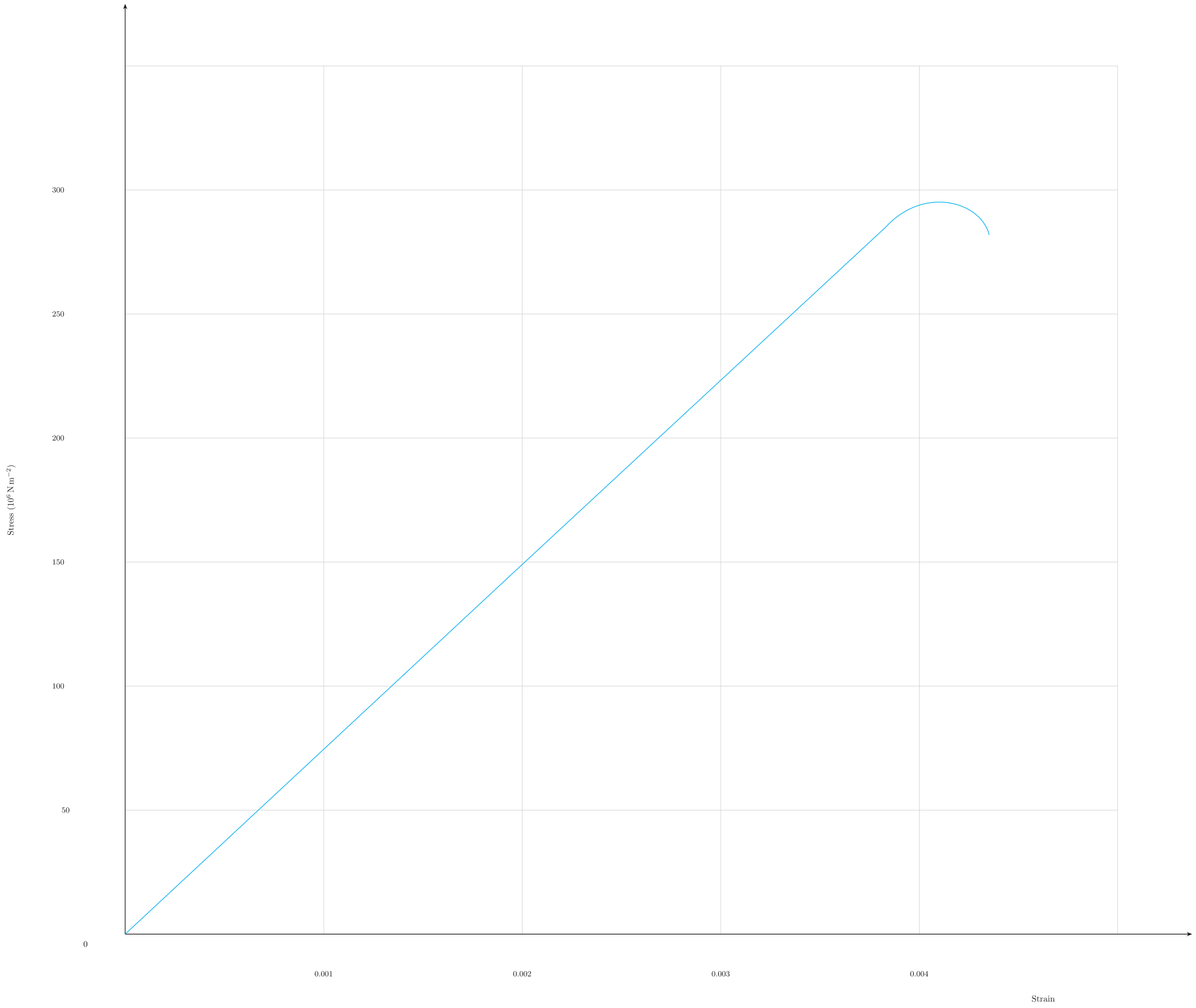
Q.Figure 8.9 shows the strain-stress curve for a given material. What are
Concept understanding — Youngs Modulus
Young’s Modulus: The Stretchiness of a Solid
When you pull on a rubber band, it stretches easily. When you pull on a steel rod of the same size, it barely moves. Both are elastic — they return to their original shape when you let go — but they resist stretching very differently. Young’s modulus is the number that tells you exactly how much a material resists being stretched or compressed lengthwise.
The Intuition: Stiffness per Unit Size
Think of a spring. A stiff spring requires a large force to stretch it a little. A soft spring stretches a lot with a small force. Young’s modulus is like the “stiffness” of a material, but it’s cleverly designed to be independent of the object’s shape and size.
If you take a thick steel rod and a thin steel wire of the same length, the rod is harder to stretch. That’s because you’re pulling on more material. Young’s modulus removes this size effect — it tells you the stiffness of the material itself, not the particular piece you’re holding.
The Precise Definition
Young’s modulus (E or Y) is defined as the ratio of tensile stress to tensile strain, as long as the material obeys Hooke’s law (the deformation is reversible and proportional to the force).
Y=Tensile StrainTensile Stress
Let’s break down the two parts.
Tensile Stress (σ) is the force per unit area. If you pull with a force F on a rod of cross-sectional area A, the stress is:
σ=AF
Stress has units of pressure — pascals (Pa) or N/m2. It tells you how “intense” the pulling is, regardless of the rod’s thickness.
Tensile Strain (ε) is the fractional change in length. If the original length is L0 and it stretches by ΔL, the strain is:
ε=L0ΔL
Strain is a pure number — it has no units. A strain of 0.01 means the rod stretched by 1% of its original length.
Putting it together:
Y=ΔL/L0F/A=AΔLFL0
What the Number Tells You
A high Young’s modulus means the material is very stiff — it takes a huge stress to produce even a tiny strain. Steel has Y≈200×109 Pa. A low Young’s modulus means the material is easily stretched. Rubber has Y≈0.01×10⁹ Pa — about 20,000 times smaller than steel.
Young’s modulus is only valid in the elastic region — where the material returns to its original shape after the force is removed. If you stretch too far (past the elastic limit), the material deforms permanently or breaks, and Young’s modulus no longer applies.
A Worked Example
A steel wire of length 2.0 m and cross-sectional area 1.0×10⁻⁶ m2 is pulled by a force of 100 N. How much does it stretch? (Young’s modulus of steel = 2.0×10¹¹ Pa)
From Y=AΔLFL0, rearrange:
ΔL=AYFL0=(1.0×10−6)×(2.0×1011)100×2.0=2.0×105200=1.0×10⁻³ m=1.0 mm
The wire stretches by just 1 mm. If you tried the same with a rubber band of the same dimensions (Y≈107 Pa), the stretch would be about 20,000 times larger — 20 metres! (Of course, a real rubber band would break long before that.)
Key Points for Exams
- Young’s modulus is a material property — it doesn’t depend on the object’s length or thickness.
- It applies only to axial (lengthwise) tension or compression, not to bending or twisting.
- The units are the same as pressure: pascals (Pa) or N/m2.
- For most materials, Young’s modulus is the same in tension and compression (within the elastic limit).
Do not confuse Young’s modulus with stiffness (k=F/ΔL). Stiffness depends on the object’s dimensions (k=YA/L0). Young’s modulus is the intrinsic material property; stiffness is the property of a particular object.
"Youngs Modulus important questions" is a common search among CBSE and competitive-exam aspirants alike, since Youngs Modulus sits squarely within the Mechanical Properties of Solids coverage of NCERT Class 11 Physics, so it is fair game for both CBSE board questions and competitive-exam numericals. Pairing this explanation with NCERT Physics textbook practice and previous years' questions is the surest way to lock the concept in before an exam.
The slope of the straight part of the stress-strain graph is Young's modulus, and the stress where the line bends over is the yield strength.
Using a point on the linear region, strain 0.002 with stress 150×106 N m−2: Y=0.002150×106=7.5×10¹⁰ N m−2. The curve stops being linear and levels off near a stress of 300×106 N m−2.
- Y≈7.5×10¹⁰ N m−2.
- Yield strength ≈3×10⁸ N m−2 (i.e. 300×106 N m−2).
Young's modulus is the slope of the straight (proportional) part of the stress-strain graph, and the yield strength is the stress at which the curve stops being linear and begins to level off. Reading the graph gives Y≈7.5×10¹⁰ N m−2 and a yield strength of about 3×10⁸ N m−2.
Concept
In the initial straight portion of a stress-strain curve, stress is proportional to strain (Hooke's law). The constant of proportionality is Young's modulus, Y=strainstress, which equals the slope of that straight line. The yield strength is the stress at the point where the curve departs from the straight line and the material begins to deform permanently.
(a) Young's modulus
Take a point on the straight region: at strain ε=0.002 the stress is σ=150×106 N m−2.
Y=εσ=0.002150×106=7.5×10¹⁰ N m−2.
Any other point on the line gives the same value, e.g. 225×106/0.003=7.5×1010.
(b) Yield strength
The curve stays straight up to a strain of about 0.003 and then bends over, flattening near a maximum stress of about 300×106 N m−2. The stress at which this non-linear (plastic) behaviour sets in is the yield strength:
σy≈300×106=3×10⁸ N m−2.
- Y≈7.5×10¹⁰ N m−2.
- Approximate yield strength ≈3×10⁸ N m−2 (300×106 N m−2).
Step 1: identify the linear (Hooke's law) portion. Step 2: Y=slope=(150e6)/0.002=7.5e10 N/m^2. Step 3: yield strength read at the point curve stops being straight, ~3e8 N/m^2.
Showing the 12 most recent of 55 on this concept.
- CBSE 2026Set ANNUAL1 markMCQQ.Among the following, the material with the highest elasticity is :(1) Copper(2) Aluminium(3) Brass(4) Steel
›Reveal solutionSolution
Elasticity is measured by the modulus of elasticity (e.g. Young's modulus): the higher the modulus, the more elastic the material (the smaller the strain for a given stress, and the more completely it returns to its original shape).
Typical Young's modulus values (approximate, standard NCERT comparison): steel is markedly stiffer/more elastic than copper, brass, or aluminium — steel deforms the least under a given stress and recovers its shape most completely, so among Copper, Aluminium, Brass and Steel, steel has the highest elasticity. This is also why steel is preferred for structural applications (bridges, machine parts) needing minimal, fully-recoverable deformation.
✓Final answer(4) Steel has the highest elasticity among the given materials.
- CBSE 2026Set ANNUAL1 markMCQQ.Which of the following materials is most elastic?(a) Steel(b) Rubber(c) Copper(d) Glass
›Reveal solutionSolution
"More elastic" means better at returning to the original shape/size after a deforming force is removed -- steel does this more effectively (higher Young's modulus, closer to ideal elastic behaviour under normal loads) than rubber, which is often mistakenly assumed to be "more elastic" just because it stretches a lot.
Elasticity is the property of a material to regain its original shape and size after the removal of a deforming force -- it is NOT the same as flexibility or how much a material can stretch.
Steel has a very high Young's modulus, meaning for a given stress it strains very little, and importantly, it returns almost completely to its original dimensions when the stress is removed (within its elastic limit). Rubber, though it can stretch a great deal, shows more internal energy loss (hysteresis) and does not restore its original shape as precisely or as strongly resist deformation -- rubber is more "flexible"/extensible, but steel is considered the MORE elastic material in the standard physics sense taught in this chapter (this is the classic NCERT comparison: "steel is more elastic than rubber").
✓Final answer(a) Steel.
- CBSE 2026Set ANNUAL1 markMCQQ.The restoring force per unit area is known as(a) strain(b) elasticity(c) stress(d) plasticity
›Reveal solutionSolution
Stress = restoring force / area, by definition.
When a deforming force is applied to a body, internal restoring forces develop within it that try to bring it back to its original shape. The magnitude of this internal restoring force, per unit cross-sectional area, is called STRESS:
Stress = Restoring force / Area
Strain, by contrast, is the fractional change in dimension (deformation) caused by the stress, not a force-per-area quantity. Elasticity is the property of resisting/recovering from deformation, and plasticity is the opposite property (permanent deformation) -- neither is itself defined as "force per unit area."
✓Final answer(c) stress.
- CBSE 2026Set ANNUAL1 markQ.............. law states that stress is directly proportional to strain.
›Reveal solutionSolution
The proportionality between stress and strain, within the elastic limit, is Hooke's Law.
When a solid material is deformed by an external force, the internal restoring force per unit area is called stress, and the fractional change in dimension (length, volume, or shape) is called strain. For small deformations — within the material's elastic limit — experiments show stress is directly proportional to strain:
stress∝strain⇒stress=k×strain
where the proportionality constant k is called the modulus of elasticity (e.g. Young's modulus for longitudinal stress/strain). This law was first stated by Robert Hooke and hence bears his name.
✓Final answerHooke's Law states that stress is directly proportional to strain (within the elastic limit).
- CBSE 2026Set ANNUAL1 markQ.What is Young's Modulus of a rigid body?
›Reveal solutionSolution
Since Y=stress/strain and a rigid body has zero strain for any stress, Y→∞.
Young's modulus is defined as:
Y=longitudinal strainlongitudinal stress
A 'rigid body' is, by definition, a body whose shape and size do not change no matter how large a force (stress) is applied — its strain is always exactly zero. Substituting strain =0 into the formula makes the ratio undefined in the finite sense, i.e. it tends to infinity: a rigid body needs an infinitely large force to produce even the smallest deformation, so we say its Young's modulus is infinite.
✓Final answerYoung's Modulus of a (perfectly) rigid body is infinite.
- CBSE 2026Set ANNUAL1 markMCQQ.The Young's Modulus for a perfect rigid body is:(a) 0.5(b) zero(c) infinity(d) 1
›Reveal solutionSolution
Young's modulus is stress divided by strain; a perfectly rigid body has zero strain for any stress (it never deforms), so its Young's modulus is infinite.
Young's modulus is defined as
Y = (longitudinal stress)/(longitudinal strain) = (F/A)/(deltaL/L)
A 'perfectly rigid body' is an idealization in which the body does not change its shape or size at all, no matter how large a force (stress) is applied — that is, deltaL = 0 always, so strain = deltaL/L = 0.
Since Y = stress/strain, and the denominator (strain) is zero for any non-zero stress, the ratio tends to infinity. This is consistent with the physical idea that a perfectly rigid body requires an infinitely large modulus to resist any deformation whatsoever — no real material achieves this exactly, but it is a useful idealization.
✓Final answerThe correct option is (c) infinity — since strain is zero for a perfectly rigid body, Y = stress/strain is infinite.
- CBSE 2026Set ANNUAL1 markMCQQ.Substances like tissue of aorta, rubber etc. which can be stretched to cause large strain are called -(a) elastic substances(b) Inelastic substances(c) elastomer substances(d) brittle substances
›Reveal solutionSolution
Materials that show a large elastic (recoverable) strain for a given stress, without obeying Hooke's law over most of that range, are called elastomers.
Most elastic materials, like steel, obey Hooke's law and can only sustain small strains (typically under 1%) before permanent deformation. Elastomers — such as rubber and the elastic tissue found in blood vessels like the aorta — are a special class of elastic substances that can be stretched to very large strains (several hundred percent) while still recovering their original shape when the deforming force is removed. Their stress-strain curve is markedly non-linear, unlike Hookean solids.
This is distinct from (a) generic 'elastic substances' (too broad — the question specifically wants the term for large-strain elastic materials), (b) inelastic substances (which do not recover their shape at all), and (d) brittle substances (which fracture at small strain, e.g., glass).
✓Final answerThe correct option is (c) elastomer substances.
- CBSE 2026Set ANNUAL1 markQ.Fill in the blank: The ratio of lateral strain to the longitudinal strain in a stretched wire is called ____.
›Reveal solutionSolution
The ratio of lateral strain to longitudinal strain in a stretched wire is called Poisson's ratio.
When a wire of original length L and diameter D is stretched by a longitudinal force, it becomes longer (longitudinal strain = ΔL/L) and simultaneously its diameter decreases slightly (lateral strain = ΔD/D). For a given material, within the elastic limit, the ratio of these two strains is constant:
σ (Poisson's ratio) = lateral strain / longitudinal strain = (ΔD/D) / (ΔL/L)
It is a dimensionless quantity (a pure ratio) and for most engineering materials lies between about 0.2 and 0.4.
✓Final answerPoisson's ratio (denoted σ or μ).
- CBSE 2026Set ANNUAL1 markMCQQ.The unit of Young's modulus of elasticity is(a) N/m^2(b) N-m^2(c) joule (J)(d) unitless
›Reveal solutionSolution
Young's modulus has the unit N/m^2 (pascal). Answer (A).
Young's modulus Y = (longitudinal stress)/(longitudinal strain).
Stress = force/area, unit N/m^2. Strain = change in length/original length, which is a pure number (no unit).
Therefore Y has the same unit as stress: N/m^2 (which is the pascal, Pa).
✓Final answer(A) N/m^2.
- CBSE 2026Set ANNUAL1 markMCQQ.The Young's modulus of a perfectly rigid body is(a) zero(b) 1(c) infinite(d) between zero and one
›Reveal solutionSolution
A perfectly rigid body has zero strain, giving infinite Young's modulus. Answer (C).
Y = stress/strain. A perfectly rigid body cannot be deformed, so no matter how much stress is applied, the strain remains zero.
Dividing a finite stress by zero strain gives an infinitely large modulus. Hence a perfectly rigid body has infinite Young's modulus.
✓Final answer(C) infinite.
- CBSE 2026Set ANNUAL1 markMCQQ.Elastic potential energy in a stretched wire is(a) 1/2 × stress × strain(b) 1/2 × stress × strain^2(c) 1/2 × stress × strain × volume of the wire(d) 1/2 × stress × strain^2 × volume of the wire
›Reveal solutionSolution
Elastic PE = ½ x stress x strain x volume. Answer (C).
The energy stored per unit volume (energy density) in a stretched wire is u = ½ x stress x strain.
Multiplying by the volume of the wire gives the total elastic potential energy:
U = ½ x stress x strain x volume.
✓Final answer(C) 1/2 x stress x strain x volume of the wire.
- CBSE 2026Set ANN1 markQ.Steel is more elastic than rubber. (True / False)
›Reveal solutionSolution
True: steel is more elastic than rubber because it regains its shape with a much larger restoring stress (higher Young's modulus).
In physics, a material is more elastic if it develops a greater restoring force (stress) for a given deformation (strain) and returns more exactly to its original shape when the load is removed. Elasticity is measured by the modulus of elasticity (Young's modulus): the larger the modulus, the more elastic the material.
For the same applied stress, steel stretches only slightly while rubber stretches a great deal, so steel's Young's modulus is far higher than rubber's. Therefore steel is more elastic than rubber (a common surprise, since rubber merely deforms more easily - which is not the same as being more elastic).
✓Final answerTrue.
🎓Unlock everything free for 14 days
- ✓Full step-by-step solutions
- ✓Concept-first explanations
- ✓Methods, shortcuts & mistakes
- ✓PYQ mapping + timed mock tests
Full access for 14 days. No credit card required.