Q.A passenger arriving in a new town wishes to go from the station to a hotel located 10 km away on a straight road from the station. A dishonest cabman takes him along a circuitous path 23 km long and reaches the hotel in 28 min. What is
🔒You're viewing a preview — the full solution, concept, methods & PYQ mapping are locked.
🔒 Start your 14-day free trial to unlock the full solution →Concept understanding — Average Speed vs Velocity
Average Speed vs Velocity: The Intuition First
Imagine you're walking home from school. You take a shortcut through a park, then stop to buy a snack, then realise you forgot something and run back a bit, then finally walk home. By the time you reach your front door, you've walked a total of 2 km — but your house is only 500 metres from school in a straight line.
That difference — between the total ground you covered and how far you actually ended up from where you started — is the entire point of speed vs velocity.
The Precise Definitions
Average speed is a measure of how fast something is moving overall. It cares only about the total distance travelled, not the direction.
Average speed=Total time takenTotal distance travelled
Average velocity is a measure of how fast and in what direction something is moving overall. It cares about the net displacement — the straight-line distance from start to finish, with a direction.
Average velocity=Total time takenDisplacement
Displacement is the straight-line distance from the starting point to the ending point, with a direction. Distance is the total length of the actual path travelled, with no direction.
The Key Difference in One Sentence
Speed is a scalar (just a number, like 5 km/h). Velocity is a vector (a number and a direction, like 5 km/h north).
That one word — direction — changes everything.
A Concrete Example
You walk 3 km east, then 4 km north. The whole trip takes 1 hour.
- Total distance travelled = 3 + 4 = 7 km
- Displacement = straight line from start to finish = 32+42=5 km, northeast
Now compute:
Average speed=1 h7 km=7 km/h
Average velocity=1 h5 km, northeast=5 km/h, northeast
A common mistake: students think average velocity is just "speed with direction". It's not. It's displacement divided by time, not distance divided by time. If you walk in a circle and return to your starting point, your displacement is zero — so your average velocity is zero, even though your average speed is positive.
When Are They Equal?
Only when the motion is in a straight line without changing direction. If you walk 2 km east in a straight line, then distance = displacement, so average speed = magnitude of average velocity.
But the moment you turn, or stop, or go backwards — they diverge.
Why This Matters for Exams
In Indian board exams (CBSE, ICSE, state boards), you will be asked to:
- Distinguish between speed and velocity (scalar vs vector)
- Calculate average speed and average velocity from given data …
Concept: Average speed depends on total distance traveled; average velocity depends on net displacement.
The taxi covers a distance of 23 km along the actual (circuitous) path, but the displacement—the straight-line separation between station and hotel—is only 10 km. Time taken is 28 min=6028 h=157 h.
- Average speed = timetotal distance=15723=23×715=7345≈49.3 km/h.
- Magnitude of average velocity = timedisplacement=15710=10×715=7150≈21.4 km/h. …
Average speed depends on the actual path travelled (23km), while average velocity depends only on the net displacement (10km). They differ: the taxi's average speed is ≈49.3km/h and the magnitude of average velocity is ≈21.4km/h.
Why average speed and average velocity differ
Speed is a scalar—it cares only about how much ground you cover, regardless of direction. Velocity is a vector—it cares about where you end up relative to where you started. When a path is not straight, the distance travelled exceeds the straight-line displacement, so average speed will be larger than the magnitude of average velocity.
In this problem, the cabman takes a winding 23km route to cover a straight-line distance of only 10km. The passenger pays for the longer journey, but physically he's displaced by much less.
Step-by-step solution
1. Convert the time to consistent units
The journey takes 28min. Since speeds are typically expressed in km/h, convert:
t=28min=6028h=157h
2. Calculate the average speed
Average speed is defined as the total distance travelled divided by the total time:
vavg, speed=timetotal distance=157h23km=23×715=7345km/h≈49.3km/h
3. Calculate the magnitude of average velocity
Average velocity is defined as the displacement (straight-line distance from start to finish) divided by time. The hotel is 10km from the station along a straight road, so the displacement is 10km:
∣vavg∣=timedisplacement=157h10km=10×715=7150km/h≈21.4km/h
4. Compare the two …
Concept: Work Entirely in SI Units First, Convert to km/h Only at the End
Method: Metres-and-Seconds Route (No Fractional Hours), Using the ×3.6 Shortcut Last
Both existing solutions convert the 28 min trip time into a fraction of an hour (7/15 h) and keep every calculation in kilometres and hours throughout. This method instead converts everything to base SI units (metres, seconds) first, computes both speeds cleanly in m/s, and only converts to km/h as the very last step — avoiding fractional-hour arithmetic entirely.
Step 1 — Convert every given quantity to SI units
distance travelled=23 km=23,000 m,displacement=10 km=10,000 m
time=28 min=28×60 s=1680 s
Step 2 — Average speed, directly in m/s
vavg,speed=1680 s23,000 m≈13.69 m/s
Step 3 — Magnitude of average velocity, directly in m/s
∣vavg∣=1680 s10,000 m≈5.95 m/s
Step 4 — Convert both to km/h in one shot, at the very end
The conversion factor from m/s to km/h is exactly 3.6 (i.e. ×518):
13.69 m/s×3.6=49.3 km/h,5.95 m/s×3.6=21.4 km/h
matching 7345≈49.3 km/h and 7150≈21.4 km/h exactly.
Step 5 — Compare …
Showing the 12 most recent of 15 on this concept.
- AP EAPCET 2026Set eng-2026-05-12-AN1 markMCQQ.A motorist completes half revolution on a circular path of 60 m radius in one minute. His average speed (A) 1 ms−1 (B) 2 ms−1 (C) 3.14 ms−1 (D) 4.14 ms−1
›Reveal solutionSolution
Average speed uses the actual path length travelled (the arc), not the straight-line displacement. Half a revolution covers πr, giving average speed π≈3.14 m/s.
Concept and Intuition
Average speed is distance travelled divided by time elapsed — it does not care about direction, unlike average velocity (which would use the displacement, i.e., the diameter here, and give a much smaller value). For half a revolution, the path length is half the circumference.
Step-by-Step Solution
- Circumference of the circular path: 2πr=2π(60)=120π m.
- Half revolution ⇒ arc length travelled =2120π=60π m ≈188.5 m.
- Time taken =1 minute =60 s. …
- AP EAPCET 2026Set eng-2026-05-18-FN1 markMCQQ.A Car travels first half of the distance with a velocity 'V' and second half of the distance with a velocity '3V', then the average velocity is (A) 2.0 V (B) 3.0 V (C) 4.0 V (D) 1.5 V
›Reveal solutionSolution
Average velocity over two equal distances (not equal times) at speeds V and 3V is the harmonic-mean-like combination v1+v22v1v2=1.5V.
Concept and Intuition
Average velocity is total displacement divided by total time — not the arithmetic mean of the two speeds, because the car spends more time at the slower speed. For equal distances d at speeds v1,v2, the total distance is 2d and total time is d/v1+d/v2.
Step-by-Step Solution
- Let total distance be 2d; first half d at speed V, second half d at speed 3V.
- Time for first half: t1=d/V. Time for second half: t2=d/(3V).
- Total time: t1+t2=Vd+3Vd=3V3d+d=3V4d. …
- AP EAPCET 2025Set eng-2025-05-21-FN1 markMCQQ.If a car travels 40% of the total distance with a speed v1 and the remaining distance with a speed v2, then average speed of the car is (A) 21v1v2 (B) 2v1+v2 (C) v1+v22v1v2 (D) 3v1+2v25v1v2
›Reveal solutionSolution
This tests the formula for average speed as total distance over total time, not a simple average of speeds; the answer is (D).
Concept and Intuition
Average speed is never the arithmetic mean of two speeds unless the times (not distances) spent at each speed are equal. When distances (or fractions of distance) are given instead, you must add up the actual times taken for each segment.
Step-by-Step Solution
- Let total distance be D. First segment: 0.4D at speed v1, taking time t1=v10.4D.
- Second segment: remaining 0.6D at speed v2, taking time t2=v20.6D.
- Average speed =total timetotal distance=t1+t2D=v10.4D+v20.6DD=v10.4+v20.61.
- Combine the fractions: v10.4+v20.6=v1v20.4v2+0.6v1. …
- AP EAPCET 2025Set eng-2025-05-21-AN1 markMCQQ.A car is moving with a velocity of 4 ms−1 towards east. After a time of 4 s, if it is heading north-east with a velocity of 42 ms−1, then the average velocity of the car is (A) 25 ms−1 (B) 35 ms−1 (C) 43 ms−1 (D) 53 ms−1
›Reveal solutionSolution
Under constant acceleration, average velocity is the vector average of the initial and final velocities, (v1+v2)/2. Computing this vector sum gives (A) 25 m/s.
Concept and Intuition
For a body under constant acceleration a, displacement is s=v1t+21at2, and average velocity is vavg=s/t=v1+21at. Since v2=v1+at, we can write 21at=21(v2−v1), so vavg=v1+21(v2−v1)=2v1+v2. This vector identity holds even though the direction of velocity changes, as long as the acceleration is constant.
Step-by-Step Solution
- Set up axes: east =i^, north =j^.
- Initial velocity: v1=4i^ ms−1 (due east).
- Final velocity: north-east means 45° between east and north, so v2=42(cos45∘i^+sin45∘j^)=42(22i^+22j^)=4i^+4j^.
- Average velocity =2v1+v2=2(4+4)i^+(0+4)j^=4i^+2j^. …
- AP EAPCET 2025Set ap-2025-05-20-FN1 markMCQQ.A body moving along a straight line path travels first 10 m distance in a time of 3 seconds and the next 10 m distance with a velocity of 5 ms−1. The average velocity of the body is (A) 4 kmph (B) 10.6 kmph (C) 18.2 kmph (D) 14.4 kmph
›Reveal solutionSolution
Total distance 20 m over total time 5 s gives average velocity 4 m/s, which converts to 14.4 km/h. Answer: (D).
Concept and Intuition
Average velocity over a whole journey is always total displacement divided by total time, not simply an average of the different speeds used in each part. Whenever a journey is split into segments each with their own speed or time, the correct approach is to work out the time (or distance) for each segment separately, sum them, and only then divide.
Step-by-Step Solution
- First segment: distance =10 m, time =3 s (given directly).
- Second segment: distance =10 m, travelled at 5 ms−1, so time =510=2 s.
- Total distance =10+10=20 m.
- Total time =3+2=5 s.
- Average velocity =total timetotal distance=520=4 ms−1. …
- AP EAPCET 2025Set eng-2025-05-23-AN1 markMCQQ.A particle moving along a straight line covers the first half of the distance with a speed of 3 ms−1, the other half of the distance is covered in two equal time intervals with speeds of 4.5 ms−1 and 7.5 ms−1 respectively, then the average speed of particle during the motion is (A) 4.0 ms−1 (B) 5.0 ms−1 (C) 5.5 ms−1 (D) 4.8 ms−1
›Reveal solutionSolution
This tests computing average speed as total distance divided by total time, carefully handling a first half defined by distance and a second half defined by equal time intervals. The average speed is 4.0 m/s, option (A).
Concept and Intuition
Average speed is always total timetotal distance — never a simple average of the individual speeds unless the time intervals happen to be equal for all segments. Here the first half of the distance takes one particular time, while the second half of the distance is split into two equal time intervals at different speeds; we must find the time taken for each part separately using t=speeddistance or the given time-split information, then add them up.
Step-by-Step Solution
- Let the total distance be 2d, so each half is d.
- First half: distance d at speed 3 m/s, so time t1=3d.
- Second half: distance d covered in two equal time intervals τ each, at speeds 4.5 m/s and 7.5 m/s. So distance covered =4.5τ+7.5τ=12τ=d⇒τ=12d.
- Total time for second half =2τ=6d. …
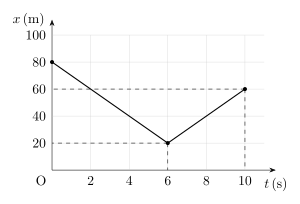
- AP EAPCET 2025Set eng-2025-05-26-AN1 markMCQQ.The displacement(x) and time (t) graph of a particle moving along a straight line is shown in the figure. The average velocity of the particle in the time of 10 s is [FIGURE] (a graph of x(m) vs t(s): the line starts at x = 80 m at t = 0, decreases linearly to x = 20 m at t = 6 s, then increases linearly to x = 60 m at t = 10 s) (A) 2 ms−1 (B) 4 ms−1 (C) 6 ms−1 (D) 8 ms−1
›Reveal solutionSolution
Average velocity is net displacement over total time — the intermediate dip in the graph doesn't matter. Answer: 2 m/s.
Concept and Intuition
A common trap is to try to add up distances covered on each segment of the V-shaped graph. But average velocity (as opposed to average speed) only cares about the straight-line displacement between the initial and final positions and the total elapsed time.
Step-by-Step Solution
- From the graph: at t=0, x=80 m; at t=10 s, x=60 m.
- Net displacement =x(10)−x(0)=60−80=−20 m.
- Average velocity =ΔtΔx=10−20=−2 ms−1.
- The magnitude of average velocity is 2 ms−1.
Common Mistakes …
- AP EAPCET 2023Set eng-2023-05-17-AN1 markMCQQ.If a person moving along a straight line path covers first half distance with velocity 'V1' and the next half distance with velocity 'V2', then the average velocity of the person is (A) 2V1+V2 (B) 2V1V2V1+V2 (C) V11+V212 (D) V1+V2V1V2
›Reveal solutionSolution
Equal distances covered at different speeds average to the harmonic mean of the speeds, not the arithmetic mean — here that harmonic mean simplifies to option (D).
Concept and Intuition
Averaging speeds is only a simple arithmetic mean when the times spent at each speed are equal. When instead the distances are equal (as here — 'first half distance', 'next half distance'), the body spends more time at the slower speed, which pulls the average down toward the smaller value. This is exactly the situation that produces a harmonic mean rather than an arithmetic mean.
Step-by-Step Solution
- Let the total distance be 2s, so each half is s.
- Time for the first half: t1=V1s.
- Time for the second half: t2=V2s.
- Average velocity =total timetotal distance=V1s+V2s2s=V11+V212=V1+V22V1V2. …
- AP EAPCET 2022Set ap-2022-07-12-AN1 markMCQQ.A person is running with an uniform velocity towards a flyover. He takes 5 s to reach the flyover from a reference point and takes 50 s to cross the flyover from the same reference point. If the length of the flyover is 1000 m then his velocity is nearly (A) 83.1 kmph (B) 80.0 kmph (C) 75.4 kmph (D) 85.2 kmph
›Reveal solutionSolution
Both given times are measured from the same reference point, so the time spent actually crossing the flyover is the difference of the two times, not either one directly.
Concept and Intuition
The person moves at constant (uniform) velocity throughout. "Reaching the flyover" and "crossing the flyover" are both timed from the same starting reference point, so:
- t1=5 s: time to reach the start of the flyover.
- t2=50 s: time to reach the end of the flyover (i.e., to have crossed it), from the same reference point.
The actual time spent traversing the flyover's length is t2−t1.
Step-by-Step Solution
- Time to cross the flyover =t2−t1=50−5=45 s.
- Length of flyover =1000 m. …
- AP EAPCET 2022Set eng-2022-07-04-FN1 markMCQQ.A car covers a distance at speed of 60 kmh−1. It returns and comes back to the original point moving at a speed of V. If the average speed for the round trip is 48 kmh−1, then the magnitude of V is (A) 40 kmh−1 (B) 36 kmh−1 (C) 44 kmh−1 (D) 32 kmh−1
›Reveal solutionSolution
For equal-distance round trips at two speeds, average speed is the harmonic mean, not the arithmetic mean; solving gives V=40 kmh−1.
Concept and Intuition
Average speed = total distance / total time. For a trip covering the same distance d each way at speeds v1 and v2, total time =v1d+v2d, and total distance =2d, giving vˉ=v1+v22v1v2 — the harmonic mean, always less than the arithmetic mean.
Step-by-Step Solution
- Let distance one-way be d. Time going =d/60, time returning =d/V.
- Average speed =d/60+d/V2d=601+V12=60+V2⋅60V.
- Set this equal to 48: 60+V120V=48.
- 120V=48(60+V)=2880+48V. …
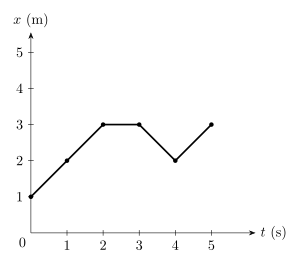
- AP EAPCET 2022Set eng-2022-07-06-FN1 markMCQQ.A particle moves along a straight line along the x-axis. Its position(x) versus time (t) graph is shown in the figure [x in meters and t in seconds]. It's average speed during this motion is [FIGURE] (x-t graph: (0,1) to (1,2) to (2,3) to (3,3) to (4,2) to (5,3), straight line segments) (A) 0.4 ms−1 (B) 1.0 ms−1 (C) 0.8 ms−1 (D) 0.6 ms−1
›Reveal solutionSolution
Average speed uses total distance (always positive, path length), not net
displacement — read the distance off each segment of the x-t graph and divide
by the total time.
Concept and Intuition
On an x-t graph, the slope of each segment is the velocity during that
interval, but average speed cares only about how much ground was actually
covered — direction reversals still add positively to the distance. So we must
look at each of the five 1-second segments individually and add up
∣Δx∣ for each, rather than just taking ∣x(5)−x(0)∣.
Step-by-Step Solution
- Read the vertices from the graph: (0,1)→(1,2)→(2,3)→(3,3)→(4,2)→(5,3).
- Segment 1 (t=0→1): x:1→2, distance =1 m (motion in +x).
- Segment 2 (t=1→2): x:2→3, distance =1 m (motion in +x).
- Segment 3 (t=2→3): x:3→3, distance =0 (particle momentarily at rest).
- Segment 4 (t=3→4): x:3→2, distance =1 m (motion reverses, in −x).
- Segment 5 (t=4→5): x:2→3, distance =1 m (motion in +x again).
- Total distance =1+1+0+1+1=4 m. Total time =5 s. …
- AP EAPCET 2022Set eng-2022-07-07-FN1 markMCQQ.A biker travels 31 of the distance L with speed v1 and 32 of the distance with speed v2. Then the average speed is (A) v1+v2v1v2 (B) 2v1+v23v1v2 (C) v1+2v23v1v2 (D) v1v2v1+v2
›Reveal solutionSolution
Average speed = total distance / total time; working through the two legs gives 2v1+v23v1v2.
Concept and Intuition
Average speed over a trip with different speeds on different legs is NOT the simple average of the speeds — it must be computed as total distance divided by total time, weighting by how long each leg actually takes.
Step-by-Step Solution
- First leg: distance =L/3, speed =v1, so time t1=3v1L.
- Second leg: distance =2L/3, speed =v2, so time t2=3v22L.
- Total time =t1+t2=3v1L+3v22L=3L(v11+v22)=3v1v2L(v2+2v1). …
🎓Unlock everything free for 14 days
- ✓Full step-by-step solutions
- ✓Concept-first explanations
- ✓Methods, shortcuts & mistakes
- ✓PYQ mapping + timed mock tests
Full access for 14 days. No credit card required.