Q.For any arbitrary motion in space, which of the following relations are true:
🔒You're viewing a preview — the full solution, concept, methods & PYQ mapping are locked.
🔒 Start your 14-day free trial to unlock the full solution →Concept understanding — Kinematics Vector Differentiation
Kinematics Vector Differentiation
Imagine you're tracking a drone flying in the sky. At any instant, it has a position — say, 30 metres east and 40 metres north of you. That's a vector: r=30i^+40j^. A second later, it's moved. The question kinematics asks is: how fast is that position changing? That rate of change is velocity, and to get it, you differentiate the position vector.
But here's the key difference from school calculus: in school, you differentiated a scalar function like y=x2. Here, you're differentiating a vector function — something that has both magnitude and direction, and both can change with time.
The Intuition First
Think of a vector as an arrow. When time passes, that arrow can do two things:
- It can get longer or shorter (magnitude changes).
- It can rotate (direction changes).
Velocity is the total rate of change of that arrow. If the drone flies straight away from you, only the length changes. If it flies in a circle around you, only the direction changes. Most real motion does both.
So vector differentiation is just: take the derivative of each component separately, because components are independent scalars.
The Precise Statement
If a position vector is written in Cartesian coordinates as:
r(t)=x(t)i^+y(t)j^+z(t)k^
where i^,j^,k^ are fixed unit vectors (they don't change direction with time), then:
dtdr=dtdxi^+dtdyj^+dtdzk^
That's it. You differentiate each component function x(t),y(t),z(t) exactly as you would in single-variable calculus, and the unit vectors stay put.
dtd(f(t)u^)=dtdfu^(if u^ is constant)
Why This Works
The derivative of a vector is defined the same way as for a scalar — as a limit:
dtdr=limΔt→0Δtr(t+Δt)−r(t)
The numerator is a vector difference. When you write r in components, the difference splits into component differences. The limit then acts on each component separately because the unit vectors are constant. So the definition forces component-wise differentiation.
A Concrete Example
A particle moves such that:
r(t)=(3t2)i^+(5sint)j^+(2e−t)k^
Its velocity is:
v(t)=dtdr=(6t)i^+(5cost)j^+(−2e−t)k^
Notice: the x-component grows linearly, the y-component oscillates, the z-component decays. Each derivative is just the ordinary derivative of that component's function.
The One Trap: Non-Constant Unit Vectors
The rule above assumes i^,j^,k^ are fixed. That's true in Cartesian coordinates. But in polar coordinates, the unit vectors r^ and θ^ rotate as the particle moves. Differentiating a vector in polar coordinates requires the product rule because the unit vectors themselves depend on time. …
Concept: Kinematics Vector Differentiation — The definitions of average velocity and acceleration are universal; the other relations assume constant acceleration.
Step 1 — Definitions that always hold
By definition, average velocity is total displacement divided by total time, and average acceleration is total change in velocity divided by total time.
So (b) and (e) are always true for any motion.
Step 2 — Relations that require constant acceleration
The formula v(t)=v(0)+at and r(t)=r(0)+v(0)t+21at2 are derived assuming a is constant. For arbitrary motion, acceleration may vary, so (c) and (d) are false in general. …
For arbitrary (general) motion, only the definitional relations hold: (b) and (e). The others assume constant acceleration or uniform motion, which is not guaranteed for arbitrary motion.
The key is to separate definitions from formulas that assume a specific type of motion. In kinematics, average velocity and average acceleration are defined in terms of the net change in position or velocity over the total time. The other relations — like the arithmetic mean of velocities, or the equations of motion — are only true under special conditions (like constant acceleration).
Let’s examine each statement one by one.
-
Statement (a): vaverage=21(v(t1)+v(t2))
This would be true only if the velocity changes linearly with time (i.e., constant acceleration). For arbitrary motion, velocity can vary in any complicated way — speeding up, slowing down, changing direction — so the average is not simply the arithmetic mean of the endpoints.
Watch outA common mistake is to assume average velocity is always the mean of initial and final velocities. That is only true for uniform acceleration.
False for arbitrary motion.
-
Statement (b): vaverage=t2−t1r(t2)−r(t1)
This is the definition of average velocity. It always holds, regardless of the path or how the motion varies.
vaverage=ΔtΔr is always true by definition.
True for any motion.
-
Statement (c): v(t)=v(0)+at
This is the first equation of motion for constant acceleration. For arbitrary motion, acceleration a itself may change with time, so this linear relation does not hold in general.
NoteIf acceleration is not constant, you would need v(t)=v(0)+∫0ta(τ)dτ, not a simple product.
False for arbitrary motion. …
Concept: Disprove the False Ones with One Concrete Non-Uniform Motion
Method: A Single Explicit Counterexample (r(t)=t3i^, So Acceleration Genuinely Varies) — Numbers, Not General Argument
The existing solutions argue each statement in words (definitions always hold; constant-acceleration formulas don't hold in general). This method instead picks one explicit, concrete non-uniformly-accelerated motion, computes both sides of every relation with real numbers for that motion, and shows directly — by arithmetic mismatch — exactly which relations break down.
Step 1 — Choose a concrete arbitrary (non-uniformly-accelerated) motion
Let r(t)=t3i^ (metres, t in seconds) — deliberately chosen so the acceleration is not constant:
v(t)=dtdr=3t2i^,a(t)=dtdv=6ti^(genuinely varies with t)
Step 2 — Evaluate everything at t1=0 and t2=2 s
r(0)=0,r(2)=8i^;v(0)=0,v(2)=12i^;a(0)=0,a(2)=12i^
Step 3 — Test (b): the definition of average velocity
vavg=2−0r(2)−r(0)=28i^=4i^ m/s
This is definitionally what "average velocity" means — it cannot fail, for any motion. (b) holds.
Step 4 — Test (a): is the average of the endpoint velocities the same number?
21(v(0)+v(2))=21(0+12i^)=6i^ m/s
Compare to the true average velocity from Step 3: 6i^=4i^. Numeric mismatch — (a) is false for this arbitrary motion.
Step 5 — Test (c): does v(t)=v(0)+at hold, using the actual (non-constant) a?
Using the initial acceleration a(0)=0 as "a" in the constant-acceleration formula:
v(2)=?v(0)+a(0)(2)=0+0(2)=0
But the actual v(2)=12i^=0. Numeric mismatch — (c) is false.
Step 6 — Test (d): does r(t)=r(0)+v(0)t+21at2 hold?
r(2)=?0+0(2)+21(0)(2)2=0
But the actual r(2)=8i^=0. Numeric mismatch — (d) is false. …
Showing the 12 most recent of 25 on this concept.
- AP EAPCET 2026Set eng-2026-05-15-FN1 markMCQQ.A particle has initial velocity 2i^+3j^ ms−1 and acceleration 0.8i^+0.6j^ ms−2. Its velocity after 5 sec is (in ms−1) (A) 62 (B) 6 (C) 72 (D) 7
›Reveal solutionSolution
Straightforward kinematics with vectors: add the acceleration's contribution to each component of velocity separately, then find the magnitude.
Concept and Intuition
Since acceleration is constant here, each Cartesian component of velocity evolves independently and linearly in time: vx(t)=v0x+axt and vy(t)=v0y+ayt. There's no need to find a resultant acceleration vector's magnitude/direction first — just apply the equation component-by-component and combine at the end.
Step-by-Step Solution
- Given v0=2i^+3j^ ms−1 and a=0.8i^+0.6j^ ms−2, and t=5s.
- x-component: vx=2+0.8(5)=2+4=6 ms−1.
- y-component: vy=3+0.6(5)=3+3=6 ms−1. …
- AP EAPCET 2026Set ap-2026-05-19-FN1 markMCQQ.A particle initially at rest starts moving from origin along X-axis with velocity 'V' that varies as, V=2x ms−1. The acceleration of the particle in ms−2 is (A) 2 (B) 22 (C) 22 (D) Zero
›Reveal solutionSolution
Using a=vdv/dx on v=2x gives a constant acceleration of
2 ms−2. Answer: (A).
Concept and Intuition
When velocity is given as a function of position (not time), the cleanest way
to get acceleration is the identity a=dtdv=dxdv⋅dtdx=vdxdv. This avoids needing to first invert
v(x) into x(t).
Step-by-Step Solution
- Given v=2x=2x1/2.
- Differentiate w.r.t. x: dxdv=2⋅21x−1/2=x1.
- Apply a=vdxdv=(2x)⋅(x1)=2.
- The x terms cancel exactly, so acceleration is the constant …
- AP EAPCET 2026Set eng-2026-05-18-AN1 markMCQQ.A velocity-time graph is drawn for two different objects. They make 30° and 45° with the time axis. Then the ratio of their accelerations, a1:a2 is (A) 1:2 (B) 2:3 (C) 3:1 (D) 1:3
›Reveal solutionSolution
Acceleration equals the slope of the v–t graph, so a1:a2=tan30°:tan45°=1:3.
Concept and Intuition
On a velocity-time graph, the instantaneous acceleration is dtdv, which is exactly the slope of the graph — and slope equals the tangent of the angle the line makes with the time axis.
Step-by-Step Solution
- a1=tan30°=31
- a2=tan45°=1
- Ratio:
a2a1=11/3=31
- So a1:a2=1:3. …
- AP EAPCET 2026Set eng-2026-05-18-AN1 markMCQQ.A particle of charge 'q' and mass 'm' starts moving from the origin under the action of electric field, E=E0i^ with a velocity v=v0j^. The time taken to increase its velocity to 25v0 is (A) qE0mv0 (B) 2qE0mv0 (C) 2qE03mv0 (D) 2qE05mv0
›Reveal solutionSolution
The field only accelerates the particle along x; the y-velocity stays fixed at v0, so the target speed condition fixes vx=v0/2, giving t=2qE0mv0.
Concept and Intuition
The electric field acts only along i^, so it produces a constant acceleration a=qE0/m purely in the x-direction — exactly like projectile motion, where the y-component of velocity is completely unaffected by a force acting only along x. The particle's speed at any time is found from both components combined via Pythagoras.
Step-by-Step Solution
- Acceleration: a=mqE0, directed along x.
- Velocity components at time t: vx(t)=at=mqE0t, and vy(t)=v0 (unchanged, no force along y).
- Required speed: v=25v0⇒v2=vx2+vy2=45v02. …
- AP EAPCET 2026Set ap-2026-05-20-FN1 markMCQQ.A particle moves with velocity v=at−bt2 where a and b are constants. The acceleration becomes zero at (A) t=a/b (B) t=a/2b (C) t=2a/b (D) t=b/a
›Reveal solutionSolution
Differentiate the given velocity to get acceleration, then find when it vanishes; t=a/2b.
Concept and Intuition
Acceleration is the instantaneous rate of change of velocity. Given v(t) as a function of time, a(t)=dv/dt. Setting a(t)=0 finds the instant the velocity is momentarily stationary (an extremum of v).
Step-by-Step Solution
- v=at−bt2.
- aacc=dtdv=a−2bt.
- Set aacc=0: a−2bt=0⇒t=2ba.
Common Mistakes …
- AP EAPCET 2026Set ap-2026-05-20-AN1 markMCQQ.A particle is moving along a straight line such that its velocity is increasing at 5 ms−1 per meter. When its velocity becomes 20 ms−1 its acceleration is (A) 50 ms−2 (B) 75 ms−2 (C) 100 ms−2 (D) 10 ms−2
›Reveal solutionSolution
A velocity-vs-position relation is turned into acceleration using a=vdv/dx. Answer: (C) 100 ms−2.
Concept and Intuition
When velocity is given as a function of position rather than time, the direct route to acceleration is the chain rule: a=dtdv=dxdv⋅dtdx=vdxdv. This is the standard trick for "velocity increases so much per metre" problems — you never need to know how it depends on time at all.
Step-by-Step Solution
- The statement "velocity is increasing at 5 ms−1 per metre" means dxdv=5 s−1 (constant).
- Use a=vdxdv.
- At the instant v=20 ms−1: a=20×5=100 ms−2. …
- AP EAPCET 2025Set eng-2025-05-22-FN1 markMCQQ.A particle crossing the origin at time t=0, moves in the xy-plane with a constant acceleration 'a' in y-direction. If the equation of motion of the particle is y=bx2 (where b is a constant), then its velocity component in the x-direction is (A) a2b (B) 2ba (C) ba (D) ab
›Reveal solutionSolution
Matching the parabolic path y=bx2 to the kinematic equations of constant-velocity x-motion and constant-acceleration y-motion gives vx=a/2b.
Concept and Intuition
This is projectile-like motion: since acceleration acts only along y, the x-motion is uniform (constant velocity), while y-motion starts from rest and accelerates uniformly. The given trajectory equation y=bx2 must be consistent with both these kinematic equations at every instant t, which pins down vx in terms of a and b.
Step-by-Step Solution
- Since there's no acceleration along x: x=vxt (constant velocity vx).
- Since acceleration a acts along y starting from rest at the origin: y=21at2.
- The trajectory is given as y=bx2. Substitute x=vxt: y=b(vxt)2=bvx2t2. …
- AP EAPCET 2025Set ap-2025-05-19-FN1 markMCQQ.For a particle moving in x-y plane, if at any instant of time 't', (in second) its displacements (in metre) are x=2t2−t and y=4t2−4t, then the velocity of the particle at a time t=1 s is (A) 3 ms−1 (B) 7 ms−1 (C) 1 ms−1 (D) 5 ms−1
›Reveal solutionSolution
Differentiate x(t) and y(t) to get the velocity components, then combine them via the Pythagorean theorem to get the speed. Answer: (D) 5 m/s.
Concept and Intuition
For 2D motion described by position components x(t) and y(t), the instantaneous velocity components are obtained by differentiating each with respect to time: vx=dx/dt, vy=dy/dt. The magnitude (speed) of the velocity vector is then found via ∣v∣=vx2+vy2, exactly as with any 2D vector.
Step-by-Step Solution
- Given: x=2t2−t, so vx=dtdx=4t−1.
- Given: y=4t2−4t, so vy=dtdy=8t−4.
- Evaluate at t=1 s: vx=4(1)−1=3 m/s; vy=8(1)−4=4 m/s.
- Compute the speed: ∣v∣=vx2+vy2=32+42=9+16=25=5 m/s. …
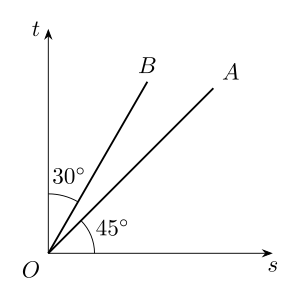
- AP EAPCET 2025Set ap-2025-05-20-AN1 markMCQQ.The displacement (s) - time (t) graphs of two bodies A and B are shown in the figure. The ratio of the velocities of the two bodies A and B is [FIGURE] (a graph with t on the vertical axis and s on the horizontal axis; two straight lines drawn from the origin — line B making a 30° angle with the vertical t-axis, and line A making a 45° angle with the horizontal s-axis) (A) 1:3 (B) 2:3 (C) 3:1 (D) 3:2
›Reveal solutionSolution
On this swapped-axis plot (t vertical, s horizontal), v=ΔtΔs: for A (45∘ to the s-axis) vA=1; for B (30∘ to the t-axis) vB=tan30∘=31; so vA:vB=3:1 -> option (C).
The axes are unusual: time t is on the vertical axis and displacement s on the horizontal axis. Velocity is still v=ΔtΔs = (horizontal change) / (vertical change).
Body A - line at 45∘ to the horizontal s-axis. Measuring from the horizontal, tan45∘=ΔsΔt=1, so
vA=ΔtΔs=1. …
- AP EAPCET 2024Set eng-2024-05-20-AN1 markMCQQ.The relation between time t and displacement x is t=αx2+βx where α and β are constants. If v is the velocity, the retardation is (A) 2αv3β2 (B) 2αβv3 (C) −2βv3 (D) 2αv3
›Reveal solutionSolution
Differentiating t=αx2+βx twice (via v=dx/dt and a=vdv/dx) gives the deceleration as 2αv3 — (D).
Concept and Intuition
When t is given as a function of x (rather than the usual x(t)), it's often easiest to first get v=dx/dt as a function of x by inverting dt/dx, and then use the identity a=vdxdv to find acceleration without ever needing an explicit x(t).
Step-by-Step Solution
- t=αx2+βx⇒dxdt=2αx+β.
- Since v=dtdx, we have v=dt/dx1=2αx+β1.
- Differentiate v with respect to x: dxdv=−(2αx+β)22α=−2αv2 (recognizing (2αx+β)−2=v2).
- Acceleration: a=vdxdv=v⋅(−2αv2)=−2αv3. …
- AP EAPCET 2023Set ap-2023-05-22-FN1 markMCQQ.The distance s (in m) travelled by a particle is given by the expression 4s=5t2+8t, here t is time in seconds. The acceleration of the particle is (A) 5 ms−2 (B) 2.5 ms−2 (C) 1.25 ms−2 (D) 2 ms−2
›Reveal solutionSolution
A kinematics differentiation problem: acceleration is the second derivative of position with respect to time. Answer: (B) 2.5 ms−2.
Concept and Intuition
Given any position–time relation s(t), velocity is v=dtds and acceleration is a=dtdv. Since the given relation is quadratic in t, the motion is uniformly accelerated (constant acceleration), so differentiating twice gives a time-independent constant.
Step-by-Step Solution
- Rewrite 4s=5t2+8t as s=45t2+2t.
- Differentiate once for velocity: v=dtds=25t+2.
- Differentiate again for acceleration: a=dtdv=25=2.5 ms−2. …
- AP EAPCET 2022Set ap-2022-07-11-FN1 markMCQQ.A particle is moving along straight line. If its location at time t is given by x(t)=αte−t/τ; α=1 ms−1, τ=1 s. The velocity of the particle at t = 2 s is (A) e−1 ms−1 (B) e2−1 ms−1 (C) e−2 ms−1 (D) e2−2 ms−1
›Reveal solutionSolution
Velocity is v=dx/dt. Differentiating the given product-of-exponential expression and plugging in t=2 s gives v=−1/e2 ms−1.
Concept and Intuition
Whenever position is given as an explicit function of time, velocity is simply its time derivative. Here x(t)=αte−t/τ is a product of t and a decaying exponential, so the product rule is required.
Step-by-Step Solution
- Write x(t)=αte−t/τ.
- Differentiate using the product rule:
v(t)=dtdx=αe−t/τ+αt(−τ1)e−t/τ=αe−t/τ(1−τt)
- Substitute α=1 ms−1, τ=1 s, t=2 s: …
🎓Unlock everything free for 14 days
- ✓Full step-by-step solutions
- ✓Concept-first explanations
- ✓Methods, shortcuts & mistakes
- ✓PYQ mapping + timed mock tests
Full access for 14 days. No credit card required.