Q.A block whose mass is 1 kg is fastened to a spring. The spring has a spring constant of 50 N m−1. The block is pulled to a distance x=10 cm from its equilibrium position at x=0 on a frictionless surface from rest at t=0. Calculate the kinetic, potential and total energies of the block when it is 5 cm away from the mean position.
🔒You're viewing a preview — the full solution, concept, methods & PYQ mapping are locked.
🔒 Start your 14-day free trial to unlock the full solution →Concept understanding — Simple Harmonic Motion Energy
Simple Harmonic Motion Energy: From Intuition to Precision
Imagine a pendulum swinging, or a mass bouncing on a spring. You push it once, and it keeps moving back and forth. Where does that energy go? It doesn't vanish — it just changes form. That's the core idea.
The Intuition: A Trade Between Two Forms
Think of a child on a swing. At the highest point, the swing is momentarily still — all the energy is stored as potential energy (the height you could fall from). At the lowest point, the swing is moving fastest — all that stored energy has turned into kinetic energy (the energy of motion). In between, it's a mix of both.
For a spring-mass system (the simplest SHM), the same trade happens:
- When the mass is at the extreme position (maximum displacement), it's momentarily at rest — all energy is potential.
- When the mass passes through the equilibrium position (the centre), it's moving fastest — all energy is kinetic.
- Everywhere else, it's a blend.
The key insight: total mechanical energy stays constant (if no friction). Energy is never created or destroyed — it just shifts between potential and kinetic.
The Precise Statement
For a particle of mass m executing SHM with angular frequency ω and amplitude A:
Etotal=21mω2A2
This is a constant. At any displacement x from equilibrium:
- Kinetic energy: K=21mv2=21mω2(A2−x2)
- Potential energy: U=21kx2=21mω2x2 (since k=mω2)
- Total energy: E=K+U=21mω2A2
Notice: when x=±A, K=0 and U=E. When x=0, K=E and U=0.
Why This Matters for Exams
Three things to remember:
-
Total energy depends only on amplitude and frequency — not on the mass's position or speed at any instant. It's a fixed number for a given oscillation.
-
Energy is proportional to the square of amplitude: double the amplitude, quadruple the energy. This is a common exam trap — students think doubling amplitude doubles energy. It doesn't.
-
The potential energy curve is a parabola: U=21kx2. This is why SHM is called "harmonic" — the restoring force (F=−kx) comes from this parabolic potential well.
A frequent mistake: writing U=21mω2x2 but forgetting that ω2=k/m. Both forms are equivalent — use whichever is given in the problem.
A Quick Check
A mass of 0.5 kg oscillates on a spring with k=8 N/m and amplitude 0.1 m. Find total energy. …
The key idea is that in Simple Harmonic Motion, total mechanical energy is conserved and splits between kinetic and potential energy depending on displacement.
Step 1: Total energy
Total energy equals maximum potential energy at the amplitude A=10 cm=0.1 m:
E=21kA2=21×50×(0.1)2=0.25 J
Step 2: Potential energy at x=5 cm=0.05 m
U=21kx2=21×50×(0.05)2=0.0625 J …
In SHM, total mechanical energy is constant and given by 21kA2. At x=5 cm, potential energy is 21kx2 and kinetic energy is the difference between total and potential energy. The values are: U=0.0625 J, K=0.1875 J, Etotal=0.25 J.
The key insight here is that in Simple Harmonic Motion on a frictionless surface, mechanical energy is conserved. The spring force is conservative, so the sum of kinetic and potential energy never changes. Once you know the amplitude, you know the total energy — and from there, finding the split at any position is just a matter of plugging in.
Let’s walk through it.
- Identify the amplitude and total energy. The block is pulled to x=10 cm=0.1 m and released from rest. That’s the maximum displacement — the amplitude A. At x=A, the block is momentarily at rest, so all energy is potential:
Etotal=21kA2
Plug in k=50 N/m and A=0.1 m:
Etotal=21×50×(0.1)2=21×50×0.01=0.25 J
Etotal=21kA2
- Find the potential energy at x=5 cm. At any displacement x, the spring potential energy is:
U=21kx2
Here x=5 cm=0.05 m:
U=21×50×(0.05)2=21×50×0.0025=0.0625 J
- Find the kinetic energy at that position. Since total energy is constant:
K=Etotal−U=0.25−0.0625=0.1875 J
A common mistake is to forget that x must be in metres, not centimetres. Using x=5 instead of 0.05 gives U=6250 J — wildly wrong. Always convert cm to m before plugging into formulas with N/m. …
Step 1: Since the block is released from rest at x=A=0.1 m, all the energy there is potential, so total energy E=21kA2=21(50)(0.1)2=0.25 J, and this stays constant (frictionless surface).
Step 2: At x=0.05 m, potential energy is U=21kx2=21(50)(0.05)2=0.0625 J. …
Showing the 12 most recent of 44 on this concept.
- AP EAPCET 2026Set eng-2026-05-12-FN1 markMCQQ.A particle is executing simple harmonic motion with an amplitude of 25 cm. If the kinetic energy of the particle at the mean position is 5 J, then the maximum force acting on the particle in its motion is (A) 20 N (B) 40 N (C) 50 N (D) 100 N
›Reveal solutionSolution
This tests the SHM energy-force relation: at the mean position all energy is kinetic (giving total E), and the maximum restoring force at the extremes can be written directly in terms of E and amplitude without ever needing m or ω separately. Answer: (B) 40 N.
Concept and Intuition
In SHM, the restoring force is F=−mω2x, maximum in magnitude at the extreme positions (x=±A): Fmax=mω2A. The total mechanical energy is constant throughout the motion and equals the kinetic energy at the mean position (where potential energy is zero): E=21mvmax2=21mω2A2. Both expressions share the combination mω2, so we can eliminate it between the two equations without knowing m or ω individually — a common trick in SHM energy problems.
Step-by-Step Solution
- Energy at mean position = total energy: E=21mω2A2=5 J, so
mω2=A22E=(0.25)22(5)=0.062510=160 N/m.
- Maximum force at the extreme: Fmax=mω2A=160×0.25=40 N. …
- AP EAPCET 2026Set eng-2026-05-12-FN1 markMCQQ.The mechanical energy of a damped harmonic oscillator at a time t=0 is 80 J. If its mechanical energy becomes 40 J after completing 15 oscillations, then the extra oscillations the oscillator has to complete so that its mechanical energy becomes 10 J is (A) 15 (B) 60 (C) 45 (D) 30
›Reveal solutionSolution
A damped oscillator's energy decays exponentially with time (and hence with the number of completed oscillations, since each takes the same period) — use the given 15-oscillation decay ratio to project how many more oscillations are needed to reach a further energy level. Answer: (D) 30.
Concept and Intuition
For a lightly damped harmonic oscillator, E(t)=E0e−γt, an exponential decay. Since each oscillation takes the same time period T (weak damping barely changes the period), the energy after n completed oscillations is En=E0rn where r=e−γT is a constant ratio — the energy shrinks by the same multiplicative factor every single oscillation, regardless of how much has already decayed. This is the hallmark of exponential decay: equal ratios over equal intervals.
Step-by-Step Solution
- Find the per-oscillation decay factor from the given data: after 15 oscillations, E15=E0r15=40 J with E0=80 J, so
r15=8040=21.
- Set up the target: we want the total number of oscillations N=15+n (where n is the extra oscillations asked for) such that EN=10 J:
E0rN=10⇒rN=8010=81.
- Relate to the known factor: rN=r15+n=r15⋅rn=21⋅rn. Setting this equal to 81: 21⋅rn=81⇒rn=41. …
- AP EAPCET 2026Set eng-2026-05-14-AN1 markMCQQ.A particle is executing simple harmonic motion with amplitude A. The position at which kinetic energy and potential energy are equal is given by (A) A/2 (B) 2A (C) A (D) A/2
›Reveal solutionSolution
In SHM, kinetic and potential energy are equal at a displacement of A/2 from the mean position — exactly where potential energy is half the total energy.
Concept and Intuition
In SHM, total mechanical energy stays constant and continuously trades off between kinetic and potential forms. Setting KE = PE means each must be exactly half the total energy, which pins down a specific displacement independent of the SHM's frequency or mass — it only depends on the amplitude.
Step-by-Step Solution
- Total energy in SHM: E=21kA2 (constant, at either extreme where all energy is potential).
- At displacement x: PE(x)=21kx2, and KE(x)=E−PE(x)=21k(A2−x2).
- Setting KE=PE: 21k(A2−x2)=21kx2 …
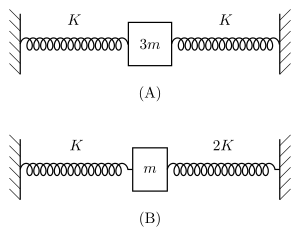
- AP EAPCET 2026Set eng-2026-05-15-AN1 markMCQQ.The springs are connected to the blocks as shown in figures A and B. When the blocks are slightly displaced and released, they oscillate with time period TA and TB respectively. Then, the value of TBTA is [FIGURE: In (A), a block of mass 3m is connected between two rigid walls by two springs each of spring constant K, one on either side. In (B), a block of mass m is connected between two rigid walls by a spring of spring constant K on one side and a spring of spring constant 2K on the other side.] (A) 23 (B) 23 (C) 32 (D) 32
›Reveal solutionSolution
This tests the effective spring constant for two springs attached to a block from opposite fixed walls (springs in parallel add), then compares SHM periods for two such setups. The answer is (A), 3/2.
Concept and Intuition
When a block sits between two walls, connected by a spring on each side, a displacement of the block stretches one spring and compresses the other — both springs then push/pull the block back toward equilibrium in the same direction. This is the parallel-spring configuration, where the effective stiffness is the SUM of the individual spring constants: keff=k1+k2. The period of the resulting SHM is T=2πm/keff.
Step-by-Step Solution
- In setup (A): block of mass 3m has a spring of constant K on each side (both attached to walls). Effective stiffness: kA=K+K=2K.
- Period: TA=2π2K3m.
- In setup (B): block of mass m has spring K on one side and spring 2K on the other. Effective stiffness: kB=K+2K=3K.
- Period: TB=2π3Km. …
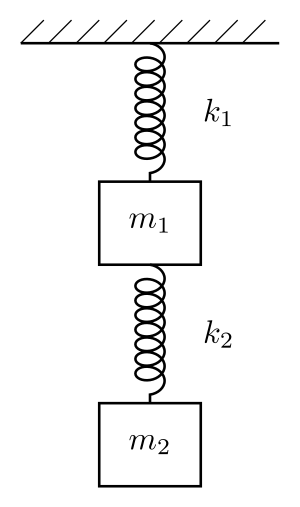
- AP EAPCET 2026Set eng-2026-05-18-FN1 markMCQQ.In the arrangement shown, k1=1500 Nm−1, k2=500 Nm−1, m1=2 kg and m2=1 kg. [FIGURE] (a fixed rigid support at the top, connected vertically downward in series to spring k1, then mass m1, then spring k2, then mass m2 hanging at the bottom) The potential energy stored in the system of springs in equilibrium is (Assume springs mass is negligible and g=10 ms−2) (A) 0.5 J (B) 0.4 J (C) 1.2 J (D) 5.6 J
›Reveal solutionSolution
This tests series-spring equilibrium: each spring stretches only under the weight it directly carries below it. Total elastic PE =0.4 J.
Concept and Intuition
When springs are connected in series with masses hanging in between (ceiling – k1 – m1 – k2 – m2), the tension in each spring is determined by everything hanging below that spring, not by the whole system's weight. This is unlike two springs simply in series holding one mass, where both springs carry the same tension — here different masses are inserted between the springs, so each spring carries a different load.
Step-by-Step Solution
- The lowest spring k2 connects m1 (above) to m2 (below). In equilibrium, the only mass hanging from k2 is m2, so the tension in k2 is F2=m2g=1×10=10 N.
- Extension of k2: x2=F2/k2=10/500=0.02 m.
- Elastic PE in k2: PE2=21k2x22=21(500)(0.02)2=0.1 J. …
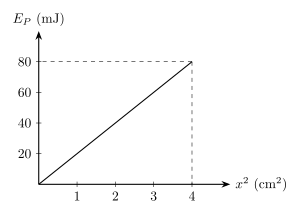
- AP EAPCET 2026Set ap-2026-05-19-AN1 markMCQQ.A particle of mass 40 gm is executing SHM. Variation of its potential energy (EP) with square of its displacement is shown in the figure. Its time period of oscillation in seconds is: [FIGURE] (graph of EP (mJ) on the vertical axis against x2 (cm2) on the horizontal axis; a straight line through the origin passing through the point x2=4, EP=80) (A) 20π (B) 50π (C) 25π (D) 100π
›Reveal solutionSolution
The slope of EP vs x2 equals 21k, giving k=400N/m; with m=0.04kg, T=2πm/k=50πs.
For SHM the potential energy is EP=21kx2, so a plot of EP against x2 is a straight line through the origin with slope 21k.
Read the slope from the point x2=4cm2, EP=80mJ. Convert to SI: x2=4×10⁻⁴m2, EP=80×10−3J.
21k=x2EP=4×10−40.080=200⇒k=400N/m. …
- AP EAPCET 2025Set eng-2025-05-21-AN1 markMCQQ.The kinetic energy of a particle executing simple harmonic motion at a displacement of 3 cm from the mean position is 4 mJ. If the amplitude of the particle is 5 cm, then the maximum force acting on the particle is (A) 0.25 N (B) 0.50 N (C) 0.75 N (D) 1.25 N
›Reveal solutionSolution
Using the SHM kinetic-energy formula to first find mω2, then applying it to the amplitude gives the maximum restoring force: (A) 0.25 N.
Concept and Intuition
In SHM, the restoring force at displacement x is F=mω2x, which is maximum at the extreme position x=A (the amplitude): Fmax=mω2A. We aren't given m and ω separately, but the kinetic energy at a known displacement lets us solve for the combination mω2 directly, which is exactly what we need for the force formula — we never need m and ω individually.
Step-by-Step Solution
- KE in SHM at displacement x: KE=21mω2(A2−x2) (since total energy 21mω2A2 splits between KE and PE =21mω2x2).
- Convert to consistent SI units: x=3 cm=0.03 m, A=5 cm=0.05 m, KE=4 mJ=4×10⁻³ J.
- Compute A2−x2=0.0025−0.0009=0.0016 m2. …
- AP EAPCET 2025Set eng-2025-05-22-AN1 markMCQQ.A body of mass 1 kg is suspended from a spring of force constant 600 Nm−1. Another body of mass 0.5 kg moving vertically upwards hits the suspended body with a velocity of 3 ms−1 and embedded in it. The amplitude of motion is (A) 5 cm (B) 15 cm (C) 10 cm (D) 8 cm
›Reveal solutionSolution
A perfectly inelastic collision shifts both the velocity (via momentum conservation) and the equilibrium point (via the new total weight); combining the resulting displacement-from-new-equilibrium and velocity through the SHM amplitude formula gives A≈5 cm.
Concept and Intuition
Before collision, the 1 kg mass hangs in equilibrium at some extension x1=km1g. The 0.5 kg mass hits and embeds (perfectly inelastic collision), so momentum is conserved at that instant, giving the combined mass a velocity. But the combined mass's own equilibrium position (extension x2=k(m1+m2)g) is different (lower) from where the collision happened — so relative to its own new equilibrium, the combined body starts displaced by Δx=x2−x1, in addition to having the collision velocity. Both this displacement and this velocity feed into the amplitude of the resulting SHM.
Step-by-Step Solution
- Momentum conservation at collision: m2u=(m1+m2)v0⇒0.5×3=1.5×v0⇒v0=1 m/s.
- Old equilibrium extension: x1=6001×10=601 m. New equilibrium extension: x2=6001.5×10=401 m.
- Displacement from new equilibrium at the moment of collision: y0=x2−x1=401−601=1203−2=1201 m. …
- AP EAPCET 2025Set eng-2025-05-22-FN1 markMCQQ.When the mass attached to a spring is increased from 4 kg to 9 kg, the time period of oscillation increases by 0.2π s. Then the spring constant of the spring is (A) 80 Nm−1 (B) 200 Nm−1 (C) 50 Nm−1 (D) 100 Nm−1
›Reveal solutionSolution
Uses the spring-mass period formula twice to eliminate k from a known period difference; k=100 Nm−1.
Concept and Intuition
The period of a mass-spring oscillator is T=2πm/k — it depends on m, so equal jumps in mass don't give equal jumps in period, but the algebra stays linear in k once you plug in the actual masses (which happen to be perfect squares, 4 and 9), making m a clean integer.
Step-by-Step Solution
- T1=2πk4=k4π.
- T2=2πk9=k6π. …
- AP EAPCET 2025Set eng-2025-05-23-FN1 markMCQQ.A body of mass 4 kg attached to a spring of force constant 64 Nm−1 executes simple harmonic motion on a frictionless horizontal surface. The time period of oscillation is (A) 3π s (B) 2π s (C) π s (D) 23π s
›Reveal solutionSolution
This tests the direct application of the spring-mass SHM time period formula. Answer: (B).
Concept and Intuition
A mass on a spring on a frictionless surface undergoes SHM with restoring force F=−kx, giving angular frequency ω=k/m and time period T=2π/ω=2πm/k — independent of amplitude.
Step-by-Step Solution
- Time period formula: T=2πkm.
- Substitute m=4 kg, k=64 N/m:
T=2π644=2π161=2π×41=2π s.
Common Mistakes …
- AP EAPCET 2025Set ap-2025-05-20-AN1 markMCQQ.The ratio of kinetic energy and total energy of a particle in simple harmonic motion, at a point where the displacement is 30% of its amplitude is (A) 91 : 100 (B) 49 : 100 (C) 81 : 100 (D) 51 : 100
›Reveal solutionSolution
The KE-to-total-energy ratio in SHM is 1−(x/A)2; at 30% amplitude displacement this evaluates to 91:100.
Concept and Intuition
In simple harmonic motion, total mechanical energy is conserved and constant, split between kinetic and potential energy depending on displacement x from the mean position: KE=21mω2(A2−x2), PE=21mω2x2, and TE=21mω2A2 (using k=mω2). Since TE is position-independent, the fraction of energy that is kinetic depends only on how far (as a fraction of amplitude) the particle is displaced.
Step-by-Step Solution
- Write TEKE=A2A2−x2=1−(Ax)2.
- Given x=0.3A (30% of amplitude): (Ax)2=0.09. …
- AP EAPCET 2025Set ap-2025-05-20-FN1 markMCQQ.The length of the scale of a spring balance that can weigh zero to 100 kg is 25 cm. If a body suspended from this balance oscillates with a time period of 0.2π s, then the mass of the suspended body is (Acceleration due to gravity = 10 ms−2) (A) 30 kg (B) 50 kg (C) 40 kg (D) 60 kg
›Reveal solutionSolution
The scale's markings fix the spring constant (k=4000 N/m); using the SHM period formula with the given T=0.2π s gives a suspended mass of 40 kg.
Concept and Intuition
A spring balance is just a calibrated spring: its full deflection (25 cm) corresponds to its maximum rated weight (100 kg). This directly gives the spring constant k=F/x. Once k is known, any mass hung on it and set oscillating obeys the standard mass-spring SHM period formula T=2πm/k, from which the oscillating mass can be found.
Step-by-Step Solution
- Full-scale force: F=100×10=1000 N, corresponding to extension x=0.25 m.
- Spring constant: k=xF=0.251000=4000 N/m.
- SHM period of a mass m on this spring: T=2πkm. …
🎓Unlock everything free for 14 days
- ✓Full step-by-step solutions
- ✓Concept-first explanations
- ✓Methods, shortcuts & mistakes
- ✓PYQ mapping + timed mock tests
Full access for 14 days. No credit card required.