Q.A spring having with a spring constant is mounted on a horizontal table as shown in Fig. 13.19. A mass of 3 kg is attached to the free end of the spring. The mass is then pulled sideways to a distance of 2.0 cm and released.
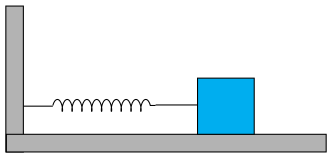
You're viewing a preview — the full solution, concept, methods & PYQ mapping are locked.
Start your 14-day free trial to unlock the full solution →This is a standard SHM energy problem: the spring constant , mass , and amplitude . Using , we get frequency , maximum acceleration , and maximum speed .
The key insight here is that a mass on a horizontal spring, when pulled and released, executes simple harmonic motion (SHM). The spring force is the restoring force — it always tries to bring the mass back to the equilibrium position. Because the table is horizontal, gravity plays no role in the motion; only the spring matters.
In SHM, all quantities (frequency, acceleration, speed) are determined by just two things: the angular frequency and the amplitude . The angular frequency comes from the spring and mass: . The amplitude is the maximum displacement from equilibrium — here, .
Let’s work through each part.
1. Find the angular frequency
The formula is:
This tells us how fast the oscillation is in radians per second. From , we get the ordinary frequency (in Hz) using:
Notice that does not depend on amplitude — that’s a hallmark of SHM. Whether you pull the mass 1 cm or 10 cm, the frequency stays the same (as long as the spring is ideal).
So the answer to part (i) is or approximately .
2. Maximum acceleration
In SHM, acceleration is given by , where is the displacement from equilibrium. The magnitude is maximum when is maximum, i.e., at the extreme positions where .
Thus:
…
Unlock everything free for 14 days
- Full step-by-step solutions
- Concept-first explanations
- Methods, shortcuts & mistakes
- PYQ mapping + timed mock tests
Full access for 14 days. No credit card required.