Q.A body moves in a straight line (unidirectionally) under a source that delivers energy at a constant power. Which of the following displacement–time (d versus t) curves correctly represents its motion?
🔒You're viewing a preview — the full solution, concept, methods & PYQ mapping are locked.
🔒 Start your 14-day free trial to unlock the full solution →Concept understanding — Power Time Relation
Power and Time: The Intuition
Think about lifting a heavy box. If you lift it slowly, you feel tired but you manage. If you lift it fast — the same box to the same height — you feel a much greater strain. The work done (force × distance) is identical in both cases. So why does the fast lift feel harder?
The answer is power. Power tells you not just how much work is done, but how quickly it is done. The fast lift requires more power because the same work is compressed into a shorter time.
Everyday language often confuses power with energy. A "powerful" car isn't one that uses more fuel (energy) — it's one that can accelerate faster or climb a hill at higher speed, meaning it delivers energy more quickly.
The Precise Statement
Power is defined as the rate at which work is done (or energy is transferred). Mathematically:
P=tW
where:
- P = power (watts, W)
- W = work done (joules, J)
- t = time taken (seconds, s)
This is the power-time relation in its simplest form: power is work divided by time.
P=tW
If you rearrange it, you get two other useful forms:
W=P×tandt=PW
These tell you:
- To do a fixed amount of work, using more power means less time.
- To run a device for a fixed time, more power means more work (and more energy consumed).
A Concrete Example
Suppose you need to lift a 10 kg mass to a height of 2 metres. The work done against gravity is:
W=mgh=10×9.8×2=196 J
Now consider two cases:
| Case | Time taken | Power required |
|---|---|---|
| Slow lift | 4 seconds | P=4196=49 W |
| Fast lift | 1 second | P=1196=196 W |
The fast lift requires four times the power — that's why it feels much harder, even though the work is the same.
A common mistake is to think power and work are the same thing. They are not. Work is the total energy transferred; power is the rate of that transfer. A 100 W bulb uses 100 J of energy every second, but if you leave it on for an hour, the total work (energy used) is 100×3600=360,000 J.
Why This Matters for Exams
The power-time relation appears in two main forms in problems:
- Direct calculation: Given work and time, find power (or any missing variable). …
Constant power gives 21mv2=Pt, so v∝t and d∝t3/2 — a curve whose slope increa …
Constant power means 21mv2=Pt, so v∝t1/2 and displacement d∝t3/2 — a curve that starts at the origin and gets steeper with time. Correct option (B).
Derivation
Constant power P delivered from rest. By the work–energy theorem, work done =Pt equals kinetic energy:
Pt=21mv2⟹v=m2Pt1/2
Integrating v=dx/dt:
d=m2P⋅3/2t3/2∝t3/2
Since d∝t3/2, the graph rises from the origin with a slope (velocity) that increases with time — concave up.
Why the others fail …
Concept: Constant Power, Work-Energy Theorem and Kinematics
Constant power delivered from rest builds up kinetic energy linearly with
time; converting that into a displacement-time relation reveals the shape
of the d-t curve.
Step 1: Relate power to speed
Work done in time t at constant power P equals the kinetic energy
gained:
Pt=21mv2⟹v=m2Pt1/2
Step 2: Integrate velocity to get displacement
d=∫0tvdt′=m2P⋅3/2t3/2∝t3/2
Step 3: Interpret the shape
Since d∝t3/2, the slope dd/dt=v∝t1/2 keeps
increasing with time — the curve starts at the origin and gets steeper,
i.e. concave up.
Step 4: Eliminate the other options …
Showing the 12 most recent of 17 on this concept.
- AP EAPCET 2026Set eng-2026-05-14-AN1 markMCQQ.A 1000 kg car moves at 20 ms−1 power required to maintain speed against 500 N resistive force is (A) 5 kW (B) 10 kW (C) 20 kW (D) 50 kW
›Reveal solutionSolution
Power to maintain constant speed against a resistive force is simply P=Fv; here it's 10 kW.
Concept and Intuition
When a car moves at constant velocity, its net force is zero, so the driving force from the engine must exactly balance the resistive force. Power delivered by any force is the dot product of force and velocity, which for force and velocity in the same direction is just their product.
Step-by-Step Solution
- At constant speed, net force = 0, so engine's driving force F=500 N (equal and opposite to resistance).
- Power required: P=F×v=500×20=10,000 W.
- Convert to kW: 10,000 W=10 kW. …
- AP EAPCET 2026Set ap-2026-05-20-FN1 markMCQQ.If force, F=kvn (k is constant) and power delivered is independent of velocity 'v', then n equals to (A) 0 (B) 1 (C) −1 (D) −2
›Reveal solutionSolution
Power is force times velocity; substituting F=kvn shows P∝vn+1, which is independent of v only when n=−1.
Concept and Intuition
Power delivered by a force moving at velocity v is P=Fv. If the force itself depends on velocity as F=kvn, then the power becomes P=kvn+1. For P to have no dependence on v at all, the net power of v appearing in the expression must be zero.
Step-by-Step Solution
- Write power: P=F⋅v.
- Substitute F=kvn: P=kvn⋅v=kvn+1. …
- AP EAPCET 2026Set ap-2026-05-20-FN1 markMCQQ.A body is moving in a straight line with constant power. The distance moved by the body in time t is proportional to (A) t (B) t2 (C) t3/2 (D) t3/4
›Reveal solutionSolution
With constant power, v∝t and integrating velocity over time gives distance ∝t3/2.
Concept and Intuition
Power is the rate of doing work, P=Fv. Since F=mdv/dt, we get a differential equation relating v and t for constant P. Solving it shows the speed grows as t, and integrating speed over time gives how distance grows.
Step-by-Step Solution
- P=Fv=mdtdvv, constant.
- Rearranging: vdv=mPdt.
- Integrating from 0 to t (starting from rest): 2v2=mPt⇒v=m2Pt∝t1/2. …
- AP EAPCET 2025Set eng-2025-05-22-FN1 markMCQQ.A body is moving along a straight line under the influence of a constant power source. If the relation between the displacement (s) of the body and time (t) is s∝tx, then x= (A) 1 (B) 2 (C) 32 (D) 23
›Reveal solutionSolution
Under constant power, velocity grows as t1/2 and displacement as t3/2, so x=3/2.
Concept and Intuition
Constant power means P=Fv=mvdtdv is constant, which is a differential equation directly relating v and t (not F and t as in constant force). Solving it shows velocity itself grows with time as a power law, and integrating once more gives displacement's power law.
Step-by-Step Solution
- Constant power: P=Fv=mdtdv⋅v= constant =k (say).
- Rewrite: vdv=mkdt. Integrate both sides (starting from rest, v=0 at t=0): 2v2=mkt⇒v2∝t⇒v∝t1/2. …
- AP EAPCET 2025Set eng-2025-05-23-FN1 markMCQQ.A car of mass 2000 kg is accelerating from rest. If its engine is supplying constant power of 10 kW, then the velocity of the car at a time of 10 s is (A) 15 ms−1 (B) 20 ms−1 (C) 5 ms−1 (D) 10 ms−1
›Reveal solutionSolution
This tests the work-energy theorem for constant-power motion starting from rest, avoiding the trap of assuming constant acceleration. Answer: (D).
Concept and Intuition
When power (not force) is constant, the force F=P/v decreases as speed increases, so acceleration is not constant — the usual v=u+at does not directly apply. Instead, use energy: at constant power, the work done equals P×t, and this must equal the gain in kinetic energy.
Step-by-Step Solution
- Work done by the engine in time t at constant power P: W=Pt.
- Since the car starts from rest, all this work becomes kinetic energy: Pt=21mv2−0.
- Solve for v: v=m2Pt.
- Substitute P=10000 W, t=10 s, m=2000 kg: …
- AP EAPCET 2025Set eng-2025-05-23-FN1 markMCQQ.A body of mass 'M' is moving with a uniform speed of 'v' on a frictionless horizontal surface under the influence of two forces F1 and F2 as shown in the figure. The net power of the system is [FIGURE] (a block of mass M on a horizontal surface, with force F1 acting rightward on the left side and force F2 acting leftward on the right side, both forces pointing toward the block) (A) (F1−F2)v (B) 0.5(F1+F2)v (C) (F1+F2)v (D) zero
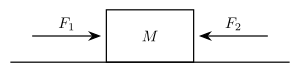
›Reveal solutionSolution
This tests the work-energy theorem: for a body moving at truly constant (uniform) speed, the net power delivered by all forces is always zero — regardless of the individual force values. Answer: (D).
Concept and Intuition
Power is the rate of doing work, and kinetic energy is directly tied to total work done (work-energy theorem). If the speed genuinely stays uniform, kinetic energy is constant in time, so the net work done — and therefore the net power delivered by all forces combined — must be zero at every instant. This is true even though two individual forces are acting on the body.
Step-by-Step Solution
- The body moves on a frictionless horizontal surface with uniform speed v, under only two horizontal forces F1 and F2 acting toward each other (opposing directions) along the line of motion.
- For the speed to remain truly uniform (not just momentarily equal but constant throughout), the net force on the body must be zero at all times — otherwise it would accelerate and speed would change. This forces F1=F2.
- Kinetic energy =21Mv2 is therefore constant (since v doesn't change).
- By the work-energy theorem, the total work done by all forces on the body over any time interval is ΔKE=0; correspondingly, the net power (rate of total work) delivered to the body is zero at every instant. …
- AP EAPCET 2024Set ap-2024-05-17-FN1 markMCQQ.A substance of mass m requires a power input of P to remain in the molten state at its melting point. When the power is turned off, the sample completely solidifies in time t. The latent heat of the substance is (A) mPt (B) tPm (C) Ptm (D) Pmt
›Reveal solutionSolution
The power P that was needed to keep the substance molten equals its steady rate of heat loss to the surroundings; that same rate removes the latent heat when the power is cut. Answer: (A) mPt.
Concept and Intuition
At the melting point, a pure substance can sit as liquid (or partly liquid/partly solid) at constant temperature — any heat you add there does NOT raise its temperature, it goes into changing phase (or, run in reverse, holding it in the liquid phase against heat losses). If the substance's temperature is not changing while power P is supplied, that power must be exactly compensating the rate of heat loss to the environment (otherwise it would slowly freeze even with the heater on). So the environment is steadily draining heat from the sample at rate P, regardless of whether the heater is on or off — the heater's job was simply to replace that loss.
Step-by-Step Solution
- Before power-off: to remain molten at constant temperature (melting point), heat supplied = heat lost to surroundings, both equal to P (power). This tells us the ambient heat-loss rate for this sample is P.
- Power off: the heater no longer replaces the loss, so the sample now loses heat to the surroundings at that same rate P (same temperature difference, same conditions, so same rate).
- This heat loss is entirely what freezes the sample (heat leaving = latent heat given up, since temperature stays at the melting point throughout the freezing process). …
- AP EAPCET 2024Set eng-2024-05-23-FN1 markMCQQ.A particle of mass 'm' at rest on a rough horizontal surface with a coefficient of friction 'μ' is given a velocity 'u'. The average power imparted by friction before it stops (A) Zero (B) 21μmgu (C) μmgu (D) 2μmgu
›Reveal solutionSolution
Average power is total work done by friction (equal to the initial kinetic energy) divided by the total time taken to stop, giving 21μmgu.
Concept and Intuition
"Average power" here means total energy dissipated divided by total time — not the instantaneous power at any moment (which actually starts at μmgu and falls linearly to zero as the particle slows). The whole kinetic energy 21mu2 is dissipated by friction, and this happens over the stopping time t=u/(μg).
Step-by-Step Solution
- Friction force f=μmg, deceleration a=μg.
- Time to stop from speed u: t=μgu.
- Work done by friction (magnitude) = initial KE =21mu2. …
- AP EAPCET 2023Set ap-2023-05-22-AN1 markMCQQ.The charge flowing through a resistance 'R' varies with time as q=at−bt2 where a,b are positive constants. The total heat produced in R is (A) 6ba3R (B) 2ba3R (C) 3ba3R (D) ba3R
›Reveal solutionSolution
This tests using i=dq/dt and then integrating i2R over time to find total heat — the answer is 6ba3R.
Concept and Intuition
Heat produced in a resistor over an interval is H=∫i2Rdt (Joule heating), not simply q2R or similar shortcuts — because current itself varies with time here, so we must integrate its square. The first step is always to get the actual instantaneous current from the given charge function.
Step-by-Step Solution
- Charge: q(t)=at−bt2. Current: i=dtdq=a−2bt.
- This current starts at a (at t=0) and decreases linearly, becoming zero at t=2ba — beyond this instant the current (as modeled) would go negative, i.e., the physical flow described has effectively ended. So the relevant interval for a single "pulse" of current is t∈[0,2ba].
- Heat generated: H=∫0a/2bi2Rdt=R∫0a/2b(a−2bt)2dt.
- Substitute x=a−2bt⇒dx=−2bdt⇒dt=−2bdx. Limits: t=0⇒x=a; t=2ba⇒x=0. …
- AP EAPCET 2023Set eng-2023-05-19-FN1 markMCQQ.A toy of mass 20 g at rest acquires a velocity (3i^−2j^)ms−1 in 2 seconds. Then the power of the toy is (A) 0.975 W (B) 0.325 W (C) 1.3 W (D) 0.065 W
›Reveal solutionSolution
This tests the work-energy theorem: power delivered equals the kinetic energy gained
divided by time. Answer: 0.065 W.
Concept and Intuition
Power is the rate of doing work. If a body starts from rest and ends up with some
kinetic energy after a time t, all of that kinetic energy must have come from the
work done by the driving force, so the average power is just that kinetic energy
divided by the time taken — we don't need the actual force or the path.
Step-by-Step Solution
- Mass m=20 g=0.02 kg. Final velocity v=(3i^−2j^) ms−1.
- Speed squared: v2=32+(−2)2=9+4=13 m2s−2.
- Since the toy starts at rest, kinetic energy gained: KE=21mv2=21(0.02)(13)=0.13 J …
- AP EAPCET 2022Set eng-2022-07-04-FN1 markMCQQ.A bead of mass 400 g is moving along a straight line under a force that delivers a constant power 1.2 W to the bead. If the bead is initially at rest, the speed it attains after 6 sec in ms−1 (A) 5 (B) 4 (C) 6 (D) 3
›Reveal solutionSolution
Constant power delivered over time t does work Pt; equating this to the kinetic energy gained from rest gives v=6 ms−1.
Concept and Intuition
Power is the rate of doing work. If power is held constant (not force), the total work done over a time interval is simply P×t, regardless of how velocity varies during that interval. By the work-energy theorem, this work equals the change in kinetic energy.
Step-by-Step Solution
- Work done in t=6 s at constant power P=1.2 W: W=Pt=1.2×6=7.2 J.
- Since the bead starts from rest, this work equals the final kinetic energy: W=21mv2.
- 7.2=21(0.4)v2=0.2v2. …
- AP EAPCET 2022Set eng-2022-07-05-AN1 markMCQQ.A battery with a 12 V emf has an initial charge of 80 A.h. If the potential across the terminals stays constant until battery is completely discharged, then this battery can deliver energy at the rate of 120 W for a time (A) 16 h (B) 8 h (C) 4 h (D) 5 h
›Reveal solutionSolution
Compute total stored energy from EMF and charge capacity, then divide by the power delivery rate.
Concept and Intuition
A battery's charge capacity in ampere-hours (A·h), multiplied by its (constant) terminal voltage, gives the total energy it can deliver in watt-hours. Dividing this total energy by a constant power output gives the time for which that power can be sustained.
Step-by-Step Solution
- Total energy =V×Q=12V×80A⋅h=960Wh. …
🎓Unlock everything free for 14 days
- ✓Full step-by-step solutions
- ✓Concept-first explanations
- ✓Methods, shortcuts & mistakes
- ✓PYQ mapping + timed mock tests
Full access for 14 days. No credit card required.