Q.A body falls towards earth in air. Will its total mechanical energy be conserved during the fall? Justify.
🔒You're viewing a preview — the full solution, concept, methods & PYQ mapping are locked.
🔒 Start your 14-day free trial to unlock the full solution →Concept understanding — Conservative Force Work
What is a Conservative Force? — Starting from Intuition
Imagine you are carrying a bucket of water up a hill and then walking back down. The work your muscles do against gravity depends only on how high you climbed, not on the path you took. Whether you go straight up the steep side or take a long winding road, the net work done by gravity on the bucket when you return to the starting point is exactly zero.
That is the core idea: a force is conservative if the work it does on an object moving between two points depends only on those points, not on the path taken.
The Precise Statement
A force F is conservative if the work W done by it on a particle moving from point A to point B is the same for every possible path connecting A and B.
Mathematically:
WA→B=∫ABF⋅dris path-independent
This single property leads to two equivalent, powerful consequences:
- Work around any closed loop is zero. If you go from A to B along one path and return along another, the total work is zero:
∮F⋅dr=0
- The force can be written as the negative gradient of a potential energy function U:
F=−∇U
This means you can define a potential energy for the system — a stored energy that depends only on position.
Examples You Already Know
| Force | Conservative? | Why |
|---|---|---|
| Gravity (near Earth) | Yes | Work depends only on height difference |
| Spring force (F=−kx) | Yes | Work depends only on stretch/compression |
| Electrostatic force | Yes | Work depends only on charge positions |
| Friction | No | Work depends on path length — longer path = more work |
| Air resistance | No | Same reason — dissipative |
A common mistake: thinking "conservative" means the force conserves kinetic energy. It does not. It means the force itself allows a potential energy to be defined, so total mechanical energy (kinetic + potential) is conserved when only conservative forces act.
Why This Matters for Exams
When you see a problem with gravity, springs, or electric fields, you can immediately:
- Use energy conservation: Ki+Ui=Kf+Uf
- Ignore the path — only initial and final positions matter
- Compute work as W=−ΔU instead of doing a line integral …
Concept: Conservation of mechanical energy holds only when work is done exclusively by conservative forces.
During the fall, two forces act on the body: gravity (conservative) and air resistance (non-conservative). Gravity does positive work, converting potential energy to kinetic energy. Air resistance opposes motion, doing negative work that dissipates mechanical energy as heat in the surrounding air.
The work–energy theorem gives:
ΔEmech=Wnon-conservative=Wair<0 …
No, the total mechanical energy is not conserved during the fall because air resistance does negative work on the body, converting mechanical energy into thermal energy.
Why mechanical energy conservation fails here
Mechanical energy—the sum of kinetic and potential energy—remains constant only when the forces doing work are conservative. Gravity is conservative, but air resistance is not. Air resistance is a dissipative force: it opposes motion and converts ordered kinetic energy into disordered thermal energy (heating both the body and the surrounding air). This energy leaves the mechanical "account" entirely, so the total Emech=KE+PE decreases as the body falls.
Step-by-step justification
-
Identify the forces acting on the falling body.
Two forces act: gravitational force mg (downward) and air resistance fair (upward, opposing the velocity).
-
Examine the work done by each force.
- Gravity does positive work Wg=mgh as the body descends through height h, converting gravitational potential energy into kinetic energy.
- Air resistance does negative work Wair=−fair⋅d (where d is the distance fallen), because the force opposes the displacement.
-
Apply the work-energy theorem.
The net work done equals the change in kinetic energy:
Wnet=Wg+Wair=ΔKE
Rearranging:
Wg=ΔKE−Wair
Since Wg=−ΔPE (the loss in potential energy), we have:
−ΔPE=ΔKE−Wair
ΔKE+ΔPE=Wair<0
The left side is the change in total mechanical energy, and it equals the (negative) work done by air resistance.
- Conclude about energy conservation. …
Concept: Conservation of Mechanical Energy — Only Holds for Conservative Forces
Mechanical energy E=K+U stays constant only when every force doing work
on the body is conservative; a falling body in air also experiences a
non-conservative drag force.
Step 1: List the forces acting on the falling body
Two forces act: gravity mg (downward, conservative) and air
resistance fair (upward, opposing velocity, non-conservative).
Step 2: Apply the work-energy theorem, separating the two forces
Wnet=Wg+Wair=ΔKE
Since Wg=−ΔU (the drop in potential energy), rearranging gives:
ΔKE+ΔU=Wair
The left-hand side is exactly ΔEmech, so:
ΔEmech=Wair
Step 3: Sign of the air-resistance term
Air resistance always opposes the motion, so it does negative work: …
Showing the 12 most recent of 22 on this concept.
- AP EAPCET 2026Set eng-2026-05-12-AN1 markMCQQ.If the ratio of the potential and kinetic energies of a body of mass 3 kg thrown vertically upwards at a height of 40 m is 2:3, then the kinetic energy of the body at a height of 65 m is (Acceleration due to gravity = 10 ms−2) (A) 3000 J (B) 1050 J (C) 1950 J (D) 1200 J
›Reveal solutionSolution
Total mechanical energy is conserved for the vertically thrown body; the given PE:KE ratio at one height pins down that total, letting us find KE at any other height. The answer is 1050 J.
Concept and Intuition
For a body in free vertical flight under gravity alone (no air resistance), the sum PE+KE stays constant throughout the motion. So if we know the PE:KE ratio at one height, we can find the total energy there, and then use it to find KE at any other height by simply subtracting the new PE.
Step-by-Step Solution
- At h1=40 m: PE1=mgh1=(3)(10)(40)=1200 J.
- Given PE1:KE1=2:3, so KE1=PE1×23=1200×1.5=1800 J.
- Total mechanical energy: E=PE1+KE1=1200+1800=3000 J (this is conserved for the whole flight). …
- AP EAPCET 2026Set eng-2026-05-14-FN1 markMCQQ.A force F=4x is applied to move an object from x=0 to x=2m, the work done is (A) 8 J (B) 16 J (C) 4 J (D) 32 J
›Reveal solutionSolution
This tests work done by a position-dependent (variable) force, found via integration rather than simple multiplication. The answer is 8 J.
Concept and Intuition
Work done by a force that varies with position is the area under the Force-vs-displacement graph, computed as W=∫Fdx. Here F=4x increases linearly with x, so the force-displacement graph is a straight line through the origin — the work equals the area of the triangle formed, which is the same result the integral gives.
Step-by-Step Solution
- Given F(x)=4x, moving from x=0 to x=2 m.
- Work done: W=∫02Fdx=∫024xdx.
- Evaluate: ∫024xdx=[2x2]02=2(2)2−0=8 J. …
- AP EAPCET 2026Set eng-2026-05-18-FN1 markMCQQ.A block of mass 2 kg, moving along X-axis on a horizontal surface with a speed of 4 ms−1 enters a rough surface from x=0.5 m to x=1.5 m. The retardating force on this rough surface is related to distance by F=−12x N. The speed of the block as it just crosses the rough surface is (A) Zero (B) 1.5 ms−1 (C) 2 ms−1 (D) 2.5 ms−1
›Reveal solutionSolution
Integrating the position-dependent retarding force gives the work done, and the work-energy theorem then gives the exit speed as 2 ms−1.
Concept and Intuition
When force varies with position rather than being constant, we can't use v2=u2−2as directly with a single acceleration. Instead, the work-energy theorem W=ΔKE handles a position-dependent force cleanly by integrating Fdx over the path.
Step-by-Step Solution
- Mass m=2 kg, initial speed vi=4 ms−1 (at x=0.5 m, entering the rough patch).
- Retarding force: F=−12x N, acting from x=0.5 m to x=1.5 m.
- Work done by this force: W=∫0.51.5Fdx=∫0.51.5(−12x)dx=−12[2x2]0.51.5=−6(1.52−0.52).
- 1.52−0.52=2.25−0.25=2.0, so W=−6×2=−12 J.
- Work-energy theorem: 21mvf2−21mvi2=W.
- 21(2)vf2−21(2)(16)=−12⇒vf2−16=−12⇒vf2=4. …
- AP EAPCET 2026Set ap-2026-05-20-AN1 markMCQQ.A loaded bus and an unloaded bus are both moving with the same kinetic energy. The mass of the former is twice that of the later. Brakes are applied to both so as to exert equal retarding forces. If S1 and S2 are the distances covered by the two buses before coming to rest respectively, then (A) 4S1=S2 (B) 2S1=S2 (C) S1=2S2 (D) S1=4S2
›Reveal solutionSolution
With equal kinetic energy but mass in ratio 2:1, matching the two buses' braking through equal deceleration gives stopping distances in the ratio S1:S2=1:2, i.e. 2S1=S2. Answer: (B).
Concept and Intuition
Two vehicles carrying the same kinetic energy but different masses must be moving at different speeds — the heavier one (loaded bus, mass 2m) moves slower than the lighter one (unloaded, mass m) for the same KE, since KE=21mv2. When brought to rest under the same braking condition, the vehicle that started slower needs a shorter distance to stop. Working through v2=2as with the masses and speeds properly related through the common KE gives the exact ratio.
Step-by-Step Solution
- Let unloaded bus mass =m, loaded bus mass =2m (loaded is twice the unloaded).
- Equal kinetic energy: 21(2m)v12=21(m)v22⇒2v12=v22⇒v22=2v12 (loaded bus = subscript 1, moves slower).
- Both experience the same braking effect, so using v2=2as: s=2av2, with a the (equal) deceleration each undergoes.
- S1=2av12, S2=2av22=2a2v12=2S1.
- Hence 2S1=S2. …
- AP EAPCET 2025Set ap-2025-05-19-FN1 markMCQQ.The slope of kinetic energy (on y-axis) and linear displacement (on x-axis) graph of a body gives the rate of change of (A) linear momentum (B) linear velocity (C) force (D) angular momentum
›Reveal solutionSolution
Differentiating kinetic energy with respect to displacement always yields the net force, and force is by definition the rate of change of linear momentum — so the KE-vs-displacement slope gives dp/dt.
Concept and Intuition
This is a standard identity worth memorizing: for any particle of mass m, momentum p=mv, and KE=2mp2=21mv2,
dxd(KE)=F,
i.e. the spatial derivative of kinetic energy always equals the net force acting on the particle — this is essentially a restatement of the work–energy theorem in differential form (dW=Fdx=d(KE)). And Newton's second law states F=dtdp, the rate of change of linear momentum. So a slope of a KE–x graph measures the rate of change of momentum (equivalently, the force).
Step-by-Step Solution
- Start from KE=2mp2.
- Differentiate with respect to x: dxd(KE)=mpdxdp=v⋅dxdp.
- Use chain rule: dxdp=dtdp⋅dxdt=dtdp⋅v1.
- Substitute: dxd(KE)=v⋅dtdp⋅v1=dtdp. …
- AP EAPCET 2025Set eng-2025-05-26-FN1 markMCQQ.If a position dependent force (3x2−2x+7)N acting on a body of mass 2 kg displaces it from x=0 m to x=5 m, then the work done by the force is (A) 165 J (B) 115 J (C) 150 J (D) 135 J
›Reveal solutionSolution
This tests computing work done by a variable (position-dependent) force via direct integration W=∫F(x)dx — the mass given in the problem is a distractor, not needed for this calculation.
Concept and Intuition
Work done by a force that varies with position is the area under the force-vs-displacement curve, computed by integrating F(x) over the displacement range. This is true regardless of the object's mass — mass would only matter if we were asked for the resulting speed or kinetic energy change (which, by the work-energy theorem, would in fact equal this same work value).
Step-by-Step Solution
- Work done: W=∫05(3x2−2x+7)dx.
- Antiderivative: ∫(3x2−2x+7)dx=x3−x2+7x+C. …
- AP EAPCET 2025Set eng-2025-05-27-FN1 markMCQQ.A body is projected vertically upwards with a velocity of 20 ms−1. If the potential energy of the body at a height of 5 m from the ground is 100 J, then the kinetic energy of the body at a height of 10 m from the ground is (Acceleration due to gravity = 10 ms−2) (A) 200 J (B) 300 J (C) 150 J (D) 250 J
›Reveal solutionSolution
Using energy conservation and the given PE at 5 m to fix the mass, the KE at 10 m works out to 200 J.
Concept and Intuition
In free flight under gravity (no air resistance), the total mechanical energy — KE + PE — stays constant throughout the motion. So once we know the total energy (from the initial launch) and the PE at any height, the KE there follows immediately by subtraction.
Step-by-Step Solution
- PE at height 5 m: mgh=100J ⇒m×10×5=100⇒m=2kg.
- Total mechanical energy = initial KE at launch (ground level, PE = 0): E=21mu2=21(2)(20)2=400J.
- PE at height 10 m: mgh=2×10×10=200J. …
- AP EAPCET 2024Set eng-2024-05-18-FN1 markMCQQ.A spring of 5×10³ Nm−1 spring constant is stretched initially by 10 cm from unstretched position. The work required to stretch it further by another 10 cm is (A) 75 N-m (B) 50 N-m (C) 76 N-m (D) 82 N-m
›Reveal solutionSolution
This tests spring elastic potential energy; the extra work to stretch further equals the CHANGE in 21kx2 between the two states, not 21k(Δx)2.
Concept and Intuition
A spring stores energy U=21kx2 when stretched by x from its natural length. Because U is quadratic in x, doubling the stretch does not simply double the energy — you must subtract the energy already stored at the initial stretch from the energy stored at the final stretch to get the extra work done in the second stage.
Step-by-Step Solution
- Given k=5×10³ N/m, initial stretch x1=10 cm=0.10 m, final stretch x2=x1+10 cm=0.20 m.
- Energy stored at x1: U1=21kx12=21(5000)(0.01)=25 J.
- Energy stored at x2: U2=21kx22=21(5000)(0.04)=100 J. …
- AP EAPCET 2024Set eng-2024-05-19-AN1 markMCQQ.A force of (6x2−4x+3) N acts on a body of mass 0.75 kg and displaces it from x=2 m to x=5 m. The work done by the force is (A) 201 J (B) 215 J (C) 229 J (D) 307 J
›Reveal solutionSolution
For a position-dependent force, work is the integral of force over displacement; evaluating ∫25(6x2−4x+3)dx gives 201 J.
Concept and Intuition
When a force varies with position, W=∫F(x)dx over the displacement — this is the generalization of W=Fd (which only holds for constant force) via the work-energy definition as the area under the force–displacement curve. The mass given (0.75 kg) is irrelevant to this direct integral (it would only matter if asked for the resulting speed via the work-energy theorem).
Step-by-Step Solution
- W=∫25(6x2−4x+3)dx.
- Antiderivative: 2x3−2x2+3x.
- At x=5: 2(125)−2(25)+3(5)=250−50+15=215. …
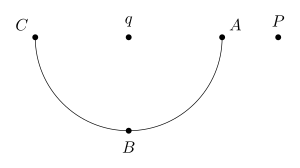
- AP EAPCET 2024Set eng-2024-05-19-AN1 markMCQQ.In the following diagram, the work done in moving a point charge from point P to point A, B and C are WA,WB and WC respectively. Then (A, B, C are points on semicircle and point charge q is at the centre of semicircle) [FIGURE] (a semicircular arc with point C at the top-left end, point A at the right end, and point B at the bottom-most point of the arc; the point charge q is marked at the centre, level with the diameter of the semicircle; an external point P is shown to the right, outside the arc) (A) WA=WB=WC=0 (B) WA=WB=WC=0 (C) WA>WB>WC (D) WA<WB<WC
›Reveal solutionSolution
This tests that potential due to a point charge depends only on distance from it — so equidistant points are equipotential, making the work done to reach any of them (from the same starting point) equal.
Concept and Intuition
The electric potential of a point charge depends only on radial distance, V=4πϵ01rq, not on direction. Any set of points equidistant from the charge — such as points lying on a circle (or arc) centred on the charge — are all at the same potential. Work done by an external agent moving a charge between two points depends only on the potential difference between those points, not the path taken.
Step-by-Step Solution
- A, B, C lie on a semicircular arc whose centre is where charge q sits — so each of A, B, C is at the same distance r (the radius) from q.
- Hence VA=VB=VC (same distance from q means same potential).
- Work done in moving a test/point charge from P to any point X is WX=qtest(VX−VP).
- Since VA=VB=VC, and VP is the same starting potential in every case, WA=WB=WC. …
- AP EAPCET 2024Set eng-2024-05-20-FN1 markMCQQ.Two bodies A and B of masses 2m and m are projected vertically upwards from the ground with velocities u and 2u respectively. The ratio of the kinetic energy of body A and the potential energy of body B at a height equal to half of the maximum height reached by body A is (A) 8:1 (B) 1:1 (C) 4:1 (D) 2:1
›Reveal solutionSolution
Using energy conservation for A to get its KE at a fixed height, and simple mgh for B's PE at that same height, the ratio comes out to 2:1 regardless of the actual value of u or g.
Concept and Intuition
Both bodies are projected independently; the height in question is defined purely in terms of body A's own maximum height, so we must first find that height, then evaluate both A's kinetic energy and B's potential energy at that specific height (which has nothing to do with B's own trajectory except that B must simply be present there, going up or down).
Step-by-Step Solution
- Maximum height of A: HA=2gu2 (mass 2m, initial speed u; mass doesn't affect max height in free projectile motion).
- The height of interest: h=2HA=4gu2.
- KE of A at height h: using energy conservation, 21(2m)u2=21(2m)v2+(2m)gh, so KEA=21(2m)u2−(2m)gh=2m[2u2−g⋅4gu2]=2m[2u2−4u2]=2m⋅4u2=2mu2. …
- AP EAPCET 2024Set eng-2024-05-21-FN1 markMCQQ.A spring of spring constant 200 Nm−1 is initially stretched by 10 cm from the unstretched position. The work to be done to stretch the spring further by another 10 cm is (A) 3 J (B) 6 J (C) 9 J (D) 12 J
›Reveal solutionSolution
The work needed is just the difference in elastic potential energy between the two stretched states, giving 3 J.
Concept and Intuition
The work done in stretching a spring further is not 21k(Δx)2 using only the additional extension — because the spring is already under tension from the first 10 cm. It equals the change in stored elastic potential energy between the initial and final stretched states.
Step-by-Step Solution
- Elastic PE at extension x: U(x)=21kx2.
- Initial extension x1=10cm=0.1m; final extension x2=20cm=0.2m. …
🎓Unlock everything free for 14 days
- ✓Full step-by-step solutions
- ✓Concept-first explanations
- ✓Methods, shortcuts & mistakes
- ✓PYQ mapping + timed mock tests
Full access for 14 days. No credit card required.