Q.Does the first polar body born out of first meiotic division divide further or degenerate?
🔒You're viewing a preview — the full solution, concept, methods & PYQ mapping are locked.
🔒 Start your 14-day free trial to unlock the full solution →Concept understanding — Oogenesis Definition
Oogenesis: The Making of an Egg Cell
Think of oogenesis as the biological story of how a female body creates the single most important cell she will ever produce — the egg, or ovum. If you've ever seen a seed that contains everything needed to grow a new plant, you have the right mental picture. The egg cell is that seed for human life. But unlike a seed that sits waiting, the egg cell goes through a long, carefully timed process before it is ready.
The Everyday Intuition
Imagine a factory that makes one very special product. This factory starts its work even before the product is ordered. It prepares the raw materials, stores them for years, and then, when the time is right, finishes the product in a matter of days. That is oogenesis. A female is born with all the "raw materials" she will ever have — millions of tiny, immature egg precursors. Most of these will never be used. Only a few hundred will ever mature into eggs that can be fertilized.
The Precise Meaning
Oogenesis is the process by which the female gamete, or egg cell, is formed in the ovaries. It begins before a girl is even born, pauses for years, and then resumes each month from puberty until menopause. The entire process transforms a primitive cell called an oogonium into a mature ovum (egg) that can be fertilized by a sperm.
The word "oogenesis" comes from Greek: oion meaning "egg" and genesis meaning "origin" or "creation." So it literally means "the origin of the egg."
Why It Matters
You might wonder why a commerce or humanities student needs to know this. Here is why: oogenesis is the biological foundation of female fertility, reproduction, and even the timing of a woman's life. It explains:
- Why a woman is born with all her eggs and never makes new ones.
- Why fertility declines with age — the eggs age along with the woman.
- Why only one egg is released each month, not hundreds like sperm.
- Why the egg is so much larger than a sperm — it carries the cytoplasm, nutrients, and mitochondria that the embryo will need for its first few days.
Key Stages in Simple Terms
The NCERT textbook describes oogenesis in three main phases, but you can think of them as three acts of a play:
-
Multiplication phase — Before birth, the oogonia (the stem cells) multiply rapidly. This happens only in the fetal ovary. By the time a female is born, all the oogonia have transformed into primary oocytes, and no new ones are ever made.
-
Growth phase — Each primary oocyte grows in size and accumulates nutrients. But then it stops. It enters a resting state called prophase I and stays there for years — until the female reaches puberty. Some primary oocytes wait for 12, 20, or even 40 years before they resume development.
-
Maturation phase — After puberty, each month a few primary oocytes start maturing. But only one usually completes the process. This phase involves two rounds of cell division (meiosis I and meiosis II) that reduce the chromosome number by half. The result is one large, functional egg and three tiny, non-functional cells called polar bodies that eventually degenerate. …
The NCERT textbook itself answers this honestly with an acknowledgment of scientific uncertainty, stated verbatim right after the question: "At present we are not very certain about this." So there is no single settled answer to quote — some sources describe the first polar body dividing (mirroring meiosis II) to give two smaller polar bodies, while others describe it degenerating directly without dividing; either way, all polar bodies eventually degenerate and take no further part in reproduction. …
NCERT explicitly flags this as scientifically unresolved: "At present we are not very certain about this." The first polar body's fate — whether it divides once more or simply degenerates — has no single confirmed answer, but either way it never becomes a gamete.
This is one of the rare places in the NCERT Class 12 Biology textbook where the book itself flags an open question rather than supplying a confident answer — worth taking at face value rather than inventing a definitive resolution the source does not give (honesty over a confident-sounding guess).
What IS established (from the rest of section 2.3 and Figure 2.8(b)): the primary oocyte's first meiotic division is unequal, producing one large secondary oocyte and one small first polar body, both haploid (23 chromosomes). Some accounts of oogenesis describe the first polar body undergoing a second, mitosis-like division (paralleling the secondary oocyte's own meiosis II) to yield two smaller polar bodies; other accounts describe it degenerating without ever dividing again. Both possibilities appear in different sources, which is exactly why NCERT hedges rather than commits to one. …
- AP EAPCET 2026Set ap-2026-05-19-FN1 markMCQQ.Development of the primary oocyte stops its development until sexual maturity of that female. (A) Metaphase-I (B) Anaphase-I (C) Prophase-I (D) Telophase-I
›Reveal solutionSolution
Primary oocytes are arrested at diplotene of Prophase-I from before birth
until sexual maturity. Answer: (C).
Concept and Intuition
Oogenesis begins in the fetus: oogonia proliferate and differentiate into
primary oocytes, which enter meiosis-I. But meiosis is not completed at once —
the primary oocyte gets "stuck" at a specific checkpoint (diplotene of
prophase-I) for years, only resuming when hormonal cues at puberty (the LH
surge just before ovulation) trigger completion of meiosis-I.
Step-by-Step Solution
- Primary oocytes are formed prenatally and start meiosis-I.
- Meiosis-I is arrested specifically at the diplotene stage of Prophase-I.
- This arrest lasts from before birth until the individual attains puberty.
- At/around ovulation, meiosis-I completes to give a secondary oocyte + first …
- AP EAPCET 2021Set ap-2021-09-03-AN1 markMCQQ.In Oogamy, fertilization involves __________ (A) A small non motile female gamete and a large motile male gamete (B) A large non motile female gamete and a small motile male gamete (C) A large non motile female gamete and a small non-motile male gamete (D) A large motile female gamete and a small non-motile male gamete
›Reveal solutionSolution
Oogamy is defined by fusion between a large, immotile egg and a small, motile sperm — the most advanced and widespread type of sexual reproduction among the isogamy/anisogamy/oogamy spectrum. Answer: (B).
Concept and Intuition
Sexual reproduction in algae and beyond is classified by the morphology of the fusing gametes: isogamy (both gametes morphologically similar, both motile), anisogamy (both motile but differing in size), and oogamy (a large, non-motile female gamete — the egg/ovum — fuses with a small, motile male gamete — the sperm/antherozoid). Oogamy represents the most differentiated and specialized condition and is the pattern followed by essentially all higher plants and animals, as well as some algae such as Volvox and Fucus.
Step-by-Step Solution
- Recall the three fusion types (isogamy, anisogamy, oogamy) and their defining feature: gamete size and motility differences. …
- AP EAPCET 2021Set ap-2021-09-07-FN1 markMCQQ.At what stage of life is oogenesis initiated in a human female? (A) During menarche (B) During menopause (C) During birth (D) During embryonic development
›Reveal solutionSolution
Oogenesis begins in the fetus, not at puberty — oogonia are formed and enter meiosis before birth, then arrest until much later in life.
Concept and Intuition
Unlike spermatogenesis, which begins only at puberty in the male, oogenesis in the human female begins much earlier — during embryonic/fetal development. Primordial germ cells migrate to the developing ovary and multiply by mitosis into oogonia. Some oogonia enter meiosis I and become primary oocytes, but this meiotic division is arrested at prophase I (diplotene stage) before birth — the female is born with all the primary oocytes she will ever have, already "initiated" into meiosis but paused. Menarche (onset of menstruation at puberty) marks the point at which oocytes resume meiosis and are ovulated cyclically, not the initiation of oogenesis itself, and menopause marks the cessation of ovarian activity, not any initiation event.
Step-by-Step Solution
- Distinguish "initiation" of oogenesis (formation of oogonia and start of meiosis I) from "completion/resumption" (ovulation events at and after puberty).
- Recall that oogonial proliferation and entry into meiosis I happens in the fetal ovary, i.e., during embryonic development.
- This process arrests at prophase I in all primary oocytes before birth — meaning oogenesis's meiotic initiation is already complete before the child is even born. …
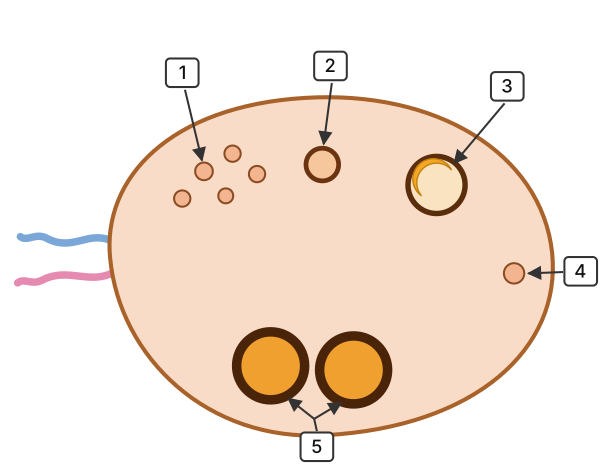
- AP EAPCET 2021Set ap-2021-10-05-FN1 markMCQQ.Diagrammatic sectional view of ovary is shown in the figure with labels 1 to 5. Identify them correctly? [FIGURE] (a diagrammatic sectional drawing of the ovary showing follicles of increasing maturity around the periphery and a large mature structure and a small structure near the hilum, with pointer labels 1-5 marking, in order: 1 a small early follicle near the surface, 2 a mid-sized follicle, 3 a larger follicle, 4 a small round structure near the hilum, 5 a large solid structure at the base) (A) 1 – Primary follicle, 2 – Graafian follicle, 3 – Tertiary follicle, 4 – Ovum, 5 – Corpus luteum (B) 1 – Primary follicle, 2 – Tertiary follicle, 3 – Graafian follicle, 4 – Corpus luteum, 5 – Ovum (C) 1 – Primary follicle, 2 – Tertiary follicle, 3 – Graafian follicle, 4 – Ovum, 5 – Corpus luteum (D) 1 – Primary follicle, 2 – Graafian follicle, 3 – Tertiary follicle, 4 – Corpus luteum, 5 – Ovum
›Reveal solutionSolution
The key is to recognise the sequence of follicular development in the ovary: from smallest (primary follicle) to largest (Graafian follicle), then the ovum released, and finally the corpus luteum formed after ovulation. The correct matching is 1–Primary, 2–Tertiary, 3–Graafian, 4–Ovum, 5–Corpus luteum, which corresponds to option (C).
The question tests your understanding of the ovarian cycle and the histological appearance of follicles at different stages. In a sectional view of the ovary, follicles are arranged by size and maturity: the smallest, most immature follicles lie near the surface (cortex), while the largest, most mature follicle bulges outward. After ovulation, the ruptured follicle transforms into the corpus luteum, a large, solid, yellowish structure. The ovum itself is a tiny, round cell that is released from the Graafian follicle.
Let’s walk through the labels step by step.
-
Label 1 points to a small circle among a cluster of similarly small circles near the upper-left surface.
- These are the earliest stage: primary follicles — each consists of a primary oocyte surrounded by a single layer of flattened or cuboidal granulosa cells. They are the smallest and most numerous.
- So label 1 = Primary follicle.
-
Label 2 points to a medium-small circle with a darker rim, located centrally in the upper part.
- This is larger than a primary follicle and shows a developing antrum (fluid-filled cavity) beginning to form. This is the tertiary (antral) follicle stage — it has multiple layers of granulosa cells and a small fluid space.
- So label 2 = Tertiary follicle.
-
Label 3 points to a large circle containing a bright yellow/orange crescent shape inside a dark ring, in the upper-right.
- This is the Graafian (mature) follicle — the largest follicle, with a large antrum and the oocyte surrounded by cumulus cells, often seen as a crescent-shaped mass. It is ready to ovulate.
- So label 3 = Graafian follicle.
-
Label 4 points to a small isolated round body near the right edge, much smaller than the Graafian follicle.
- After ovulation, the released ovum (secondary oocyte) is a tiny, round cell. It is often depicted as a small, separate structure near the surface or in the fallopian tube region.
- So label 4 = Ovum.
-
Label 5 points, via a branched arrow, to two large circles at the bottom, each a thick dark-brown ring filled with solid orange/yellow mass — the largest structures in the diagram. …
-
🎓Unlock everything free for 14 days
- ✓Full step-by-step solutions
- ✓Concept-first explanations
- ✓Methods, shortcuts & mistakes
- ✓PYQ mapping + timed mock tests
Full access for 14 days. No credit card required.