Q.Write the reactions of Williamson synthesis of 2-ethoxy-3-methylpentane starting from ethanol and 3-methylpentan-2-ol.
Concept understanding — Williamson Ether Synthesis
Williamson Ether Synthesis: From Intuition to Mechanism
Imagine you want to build a simple bridge between two carbon chains — an oxygen atom linking them together. That bridge is an ether (R−O−R′). The Williamson ether synthesis is the most reliable way to build that bridge in a lab.
The Core Idea
You have two pieces: an alkoxide ion (RO−) and an alkyl halide (R′X). The alkoxide is a strong nucleophile — it loves positive charge. The alkyl halide has a carbon attached to a halogen (like Cl, Br, I) that is slightly positive because the halogen pulls electrons away.
When you mix them, the alkoxide attacks that slightly positive carbon, kicks out the halide ion, and forms a new C−O bond. The result? An ether.
R−O−+R′−X⟶R−O−R′+X−
That's the entire reaction in one line. But the devil is in the details — especially which alkyl halide you choose.
The Mechanism (SN2)
This is a classic SN2 reaction — one step, no intermediates. The alkoxide approaches the carbon from the opposite side of the halogen. As the C−O bond forms, the C−X bond breaks. The halide leaves as a stable anion.
Because it's SN2, the reaction is sensitive to steric hindrance. The carbon being attacked must be accessible.
If the alkyl halide is tertiary (3°), the reaction will not work via SN2. The bulky carbon blocks the backside attack. Instead, the alkoxide will act as a base and cause elimination (forming an alkene). You'll get no ether.
The Practical Rule
| Alkyl halide | Works? | Why |
|---|---|---|
| Methyl (CH3X) | Yes | Least hindered, fastest SN2 |
| Primary (1°) | Yes | Clean SN2 |
| Secondary (2°) | Sometimes | Works if not too bulky; elimination competes |
| Tertiary (3°) | No | Elimination dominates |
| Aryl (e.g., bromobenzene) | No | SN2 impossible on sp2 carbon |
To make an ether like R−O−R′, always use the less hindered alkyl halide and the more hindered alkoxide. For example, to make CH3CH2−O−CH(CH3)2, use CH3CH2O− (primary alkoxide) + (CH3)2CHBr (secondary halide) — not the other way around.
How to Choose the Alkoxide
You can't just buy alkoxide ions in a bottle. You make them by reacting an alcohol with a strong base like sodium hydride (NaH) or sodium metal.
ROH+NaH⟶RO−Na++H2
The alkoxide is then used immediately with the alkyl halide.
A Common Exam Trap
Students often try to make an ether by reacting two alcohols together. That doesn't work directly — you need one alcohol to become the nucleophile (alkoxide) and the other to become the electrophile (alkyl halide). The Williamson synthesis is asymmetric by design.
The Big Picture
Williamson ether synthesis is the go-to method for making unsymmetrical ethers (R−O−R′ where R=R′). It's reliable, high-yielding, and conceptually clean — as long as you respect the SN2 mechanism and avoid tertiary halides.
The one-line takeaway: An alkoxide attacks an alkyl halide in an SN2 reaction to form an ether — but only if the halide is primary or methyl.
Williamson ether synthesis is the standard method for making ethers, taught in the NCERT/CBSE Class 12 Chemistry chapter on Alcohols, Phenols and Ethers, and ‘Williamson synthesis mechanism’ or ‘Williamson ether synthesis limitations’ are frequently searched important-question topics for board exams, JEE Main and NEET. Knowing why tertiary halides fail in this SN2-based reaction is a common distinguishing question in competitive organic chemistry exams.
Why this formula?
Williamson Ether Synthesis: Why the Key Principles Hold
The Williamson Ether Synthesis is a classic method to prepare ethers. The core reaction is:
R-O−+R’-X→R-O-R’+X−
Where:
- R-O− is an alkoxide ion (strong nucleophile)
- R’-X is an alkyl halide (electrophile)
- X− is a halide ion (leaving group)
Let's break down why this works — the reasoning behind the key principles.
1. Why an Alkoxide (Not an Alcohol) is Needed
The Problem with Alcohols
Alcohols (R-OH) are weak nucleophiles. The oxygen has a partial negative charge, but the O–H bond is strong. If you mix an alcohol with an alkyl halide, the reaction is extremely slow or doesn't happen at all.
The Solution: Deprotonation
By treating the alcohol with a strong base (like NaH, Na, or KOH), you remove the proton:
R-OH+NaH→R-O−Na++H2
The alkoxide ion (R-O−) has a full negative charge on oxygen. This makes it:
- A much stronger nucleophile (higher electron density)
- More reactive toward the electrophilic carbon in the alkyl halide
Key takeaway: The alkoxide's full negative charge is what drives the reaction — it's not just about having oxygen, but about having a charged, electron-rich oxygen.
2. Why the Alkyl Halide Must Be Primary (or Methyl)
The Mechanism: SN2 is the Only Path
The Williamson synthesis proceeds exclusively via an SN2 mechanism (bimolecular nucleophilic substitution). This means:
- The nucleophile attacks the carbon from the backside
- The leaving group departs from the opposite side
- The reaction is concerted (one step, no intermediates)
Why Primary Halides Work Best
In SN2 reactions, the rate depends on steric hindrance:
| Alkyl Halide Type | Steric Hindrance | SN2 Reactivity |
|---|---|---|
| Methyl (CH3X) | Minimal | Very fast |
| Primary (RCH2X) | Low | Fast |
| Secondary (R2CHX) | Moderate | Slow |
| Tertiary (R3CX) | High | Does not occur |
Why Tertiary Halides Fail
With a tertiary halide, the bulky alkyl groups block the backside attack. Instead, the alkoxide (a strong base) will eliminate a proton from the halide, forming an alkene:
R-O−+R’3C-X→R-OH+alkene+X−
This is an E2 elimination — not the desired ether formation.
Key takeaway: The Williamson synthesis works only when the alkyl halide is primary or methyl because SN2 requires an unhindered backside.
3. Why the Leaving Group Must Be Good
The Role of the Halide
The halide (X−) must be a good leaving group — meaning it can stabilize the negative charge after departure.
| Halide | Leaving Group Ability | Reason |
|---|---|---|
| I− | Excellent | Large, polarizable, weak base |
| Br− | Good | Moderate size, weak base |
| Cl− | Fair | Smaller, stronger base |
| F− | Poor | Small, strong base, holds tightly |
Why Fluoride Fails
Fluoride is a strong base and a poor leaving group. The C–F bond is very strong, and F− does not depart easily. So alkyl fluorides are unreactive in Williamson synthesis.
Key takeaway: The leaving group must be weakly basic and polarizable — iodide and bromide are ideal.
4. Why the Alkoxide Must Be the Nucleophile (Not the Halide)
The "Wrong Way" Problem
If you try to use an alcohol as the nucleophile and an alkoxide as the leaving group, it won't work. Why?
- The alkoxide is a stronger base than the halide
- The halide is a better leaving group than the alkoxide
So the reaction is irreversible in the direction shown:
R-O−+R’-X→R-O-R’+X−
The reverse reaction (where X− attacks the ether) would require X− to be a nucleophile and R-O− to be a leaving group — but R-O− is a terrible leaving group (strong base).
Key takeaway: The reaction is driven by the difference in leaving group ability — halides leave easily, alkoxides do not.
Summary: The Three Pillars of Williamson Ether Synthesis
- Strong nucleophile (alkoxide, not alcohol) — full negative charge on oxygen
- Unhindered electrophile (primary or methyl halide) — SN2 requires backside access
- Good leaving group (iodide, bromide, or chloride) — halide must depart easily
If any of these conditions is violated, the reaction fails or gives elimination products.
Quick Exam Tip
When asked "Why does Williamson synthesis fail with tertiary halides?" — never say "because it's bulky." Say:
"Tertiary halides undergo E2 elimination instead of SN2 because the alkoxide acts as a strong base and the steric hindrance prevents backside attack."
This shows you understand the competition between substitution and elimination — a common exam trap.
The key idea is the Williamson ether synthesis: an alkoxide attacks a PRIMARY alkyl halide via SN2; using a secondary or tertiary halide instead mostly gives elimination. So the secondary alcohol (3-methylpentan-2-ol) must supply the alkoxide, and ethanol must supply the primary halide -- not the reverse.
Step 1: Convert 3-methylpentan-2-ol to its sodium alkoxide:
CH3CH2CH(CH3)CH(OH)CH3+Na→CH3CH2CH(CH3)CH(O−Na+)CH3+21H2
Step 2: Convert ethanol to the primary halide, ethyl bromide:
CH3CH2OH+HBr→CH3CH2Br+H2O
Step 3: SN2 reaction -- the alkoxide attacks the unhindered primary carbon of ethyl bromide:
CH3CH2CH(CH3)CH(O−Na+)CH3+CH3CH2Br→CH3CH2CH(CH3)CH(OC2H5)CH3+NaBr
The correct route reacts sodium 3-methylpentan-2-olate with ethyl bromide (never the reverse, which would give mostly elimination), giving CH3CH2CH(CH3)CH(OC2H5)CH3 (2-ethoxy-3-methylpentane).
Williamson ether synthesis is an SN2 reaction between an alkoxide ion and an alkyl halide. To make 2-ethoxy-3-methylpentane, the best route uses the less hindered alkoxide (from ethanol) reacting with the more hindered halide (from 3-methylpentan-2-ol), giving the ether in high yield.
The Core Idea: Williamson Ether Synthesis
Williamson ether synthesis is the most reliable laboratory method for making unsymmetrical ethers. The reaction is a straightforward SN2 substitution: an alkoxide ion (RO⁻) attacks an alkyl halide (R'X), displacing the halide and forming the ether R–O–R'.
The key constraint is that the alkyl halide must be primary (or methyl). Why? Because SN2 reactions are extremely sensitive to steric hindrance. A secondary or tertiary halide will mostly undergo elimination (forming an alkene) instead of substitution. The alkoxide, being a strong base, will deprotonate the halide's β-hydrogens rather than attack the carbon.
This gives us a critical rule: the alkoxide can be primary, secondary, or tertiary, but the alkyl halide must be primary (or methyl).
The Classic Mistake
Students often try to make the ether by using the alkoxide of the secondary alcohol and a primary halide. That works. But they also try the reverse — using a secondary halide — which fails due to elimination. Always check: is the halide primary?
Our Target: 2-ethoxy-3-methylpentane
Let's draw the structure. The name tells us:
- Parent: pentane (5-carbon chain)
- Substituents: a methyl group at carbon 3, and an ethoxy group (–O–CH₂CH₃) at carbon 2.
So the molecule is:
CH₃–CH₂–CH(CH₃)–CH(CH₃)–O–CH₂–CH₃
The ether linkage splits the molecule into two fragments:
- Fragment A (the alkoxy part): –O–CH₂CH₃ (ethoxy group)
- Fragment B (the alkyl part): the rest, which is 3-methylpentan-2-yl group
Two Possible Routes
We can make this ether in two ways, depending on which fragment becomes the alkoxide and which becomes the halide.
Route 1: Alkoxide from ethanol + halide from 3-methylpentan-2-ol
- Alkoxide: CH₃CH₂O⁻ (from ethanol)
- Halide: 3-methylpentan-2-yl halide (secondary halide)
Route 2: Alkoxide from 3-methylpentan-2-ol + halide from ethanol
- Alkoxide: 3-methylpentan-2-olate (secondary alkoxide)
- Halide: CH₃CH₂X (ethyl halide, primary)
Now apply the Williamson rule.
The Williamson Rule
The alkyl halide must be primary (or methyl) to avoid elimination. The alkoxide can be any type.
Route 1 uses a secondary halide — this is a disaster. The secondary halide will undergo E2 elimination with the strong ethoxide base, giving mostly 3-methylpent-2-ene. Very little ether forms.
Route 2 uses a primary halide (ethyl halide) — this is perfect. The secondary alkoxide attacks the unhindered primary carbon in a clean SN2 reaction. The ether forms in high yield.
The "Which Way?" Shortcut
When choosing between two routes for Williamson synthesis, always put the more hindered group as the alkoxide and the less hindered group as the halide. The alkoxide can be bulky; the halide must be small.
Step-by-Step Reactions (Route 2 — the correct one)
1. Prepare the alkoxide from 3-methylpentan-2-ol
We need to deprotonate the alcohol to make the alkoxide ion. A strong base like sodium metal or sodium hydride works well.
CH3CH2CH(CH3)CH(OH)CH3+Na⟶CH3CH2CH(CH3)CH(O−Na+)CH3+21H2
Or with NaH:
CH3CH2CH(CH3)CH(OH)CH3+NaH⟶CH3CH2CH(CH3)CH(O−Na+)CH3+H2
2. Prepare the primary alkyl halide from ethanol
Ethanol reacts with a halogenating agent like PBr₃ or HBr to give ethyl bromide.
CH3CH2OH+PBr3⟶CH3CH2Br+H3PO3
Or simply:
CH3CH2OH+HBrΔCH3CH2Br+H2O
3. Perform the Williamson ether synthesis
Now the key step: the alkoxide (from step 1) attacks the primary alkyl halide (from step 2) in an SN2 reaction.
CH3CH2CH(CH3)CH(O−Na+)CH3+BrCH2CH3⟶CH3CH2CH(CH3)CH(OCH2CH3)CH3+NaBr
The product is 2-ethoxy-3-methylpentane.
›Proof
Why Route 1 fails
If we tried Route 1, the second step would be:
CH3CH2O−Na++BrCH(CH3)CH(CH3)CH2CH3⟶elimination products (alkenes)+very little ether
The secondary halide has β-hydrogens, and the ethoxide base abstracts them preferentially. The major products are 3-methylpent-2-ene and 3-methylpent-1-ene, not the desired ether.
Summary of the Correct Reactions
| Step | Reactants | Product |
|---|---|---|
| 1 | 3-methylpentan-2-ol + Na (or NaH) | Sodium 3-methylpentan-2-olate |
| 2 | Ethanol + HBr (or PBr₃) | Ethyl bromide |
| 3 | Sodium 3-methylpentan-2-olate + ethyl bromide | 2-ethoxy-3-methylpentane + NaBr |
The correct Williamson synthesis uses sodium 3-methylpentan-2-olate (from 3-methylpentan-2-ol and Na) reacting with ethyl bromide (from ethanol and HBr) to give 2-ethoxy-3-methylpentane via SN2.
Williamson Ether Synthesis — Method & Steps
Method: Williamson Ether Synthesis (an SN2 reaction between an alkoxide ion and a primary alkyl halide / tosylate).
Core Concept
The ether oxygen comes from the alkoxide (the more acidic alcohol is deprotonated), and the alkyl group comes from the alkyl halide (the less hindered carbon is attacked).
Step-by-Step Plan for 2-ethoxy-3-methylpentane
Target ether:
CH3CH2O−CH(CH3)CH(CH3)CH2CH3
Two possible disconnections:
| Route | Alkoxide from | Alkyl halide from |
|---|---|---|
| A | Ethanol (pKa ~16) | 3-methylpentan-2-ol → 2-bromo-3-methylpentane |
| B | 3-methylpentan-2-ol (pKa ~16–18) | Ethanol → bromoethane |
Choose Route A — because the alkyl halide is secondary in Route B, which would give elimination (E2) as the major product. Williamson works best with primary alkyl halides.
Reactions (Route A)
Step 1: Form the alkoxide from ethanol
CH3CH2OH+Na⟶CH3CH2O−Na++21H2
Step 2: Convert 3-methylpentan-2-ol to a primary alkyl halide
First, convert the alcohol to a tosylate (better leaving group), then displace with bromide:
CH3CH(OH)CH(CH3)CH2CH3TsCl, pyridineCH3CH(OTs)CH(CH3)CH2CH3
CH3CH(OTs)CH(CH3)CH2CH3+NaBr⟶CH3CH(Br)CH(CH3)CH2CH3+NaOTs
Step 3: Williamson coupling
CH3CH2O−Na++CH3CH(Br)CH(CH3)CH2CH3ΔCH3CH2OCH(CH3)CH(CH3)CH2CH3+NaBr
Final product: 2-ethoxy-3-methylpentane ✓
Key Exam Point
Always use the alkoxide from the smaller alcohol and the alkyl halide from the larger alcohol — this ensures the SN2 step occurs on a primary carbon, avoiding elimination.
Here are the most common mistakes students make with this specific Williamson Ether Synthesis problem, and how to avoid each.
1. Mistake: Choosing the Wrong Alkoxide/Alkyl Halide Pair
The biggest error is not recognizing that two different ethers can form from the given alcohols, but only one is the target.
-
The Trap: Students often react ethanol with 3-methylpentan-2-ol directly, forgetting that one alcohol must be converted to an alkoxide (strong base) and the other to an alkyl halide (leaving group).
-
The Correct Logic: You have two alcohols. You must decide which one becomes the alkoxide (the nucleophile) and which one becomes the alkyl halide (the electrophile).
- Option A: Ethanol → Ethoxide + 2-bromo-3-methylpentane
- Option B: 3-methylpentan-2-ol → 3-methylpentan-2-oxide + Bromoethane
-
How to Avoid: Always check for steric hindrance. The Williamson synthesis works best when the alkyl halide is primary (or methyl). A secondary or tertiary alkyl halide will undergo elimination (E2) instead of substitution (SN2).
- In this case, 3-methylpentan-2-ol is a secondary alcohol. Converting it to an alkyl halide (2-bromo-3-methylpentane) and reacting it with ethoxide will give elimination products (alkenes), not the desired ether.
- Correct choice: Use ethanol as the alkyl halide (bromoethane, a primary halide) and 3-methylpentan-2-oxide as the alkoxide.
2. Mistake: Forgetting to Deprotonate the Alcohol First
Students often write the reaction as: Alcohol + Alkyl Halide → Ether. This is wrong.
- The Trap: Writing
CH3CH2OH + Br-CH(CH3)CH(CH3)CH2CH3 → Etherwithout a base. - The Correct Logic: The oxygen in an alcohol is a poor nucleophile. It must be converted into a strong nucleophile (alkoxide ion, RO−) by reacting with a strong base (like NaH, Na metal, or KOH).
- How to Avoid: Always write the two-step process clearly:
- Formation of alkoxide: R-OH+NaH→R-O−Na++H2
- SN2 reaction: R-O−Na++R′-X→R-O-R′+NaX
3. Mistake: Incorrect Naming of the Target Ether
The name "2-ethoxy-3-methylpentane" tells you exactly which part is the alkoxy group and which is the parent alkane.
- The Trap: Students might try to make the ether by joining the two alcohols in the wrong order, leading to a different structural isomer (e.g., 3-methylpentan-2-oxyethane, which is the same molecule but named incorrectly, or a completely different ether).
- The Correct Logic:
- Ethoxy (CH3CH2O−) is the substituent. This comes from ethanol.
- 3-methylpentane is the parent chain. This comes from 3-methylpentan-2-ol (the oxygen is on carbon #2 of the pentane chain).
- How to Avoid: Break the ether name into two parts:
- Alkoxy group: "ethoxy" → CH3CH2O−
- Parent alkane: "3-methylpentane" → CH3CH2CH(CH3)CH2−
- The oxygen is attached to carbon #2 of the parent, so the alkoxide must be derived from 3-methylpentan-2-ol.
4. Mistake: Writing the Wrong Alkyl Halide Structure
Even if you choose the correct alcohol to be the halide (ethanol), you must write the correct halide structure.
- The Trap: Writing bromoethane as CH3CH2Br is fine, but students sometimes write it as BrCH2CH3 (which is the same) or, worse, confuse it with the structure of the other alcohol.
- The Correct Logic: Ethanol (CH3CH2OH) becomes bromoethane (CH3CH2Br). The 3-methylpentan-2-ol (CH3CH2CH(CH3)CH(OH)CH3) becomes the alkoxide (CH3CH2CH(CH3)CH(O−)CH3).
- How to Avoid: Draw the full structural formula for each reactant before writing the reaction. Double-check that the carbon skeleton of the alkyl halide matches the alcohol you intend to use.
Summary: The Correct Reaction
Step 1: Formation of the alkoxide (from the secondary alcohol)
CH3CH2CH(CH3)CH(OH)CH3+NaH→CH3CH2CH(CH3)CH(O−Na+)CH3+H2
Step 2: SN2 reaction with the primary alkyl halide (from ethanol)
CH3CH2CH(CH3)CH(O−Na+)CH3+CH3CH2Br→CH3CH2CH(CH3)CH(OCH2CH3)CH3+NaBr
The final product is 2-ethoxy-3-methylpentane.
- AP EAPCET 2026Set eng-2026-05-15-FN1 markMCQQ.Which one of the following is not correct? (A) (CH3)3CONa+CH3Br→(CH3)3COCH3 (B) (C2H5)2Oexcess HIΔ2C2H5I+H2O (C) (CH3)3COC2H5HIΔ(CH3)3CI+C2H5OH (D) C6H5Br+CH3ONa→C6H5OCH3+NaBr
›Reveal solutionSolution
Aryl halides do not undergo ordinary nucleophilic substitution the way alkyl halides
do, so bromobenzene + sodium methoxide will not simply hand you anisole. Answer: (D).
Concept and Intuition
- (A) (CH3)3CONa+CH3Br→(CH3)3COCH3: this is Williamson ether synthesis. The rule of thumb is that the alkyl halide should be unhindered (methyl or primary) for a clean SN2; the bulk of the alkoxide doesn't matter much since it's the nucleophile, not the electrophile. Methyl bromide is a perfect SN2 substrate, so this reaction proceeds cleanly to give methyl tert-butyl ether. Correct.
- (B) (C2H5)2Oexcess HIΔ2C2H5I+H2O: with excess hot HI, a symmetrical ether is cleaved completely, both alkyl-oxygen bonds broken, to give two equivalents of alkyl iodide. Correct textbook fact.
- (C) (CH3)3COC2H5HIΔ(CH3)3CI+C2H5OH: this is a mixed ether with one tertiary and one primary alkyl group. Cleavage proceeds via SN1 at the carbon that gives the more stable carbocation (tertiary), so the tert-butyl group leaves as the iodide and the ethyl-oxygen fragment is released as ethanol. This is the standard textbook outcome. Correct.
- (D) Aryl halides like bromobenzene have their C–X bond strengthened by resonance with the ring (partial double-bond character) and the carbon is sp2, blocking backside SN2 attack. Nucleophilic substitution on an unactivated aryl halide by a simple alkoxide under ordinary conditions simply does not happen — it requires either very forcing conditions (high temperature and pressure, as in phenol manufacture from chlorobenzene) or a strong base capable of a benzyne (elimination-addition) pathway (e.g. NaNH2). Plain CH3ONa at ordinary conditions will not convert bromobenzene to anisole. This statement is therefore NOT correct.
Step-by-Step Solution
- Check (A): unhindered methyl halide + alkoxide → clean Williamson synthesis. Correct.
- Check (B): excess hot HI on a simple dialkyl ether → complete cleavage to 2 alkyl iodides. Correct.
- Check (C): mixed tertiary/primary ether + HI → SN1 cleavage gives tert-halide + alcohol. Correct.
- Check (D): aryl halide + alkoxide under ordinary conditions → no reaction as drawn; aryl C–X bonds resist nucleophilic substitution. NOT correct.
- So the false statement is (D).
Common Mistakes
- Treating aryl halides like alkyl halides for nucleophilic substitution purposes.
- Doubting (C) because it "looks incomplete" (ethanol, not ethyl iodide) — this is exactly the expected SN1 outcome for a hindered mixed ether with limited HI/only one alkyl group forming a stable cation.
✓Final answerThe correct option is (D) — C6H5Br+CH3ONa→C6H5OCH3+NaBr is NOT correct as written.
ANSWER: D
- AP EAPCET 2026Set ap-2026-05-20-AN1 markMCQQ.What is the IUPAC name of the product Y formed in the given sequence of reactions? Isobutane KMnO4 X (i) Na(ii) CH3−Br Y (A) 1, 1, 1-Trimethyl methoxy methane (B) Methyl, t-Butyl ether (C) 2-Methyl-2-methoxy propane (D) 2-Methoxy-2-methyl propane
›Reveal solutionSolution
Tertiary C-H oxidation gives tert-butanol, then Williamson ether synthesis gives MTBE; the only remaining subtlety is citing the substituent prefixes in the correct alphabetical order.
Concept and Intuition
Tertiary C-H bonds are the weakest and most easily oxidised C-H bonds in an alkane (the resulting radical/cation is most stabilised), so a strong oxidant like KMnO4 selectively converts isobutane's one tertiary hydrogen into a tertiary alcohol rather than attacking the primary methyl hydrogens. Converting that alcohol to its sodium alkoxide and reacting with a primary alkyl halide (Williamson ether synthesis, SN2 at the primary carbon of CH3Br) builds the ether cleanly, since SN2 works well on primary halides.
Step-by-Step Solution
- Isobutane (CH3)3CH + KMnO4 → oxidation at the sole tertiary C-H → X = tert-butyl alcohol, (CH3)3C−OH (2-methylpropan-2-ol).
- X + Na → sodium tert-butoxide, (CH3)3C−O−Na+ (Na displaces the O-H proton).
- Sodium tert-butoxide + CH3Br → Williamson ether synthesis (the alkoxide's oxygen performs SN2 on the primary carbon of methyl bromide) → Y = (CH3)3C−O−CH3, methyl tert-butyl ether.
- Naming Y by IUPAC rules: the parent chain is propane with two substituents at C2 — methyl and methoxy. Substituent prefixes are cited in alphabetical order (methoxy before methyl, since "metho" precedes "methy"), giving 2-methoxy-2-methylpropane.
Common Mistakes
- Writing "2-methyl-2-methoxypropane" (option C) — same substituents, but the wrong (non-alphabetical) citation order, which is not the correct IUPAC name.
- Trying to oxidise a primary C-H of isobutane instead of recognising that the tertiary C-H is oxidised preferentially.
✓Final answerThe correct option is (D) — 2-Methoxy-2-methylpropane.
ANSWER: D
- AP EAPCET 2025Set ap-2025-05-20-AN1 markMCQQ.What is the major product Y in the following reaction sequence ? C6H5NH2 (aniline) (i) NaNO2/HCl, 273K(ii) H2O, Δ X (i) NaOH, CH3Br(ii) Br2/CH3COOH Y (A) C6H5−OCH2Br (benzene ring with a single −OCH2Br substituent) (B) benzene ring with Br and −OCH2Br substituents at para positions (4-Br-C6H4-OCH2Br) (C) benzene ring with Br and −OCH3 substituents at para positions (4-Br-C6H4-OCH3, 4-bromoanisole) (D) benzene ring with Br and −CH3 substituents at para positions (4-Br-C6H4-CH3, 4-bromotoluene)
›Reveal solutionSolution
Aniline → diazonium salt → phenol (X) → anisole (via Williamson ether synthesis) → 4-bromoanisole (Y, major product of electrophilic bromination directed para by the methoxy group).
Concept and Intuition
This is a multi-step synthesis chaining three classic reactions: diazotisation/hydrolysis (amine → phenol via the diazonium salt), Williamson ether synthesis (phenoxide + alkyl halide → aryl alkyl ether), and electrophilic aromatic bromination directed by a strongly activating, ortho/para-directing methoxy group. Since anisole's methoxy substituent is already present on the ring, the incoming Br+ (from Br2 in acetic acid) attacks preferentially para (and some ortho), and para is reported as the major product due to less steric crowding.
Step-by-Step Solution
- C6H5NH2NaNO2/HCl, 273KC6H5N2+Cl− (benzenediazonium chloride) — standard diazotisation of a primary aromatic amine at 0–5°C.
- C6H5N2+Cl−H2O, Δ phenol (C6H5OH) + N2 + HCl — hydrolysis of the diazonium salt on warming. So X = phenol.
- Phenol + NaOH → sodium phenoxide (C6H5O−Na+); phenoxide + CH3Br → anisole (C6H5OCH3) via SN2 (Williamson ether synthesis).
- Anisole + Br2/CH3COOH: the −OCH3 group strongly activates the ring and directs ortho/para. In a moderately mild brominating medium like acetic acid, the bulkier, less hindered para position is the major site of substitution.
- Hence Y = 4-bromoanisole (Br and −OCH3 at para positions).
Common Mistakes
- Forgetting the hydrolysis step and thinking X is still the diazonium salt.
- Choosing the ortho product as major — while some ortho product forms, para is the reported major product for anisole bromination under these conditions due to sterics.
- Confusing the ether-forming step with simple methylation of the ring (option D) — the −OCH3 must remain as an ether, not be replaced by −CH3.
✓Final answerThe correct option is (C) — benzene ring with Br and −OCH3 at para positions (4-bromoanisole).
ANSWER: C
- AP EAPCET 2024Set eng-2024-05-21-FN1 markMCQQ.The major products X and Y respectively from the following reactions are YNaOEtCH3CH2CH2CH2Br(i)Mg/dry ether(ii)H2OX (Y = major) (A) CH3CH2CH2CH3, CH3CH2CH2CH2OC2H5 (B) CH3CH2CH3, CH2=CHCH3 (C) CH3CH2CH2CH2OH, CH2=CHCH3 (D) CH3CH2CH2CH2OH, CH3CH2CH2CH2OC2H5
›Reveal solutionSolution
Grignard + water gives the alkane (not the alcohol you'd get from a carbonyl); sodium ethoxide on a primary halide gives clean SN2 substitution (an ether), not elimination.
Concept and Intuition
A Grignard reagent R-MgX behaves like a carbanion R−. Any proton source acidic enough (even water, pKa≈15.7, is far more acidic than the alkane conjugate acid) instantly protonates it: R-MgX+H2O→R-H+Mg(OH)X. This is the classic way to convert a halide into the corresponding hydrocarbon — it is not how you make an alcohol (that needs the Grignard to attack a carbonyl carbon first).
Separately, when a nucleophile/base attacks an alkyl halide, the outcome (SN2 vs E2) depends on both the base's bulk and the substrate's branching. Ethoxide (NaOEt) is a comparatively small, strong base. Against a primary substrate with an easily accessible backside carbon (n-butyl bromide), steric hindrance to backside attack is minimal, so SN2 substitution is the major pathway, not elimination.
Step-by-Step Solution
- CH3CH2CH2CH2Br+Mgdry etherCH3CH2CH2CH2MgBr (Grignard reagent formed).
- CH3CH2CH2CH2MgBr+H2O→CH3CH2CH2CH3+Mg(OH)Br — protonolysis gives butane, so X=CH3CH2CH2CH3.
- CH3CH2CH2CH2Br+NaOEt→ ethoxide's oxygen performs backside attack on the primary carbon (unhindered) ⇒SN2 substitution dominates.
- Product: CH3CH2CH2CH2-OC2H5 (di-alkyl ether), so Y=CH3CH2CH2CH2OC2H5.
Common Mistakes
- Assuming Grignard + H2O gives an alcohol — it only does that if the Grignard first adds to a carbonyl compound; with plain water it just gives the alkane.
- Assuming any alkoxide + primary halide must give elimination — bulky bases (like t-BuO−) favour elimination on branched substrates, but ethoxide on an unhindered primary carbon still substitutes cleanly.
✓Final answerThe correct option is (A) — CH3CH2CH2CH3, CH3CH2CH2CH2OC2H5.
ANSWER: A
- AP EAPCET 2024Set eng-2024-05-21-FN1 markMCQQ.What are the major products X and Y respectively in the following reactions? (CH3)3CONa+CH3CH2Br→X (CH3)3CBr+CH3CH2ONa→Y (A) CH2=CH2, (CH3)3COCH2CH3 (B) (CH3)3COCH2CH3, (CH3)3COCH2CH3 (C) CH2=CH2, (CH3)2C=CH2 (D) (CH3)3COCH2CH3, (CH3)2C=CH2
›Reveal solutionSolution
SN2 vs E2 is decided by whether backside attack at the carbon bearing the leaving group is sterically possible — here that means looking at the alkyl halide's own branching, not just the base's bulk.
Concept and Intuition
The classic trap in these paired reactions is to only look at how bulky the base/nucleophile is. What actually controls the outcome is whether the nucleophile can reach the back lobe of the C–LG bond:
- If the carbon bearing the leaving group is primary and unhindered (ethyl bromide), SN2 remains fast and dominant even with a bulky base like t-butoxide, because the bulk of the base doesn't block approach to a completely open primary carbon nearly as much as branching at the substrate would.
- If the carbon bearing the leaving group is tertiary (tert-butyl bromide), backside attack is essentially impossible regardless of which base is used — the only viable pathway is E2 (proton abstraction from a β-carbon), so even a small, strong, ionic base like ethoxide gives elimination as the major product.
Step-by-Step Solution
- Reaction 1: (CH3)3CONa (base/nucleophile) + CH3CH2Br (primary substrate). The electrophilic carbon (in CH3CH2Br) is unhindered, so t-butoxide's oxygen performs SN2 substitution: X=(CH3)3C-O-CH2CH3.
- Reaction 2: (CH3)3CBr (tertiary substrate) + CH3CH2ONa (base/nucleophile). Backside attack at the tertiary carbon is blocked by the three methyl groups, so SN2 cannot occur; ethoxide instead removes a β-hydrogen from one of the methyls in an E2 process.
- Elimination product: Y=(CH3)2C=CH2 (isobutylene / 2-methylpropene).
Common Mistakes
- Assuming that because t-butoxide is "the bulky one," it must always favour elimination — its bulk matters far less when the substrate carbon itself is wide open (primary, no β-branching issue for backside attack).
- Forgetting that a tertiary substrate physically cannot undergo SN2, so any base (bulky or not) reacting with it is forced toward E2 (or SN1/E1, but with a strong base present, E2 dominates).
✓Final answerThe correct option is (D) — (CH3)3COCH2CH3, (CH3)2C=CH2.
ANSWER: D
- AP EAPCET 2023Set ap-2023-05-23-FN1 markMCQQ.Better results for the preparation of ethers 'X' and 'Y' can be obtained from reactant pairs respectively CH3CH2C(CH3)2OCH2CH2CH3 (X); a benzene ring with substituent O-CH2CH2CH3 (Y) (A) (CH3CH2C(CH3)2Br+CH3CH2CH2ONa) ; (bromobenzene C6H5Br + CH3CH2CH2ONa) (B) (CH3CH2C(CH3)2ONa+CH3CH2CH2Br) ; (phenol C6H5OH + CH3CH2CH2Br) (C) (CH3CH2C(CH3)2ONa+CH3CH2CH2Br) ; (bromobenzene C6H5Br + CH3CH2CH2ONa) (D) (CH3CH2C(CH3)2Br+CH3CH2CH2ONa) ; (phenol C6H5OH + CH3CH2CH2Br)
›Reveal solutionSolution
Williamson ether synthesis needs the bulky/aryl partner as the alkoxide and the unhindered partner as the primary halide, to avoid elimination or a non-reactive aryl-halide substitution.
Concept and Intuition
Williamson synthesis is an SN2 reaction between an alkoxide and an alkyl halide. Two structural traps show up here: (1) tertiary alkyl halides are poor SN2 substrates — with a strong nucleophile/base like an alkoxide they instead undergo E2 elimination; and (2) aryl halides (like bromobenzene) cannot undergo SN2 at all because the aryl carbon is sp2, in-plane, and shielded, and the C–X bond is strengthened by ring resonance.
Step-by-Step Solution
- For X, CH3CH2C(CH3)2−O−CH2CH2CH3: the tertiary-pentyl part must come in as the alkoxide (sodium tert-alkoxide), while the primary propyl part comes in as the halide (propyl bromide) — the primary halide undergoes clean SN2 with the bulky alkoxide, avoiding elimination.
- For Y, phenyl propyl ether (C6H5−O−CH2CH2CH3): since aryl halides (bromobenzene) cannot undergo nucleophilic substitution, the correct route is phenoxide (from phenol) attacking the primary alkyl halide (propyl bromide).
- Matching option (B): tertiary alkoxide + primary bromide (for X); phenol (phenoxide) + primary bromide (for Y) — consistent with both mechanistic requirements.
- Options using a tertiary halide, or using bromobenzene as the electrophile, would fail (elimination or no reaction respectively).
Common Mistakes
- Pairing a tertiary alkyl halide with a primary alkoxide, which favours E2 elimination over substitution due to steric hindrance and base strength.
- Trying to react bromobenzene (an aryl halide) with an alkoxide, which simply does not proceed under normal Williamson conditions.
✓Final answerThe correct option is (B) — (CH3CH2C(CH3)2ONa+CH3CH2CH2Br) ; (phenol C6H5OH + CH3CH2CH2Br).
ANSWER: B
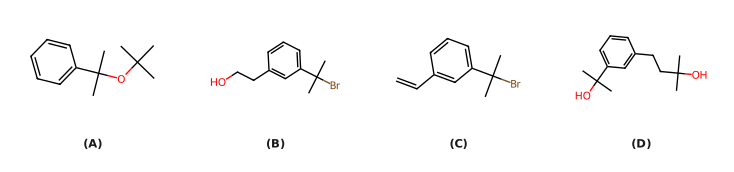
- AP EAPCET 2022Set ap-2022-07-11-AN1 markMCQQ.The major product P from the following reaction is [FIGURE] (a benzene ring bearing a −C(CH3)2Br group at one ring position and a −CH2Br group at a nearby (meta) position) Me3CONaP (A) [FIGURE] (a benzene ring bearing a −C(CH3)2−O−C(CH3)3 group, i.e. the tertiary carbon converted to a tert-butyl ether) (B) [FIGURE] (a benzene ring bearing a −C(CH3)2Br group and a −CH2OH group at the meta position) (C) [FIGURE] (a benzene ring bearing a −C(CH3)2Br group and a vinyl group −CH=CH2 at the meta position) (D) [FIGURE] (a benzene ring bearing two tertiary alcohol groups of the form −C(CH3)2OH, one directly attached to the ring and one attached via a −CH2CH2− chain)
›Reveal solutionSolution
Bulky sodium tert-butoxide is a classic E2-promoting, poor-SN2 base; on the primary bromide side chain it eliminates HBr to give a terminal alkene (vinyl group), while the more hindered tertiary bromide is unaffected — matching option (C).
Concept and Intuition
The identity of a base/nucleophile controls whether an alkyl halide undergoes substitution or elimination. Sodium tert-butoxide, (CH3)3CO−Na+, is strongly basic (as a good alkoxide) but its oxygen is buried under three bulky methyl groups, making it a very poor nucleophile for SN2 (it cannot easily approach a carbon from the back side). This steric bulk is exactly why tert-butoxide is the textbook reagent of choice to force elimination (E2) rather than substitution even on primary alkyl halides, which would normally favour SN2 with a small nucleophile like hydroxide or ethoxide. For a primary bromide such as −CH2CH2Br, tert-butoxide therefore removes a β-hydrogen (E2) to give the terminal alkene −CH=CH2, releasing Br−.
Meanwhile, this same molecule also carries a tertiary, benzylic bromide, −C(CH3)2Br, directly on the ring. In problems of this kind, the answer choices make clear that the reaction is selective for the primary position over the tertiary one under the given conditions/timescale — the tertiary center is left as the unreacted starting bromide in the major product.
Step-by-Step Solution
- Identify the base: Me3CONa = sodium tert-butoxide — strong base, very weak/hindered nucleophile.
- Recognize its standard textbook behaviour: promotes E2 elimination, especially valuable for driving primary alkyl halides toward alkenes instead of the substitution product they would normally favour with a small nucleophile.
- Apply E2 to the primary bromide arm: −CH2−CH2−Br−HBr−CH=CH2 (a terminal vinyl group, the only possible elimination product from a 2-carbon primary chain).
- Leave the tertiary benzylic C-Br bond as-is in the major product P (matching how the option set frames the outcome — one site reacts, the other survives).
- Assemble product P: aromatic ring retaining −C(CH3)2Br at one position and now bearing −CH=CH2 at the meta position — option (C).
Common Mistakes
- Assuming the more substituted (tertiary) bromide must always react first — reactivity toward a given reagent depends on both electronic and steric/mechanistic compatibility, not substitution level alone.
- Picking a substitution (ether/alcohol) product for a bulky alkoxide base — tert-butoxide's whole teaching point is that it avoids acting as a good nucleophile, favouring E2 instead.
✓Final answerThe correct option is (C) — the ring keeps its −C(CH3)2Br group, and the meta −CH2CH2Br chain becomes a vinyl group −CH=CH2.
ANSWER: C
- AP EAPCET 2021Set eng-2021-08-25-AN1 markMCQQ.Identify the product of the following reaction: CH3CH3−C−ONaCH3+CH3Cl⟶ ? (A) C2H5−C(CH3)2−O−CH3 (B) C2H5−C(CH3)2−O−C2H5 (C) C2H5−C(CH3)2−O−Cl (D) H3C−O−C2H5
›Reveal solutionSolution
A branched sodium alkoxide plus methyl chloride is a textbook Williamson ether synthesis: the alkoxide's own carbon skeleton is retained, and a new methyl group is added onto its oxygen.
Concept and Intuition
Williamson ether synthesis works best when the alkyl halide is primary/unhindered (favours clean SN2) — methyl halides are ideal because they have no β-hydrogens at all, so competing elimination is impossible regardless of how bulky the incoming alkoxide nucleophile is. The alkoxide's own carbon skeleton is untouched by the reaction (only its oxygen attacks); the methyl group from the alkyl halide simply attaches to that oxygen.
Step-by-Step Solution
- Identify the nucleophile: the sodium alkoxide of the branched alcohol, R3C–O−Na+ (with R3C its full carbon skeleton, retained unchanged throughout the reaction).
- Identify the electrophile: CH3Cl — small, unhindered, no possibility of elimination (no β-H).
- SN2 attack: the alkoxide oxygen's lone pair displaces Cl− from the methyl carbon.
- Product: the alkoxide's carbon skeleton remains attached to oxygen, which now also bears the new methyl group — an unsymmetrical ether, R3C–O–CH3.
- Among the choices, this connectivity (skeleton retained – O – new CH3) matches option (A).
Common Mistakes
- Expecting steric hindrance from the bulky alkoxide to force an elimination or a different mechanism — with methyl halide as the electrophile, there is no β-H for elimination to compete, so clean substitution dominates regardless of alkoxide bulk.
✓Final answerThe correct option is (A) — C2H5−C(CH3)2−O−CH3.
ANSWER: A
🎓Unlock everything free for 14 days
- ✓Full step-by-step solutions
- ✓Concept-first explanations
- ✓Methods, shortcuts & mistakes
- ✓PYQ mapping + timed mock tests
Full access for 14 days. No credit card required.