Chemistry · Ch 9 — Amines
Acylation
Acylation
The Reaction
Primary and secondary amines — both aliphatic and aromatic — carry at least one N–H bond, and this hydrogen can be replaced by an acyl group () when the amine reacts with an acid chloride, an acid anhydride, or an ester. Because the amine nitrogen (a nucleophile) attacks the carbonyl carbon of the acyl compound and displaces a leaving group, this is a nucleophilic acyl substitution, and the reaction as a whole is called acylation. Its products — in which an acyl group now sits where an N–H hydrogen used to be — are amides.
Tertiary amines, having no N–H bond left to replace, cannot undergo this reaction.
Because a molecule of (typically HCl, when an acid chloride is used) or a carboxylic acid (when an anhydride is used) is released alongside the amide, the reaction is normally carried out in the presence of a base stronger than the amine itself, such as pyridine. This base mops up the HCl (or acid) as it is formed, which both prevents the liberated acid from simply re-protonating the amine (and thereby stalling the reaction) and pulls the equilibrium over towards the amide product.
Acylation with an Acid Chloride
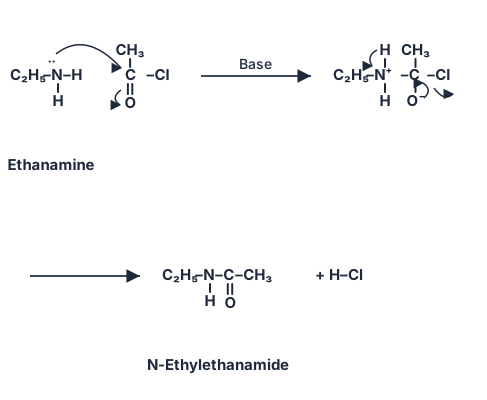
Ethanamine reacts with ethanoyl (acetyl) chloride, in the presence of a base, to give N-ethylethanamide:
Drawn by us to help you understand the concept clearly, and verified to make sure it's accurate. For exams, practice from your textbook's own diagram.
Redrawn from the NCERT page with the structures, printed labels (C2H5, –N, –H, –Cl, –N⁺, –C, –CH3, + H–Cl) and reagent placement exactly as the textbook prints them. Every element of this display was checked against the printed page during the sweep's blind-judge verification pass, so …
The mechanism proceeds through nucleophilic attack of the amine nitrogen's lone pair on the carbonyl carbon of the acid chloride, forming a tetrahedral intermediate that then expels chloride, regenerating the carbonyl and completing the substitution.
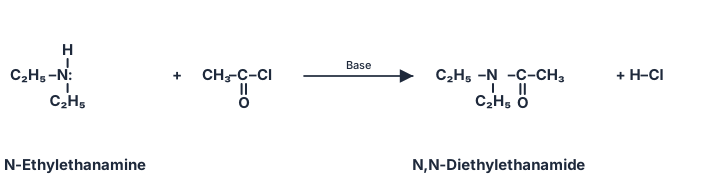
A secondary amine reacts the same way. N-ethylethanamine (a secondary amine) reacts with ethanoyl chloride to give N,N-diethylethanamide:
Drawn by us to help you understand the concept clearly, and verified to make sure it's accurate. For exams, practice from your textbook's own diagram.
Redrawn from the NCERT page with the structures, printed labels (C2H5, –N:, CH3, –C, –Cl, –N, –CH3, + H–Cl) and reagent placement exactly as the textbook prints them. Every element of this display was checked against the printed page during the sweep's blind-judge verification pass, so …
Acylation with an Acid Anhydride
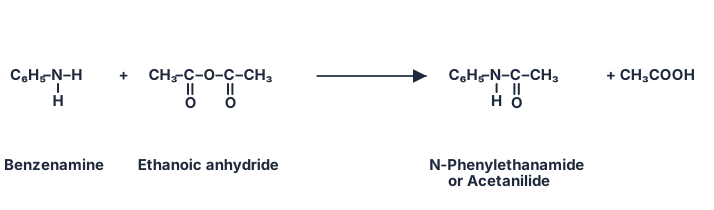
Aromatic amines react in the same way. Benzenamine (aniline) reacts with ethanoic (acetic) anhydride to give N-phenylethanamide, commonly known as acetanilide:
Drawn by us to help you understand the concept clearly, and verified to make sure it's accurate. For exams, practice from your textbook's own diagram.
Redrawn from the NCERT page with the structures, printed labels (C6H5, –N, –H, CH3, –C, –O, –CH3, + CH3COOH) and reagent placement exactly as the textbook prints them. Every element of this display was checked against the printed page during the sweep's blind-judge verification pass, so …
Here one acyl group of the anhydride is transferred to nitrogen, and the other half of the anhydride is released as free ethanoic (acetic) acid — no external base is needed to trap an HX by-product in this case, since the leaving group is simply a carboxylate/carboxylic acid rather than a strong acid such as HCl.
Benzoylation
Amines also react with benzoyl chloride () by exactly the same acyl-substitution pathway; because the acylating agent here is specifically benzoyl chloride, this particular case of acylation is given its own name, benzoylation. For example, methanamine reacts with benzoyl chloride to give N-methylbenzamide: …