Q.Acid anhydrides on reaction with primary amines give ____.
🔒You're viewing a preview — the full solution, concept, methods & PYQ mapping are locked.
🔒 Start your 14-day free trial to unlock the full solution →Concept understanding — Gabriel Phthalimide Limitation
The Gabriel Phthalimide Limitation – First Principles
Imagine you want to make a primary amine (R−NH2) from an alkyl halide (R−X). The obvious idea is to just let ammonia (NH3) attack the halide. But ammonia is a nucleophile and also a base — it will keep reacting. The product amine is even more nucleophilic than ammonia, so it attacks another alkyl halide molecule, giving a secondary amine (R2NH), then tertiary (R3N), and finally a quaternary ammonium salt (R4N+). You end up with a messy mixture.
The Gabriel synthesis was invented to solve this: it gives only the primary amine, cleanly. But it has a hard limit.
The Intuition: Why the Gabriel Method Works (and Where It Breaks)
The trick is to use phthalimide — a molecule with two carbonyl groups flanking an N−H bond. The N−H is acidic enough to be deprotonated by a mild base (like KOH or K2CO3), giving a phthalimide anion. This anion is a great nucleophile but a terrible base — it won't deprotonate the alkyl halide or cause elimination. It attacks the alkyl halide in an SN2 reaction, forming an N-alkylphthalimide.
Then you hydrolyse (or use hydrazine) to break the two amide bonds, releasing the primary amine and regenerating phthalic acid.
The key limitation is SN2 reactivity. The phthalimide anion is bulky and not very nucleophilic. It can only attack primary alkyl halides (or very reactive secondary ones like allyl/benzyl halides). Tertiary halides? They undergo elimination instead of substitution. Secondary halides? Very slow, often give poor yields.
The Precise Statement of the Limitation
Gabriel phthalimide synthesis fails for alkyl halides that are sterically hindered or prone to elimination. Specifically:
- Tertiary alkyl halides (R3C−X) do not react — they undergo E2 elimination instead of SN2 substitution.
- Secondary alkyl halides (R2CH−X) react very slowly, if at all, and yields are poor.
- Aryl halides (like chlorobenzene) do not react because SN2 on an sp2 carbon is impossible.
- Alkyl halides with bulky groups near the reaction centre (neopentyl, etc.) also fail.
A common mistake: students think the limitation is about the hydrolysis step. No — the limitation is entirely in the alkylation step. The phthalimide anion simply cannot force an SN2 reaction on a hindered carbon.
Why This Matters for Exams
You'll be asked to identify which alkyl halides cannot be used in the Gabriel synthesis. The answer is always: tertiary halides, most secondary halides, and aryl halides. For example:
| Alkyl Halide | Works? | Reason |
|---|---|---|
| CH3CH2CH2Br | Yes | Primary, unhindered |
| (CH3)2CHBr | Poor | Secondary, slow SN2 |
| (CH3)3CBr | No | Tertiary — elimination dominates |
| C6H5Br | No | Aryl — SN2 impossible on sp2 carbon |
| CH2=CHCH2Br | Yes | Allylic — very reactive SN2 |
The Gabriel phthalimide synthesis is a reliable method only for preparing primary amines from primary alkyl halides (or very reactive secondary ones). For tertiary amines or hindered substrates, you need alternative methods (like reduction of nitriles or amides).
The Deeper Reason (For the Curious) …
Why this formula?
Gabriel Phthalimide Limitation — Why It Exists
The Gabriel phthalimide synthesis is a classic method to prepare primary amines (R-NH2) from alkyl halides. However, it has a critical limitation: it fails with secondary and tertiary alkyl halides (and also with aryl halides). Let's understand why this happens — the reasoning is rooted in reaction mechanism and steric hindrance.
1. The Key Reaction Steps (Brief Recap)
The synthesis proceeds in two main steps:
- Formation of potassium phthalimide Phthalimide (C6H4(CO)2NH) is treated with alcoholic KOH to give the potassium salt:
C6H4(CO)2NH+KOH→C6H4(CO)2N−K++H2O
- N-alkylation (the critical step) The phthalimide anion acts as a nucleophile and attacks an alkyl halide (R-X) via an SN2 mechanism:
C6H4(CO)2N−+R-X→C6H4(CO)2N-R+X−
- Hydrolysis to release the primary amine.
2. Why the Limitation Exists — The SN2 Bottleneck
The key formula that governs the success of this reaction is the rate law for SN2:
Rate=k[Nucleophile][Alkyl halide]
For the Gabriel synthesis, the nucleophile is the phthalimide anion — a bulky, planar, and resonance-stabilized species. This has two consequences:
A. Steric Hindrance at the Electrophilic Carbon
- In an SN2 reaction, the nucleophile must approach the backside of the carbon bearing the leaving group.
- Primary alkyl halides (RCH2X) have a small, unhindered carbon — the nucleophile can easily attack.
- Secondary alkyl halides (R2CHX) have moderate steric hindrance — the bulky phthalimide anion struggles to approach.
- Tertiary alkyl halides (R3CX) are severely hindered — the backside is blocked by three alkyl groups. The SN2 transition state is impossible to achieve.
B. The SN2 Transition State Geometry
The SN2 transition state requires a linear arrangement of nucleophile, carbon, and leaving group:
Nu−⋯C⋯X
For the phthalimide anion, this linear approach is sterically impossible when the carbon is tertiary (and difficult for secondary). The bulky phthalimide group cannot fit into the crowded transition state.
3. What Happens Instead? — Elimination Dominates
When a secondary or tertiary alkyl halide is used, the strongly basic phthalimide anion does not perform SN2 — it instead acts as a base and promotes E2 elimination:
R3C-X+Phth−→Alkene+H-Phth+X−
This is because: …
The key idea is that acid anhydrides are highly reactive acylating agents. Primary amines have two replaceable hydrogens on nitrogen, but the reaction with an anhydride stops cleanly at the mono-acylated stage under mild conditions.
- The anhydride transfers an acyl group (RCOX−) to the nitrogen of the primary amine, forming an amide bond and releasing a carboxylic acid molecule. …
The reaction of an acid anhydride with a primary amine yields an amide via nucleophilic acyl substitution. The correct option is (A).
Why This Reaction Works the Way It Does
The key to understanding this reaction lies in the structure of an acid anhydride. An acid anhydride has two carbonyl groups (−C(=O)X−) linked by an oxygen atom. Each carbonyl carbon is electron-deficient (electrophilic) because the oxygen atom pulls electron density away from it. A primary amine (R−NHX2) has a lone pair on nitrogen, making it a strong nucleophile.
When the amine attacks, it targets the electrophilic carbonyl carbon. The reaction proceeds through a tetrahedral intermediate, and then a good leaving group (the carboxylate ion, RCOOX−) is expelled. This is a classic nucleophilic acyl substitution — the amine replaces the leaving group attached to the acyl carbon.
The product is an amide (R−CONHRX′), not an imide, imine, or secondary amine. Let's walk through the steps to see why.
Step-by-Step Mechanism
- Nucleophilic attack: The lone pair on the nitrogen of the primary amine (RX′−NHX2) attacks the electrophilic carbonyl carbon of the acid anhydride ((RCO)X2O). This forms a tetrahedral intermediate with a negative charge on the oxygen that was originally the carbonyl oxygen.
(RCO)X2O+RX′−NHX2[R−C(OX−)(OH)(O−COR)]−NHX2RX′+
-
Proton transfer: The positively charged nitrogen in the intermediate loses a proton (to a base present in the medium, often another amine molecule), neutralizing the charge. The negative charge on the oxygen is also stabilized.
-
Elimination of the leaving group: The tetrahedral intermediate collapses. One of the C−O bonds breaks, and the carboxylate ion (RCOOX−) leaves as a good leaving group. This step regenerates the carbonyl group.
[Intermediate]R−CONHRX′+RCOOX−
- Final product: The carboxylate ion picks up a proton (from the ammonium ion formed earlier or from the solvent) to become a carboxylic acid (RCOOH). The organic product is the amide (R−CONHRX′).
R−CONHRX′+RCOOX−+HX+R−CONHRX′+RCOOH
A quick way to remember: acid anhydrides are like "double acyl chlorides" — they react with amines to give amides, just like acyl chlorides do. The only difference is that the byproduct here is a carboxylic acid instead of HCl.
Why the Other Options Are Wrong …
Concept: Nucleophilic Acyl Substitution
Method: Nucleophilic addition–elimination mechanism
Steps
-
Identify the functional groups
- Acid anhydride: two acyl groups linked by an oxygen (R−CO−O−CO−RX′).
- Primary amine: RX′′−NHX2 (a good nucleophile).
-
Nucleophilic attack
The lone pair on the nitrogen of the primary amine attacks the electrophilic carbonyl carbon of the anhydride.
- This forms a tetrahedral intermediate.
-
Elimination of a leaving group
The tetrahedral intermediate collapses, expelling a carboxylate ion (R−COOX−) as the leaving group.
-
Proton transfer
The carboxylate ion picks up a proton (from the medium or from the ammonium group), giving a carboxylic acid as a byproduct.
-
Final product …
Here is the breakdown of the common mistakes students make on this specific reaction, along with the correct reasoning.
The Correct Answer
The reaction of an acid anhydride with a primary amine yields an amide.
- Answer: (A) amide
- General Reaction:
(RCO)2O+R′NH2→RCONHR′+RCOOH
Common Mistake #1: Confusing the Product with an Imide
The Mistake:
Students often see the word "anhydride" and "amine" and jump to the conclusion that the product is an imide (option B). They remember that imides are made from anhydrides, but they forget the specific reagent.
Why it happens:
- Imides are formed when an ammonia molecule (NH3) or a primary amide reacts with an anhydride.
- Students incorrectly assume that a primary amine (RNH2) will behave exactly like ammonia.
How to Avoid:
- Remember the stoichiometry: An imide requires two acyl groups to attach to the same nitrogen.
- Ammonia (NH3) has 2 hydrogens to replace → Imide.
- Primary amine (RNH2) has only 1 hydrogen to replace → Amide.
- Mnemonic: "Primary amine = one H left = one amide bond. Ammonia = two H's left = imide."
Common Mistake #2: Thinking the Product is a Secondary Amine
The Mistake:
Students see "primary amine" as the reactant and assume the product must be a "secondary amine" (option C) because the nitrogen gains an alkyl group.
Why it happens:
- They confuse nucleophilic acyl substitution (which happens here) with nucleophilic alkyl substitution (like the Hoffmann alkylation).
- In alkylation, an alkyl halide adds an alkyl group to the nitrogen, creating a secondary amine.
- Here, the anhydride adds an acyl group (RCO−), not an alkyl group (R−).
How to Avoid:
- Check the functional group being added:
- Acyl group (RCO−) → Product is an amide.
- Alkyl group (R−) → Product is an amine.
- Key clue: Anhydrides are acylating agents, not alkylating agents.
Common Mistake #3: Confusing the Product with an Imine
The Mistake:
Students see "primary amine" and "carbonyl compound" and immediately think of imine formation (option D).
Why it happens:
- Imines are formed when a primary amine reacts with an aldehyde or ketone (a condensation reaction).
- Students generalize: "Any carbonyl + primary amine = imine."
How to Avoid: …
- AP EAPCET 2024Set ap-2024-05-17-FN1 markMCQQ.Two statements are given below Statement I: Benzenamine can be prepared from phthalimide Statement II: Benzenamine is less basic than phenyl methanamine Correct answer is (A) Both statements I & II are correct (B) Both statements I & II are not correct (C) Statement I is correct, but statement II is not correct (D) Statement I is not correct, but statement II is correct
›Reveal solutionSolution
The Gabriel phthalimide synthesis is a classic method for making primary amines, but it fails for aromatic amines like benzenamine because the aryl halide does not undergo nucleophilic substitution. Meanwhile, benzenamine is indeed less basic than phenyl methanamine due to resonance delocalization of the nitrogen lone pair. Thus Statement I is false, Statement II is true — the correct option is (D).
Concept and Intuition
The question tests two separate ideas: a synthetic method (Gabriel phthalimide) and a property (basicity of amines).
- Gabriel phthalimide synthesis works beautifully for making aliphatic primary amines: you treat phthalimide with KOH to get the potassium salt, then react it with an alkyl halide (SN2), then hydrolyze to release the amine. But aryl halides (like chlorobenzene) are extremely resistant to SN2 — they need special conditions (e.g., high temperature, copper catalyst) for substitution. So you cannot make benzenamine (aniline) this way.
- Basicity of amines depends on how available the nitrogen lone pair is for protonation. In benzenamine, the lone pair is delocalized into the benzene ring (resonance), making it less basic. In phenyl methanamine (benzylamine), the lone pair is on a saturated carbon — no such delocalization — so it is more basic.
Step-by-step reasoning
-
Evaluate Statement I: “Benzenamine can be prepared from phthalimide”
- The Gabriel synthesis uses the phthalimide ion as a nucleophile to attack an alkyl halide.
- For benzenamine, you would need to use an aryl halide (e.g., chlorobenzene) as the electrophile.
- Aryl halides do not undergo SN2 reactions because the carbon–halogen bond has partial double-bond character and the backside attack is sterically and electronically hindered.
- Therefore, the reaction fails — benzenamine cannot be prepared by the Gabriel phthalimide method.
- Conclusion: Statement I is incorrect.
-
Evaluate Statement II: “Benzenamine is less basic than phenyl methanamine”
- Benzenamine (aniline): The nitrogen lone pair is conjugated with the π-system of the benzene ring. This resonance delocalization reduces electron density on nitrogen, making it a weaker base. …
- AP EAPCET 2023Set eng-2023-05-19-FN1 markMCQQ.Which of the following amine cannot be prepared by the Gabriel phthalimide synthesis method? (A) Ethylamine (B) Benzylamine (C) Phenylamine (D) Propylamine
›Reveal solutionSolution
This tests the scope/limitation of the Gabriel phthalimide synthesis; it only works via SN2 on alkyl halides, so it cannot be used to prepare aromatic amines like aniline (phenylamine), which would require an unreactive aryl halide.
Concept and Intuition
The Gabriel phthalimide synthesis is a classic method for preparing pure primary amines while avoiding the over-alkylation problem seen with direct ammonia alkylation. It proceeds by: (i) deprotonating phthalimide with KOH to form the phthalimide anion (a good nucleophile), (ii) reacting this anion with an alkyl halide via SN2 substitution to form N-alkylphthalimide, and (iii) hydrolysing (or hydrazinolysing) the N-alkylphthalimide to release the free primary amine.
The crucial mechanistic requirement is step (ii): a genuine backside (SN2) nucleophilic substitution at a sp³, alkyl carbon bearing the halide. Aryl halides (like chlorobenzene/bromobenzene, which would be needed to make aniline) cannot undergo this kind of substitution under these conditions — the halide is attached to an sp² ring carbon, the C–X bond has partial double-bond character (due to resonance with the ring), and backside attack is sterically blocked by the ring itself. Hence this method simply cannot produce phenylamine (aniline).
Step-by-Step Solution
- Recall the Gabriel synthesis mechanism: phthalimide anion + R−X (alkyl halide, SN2) → N-alkylphthalimide → hydrolysis → R−NH2.
- Check each target amine's required starting halide: ethylamine needs ethyl halide (alkyl, works); benzylamine needs benzyl halide (C6H5CH2X — the halide carbon is an sp³ benzylic carbon, not the aromatic ring itself, so it is a legitimate SN2 substrate and works); propylamine needs propyl halide (alkyl, works). …
- AP EAPCET 2022Set ap-2022-07-12-FN1 markMCQQ.Identify P and R in the following reaction sequence [FIGURE] (a benzene ring with two methyl groups on adjacent carbons and two COOH groups on the other two adjacent carbons — a dimethylbenzene-dicarboxylic acid) NH3 P Δ Q Strong heating R (A) P= [FIGURE] (the dimethylbenzene ring with two COONH4 groups in place of the COOH groups); Q= [FIGURE] (a bicyclic isoindole-1,3-dione/phthalimide-type structure fused onto the dimethylbenzene ring, with an NH between the two carbonyl groups) (B) P= [FIGURE] (the dimethylbenzene ring with two COONH2 groups in place of the COOH groups); Q= [FIGURE] (the same bicyclic isoindole-1,3-dione/phthalimide-type structure as option A) (C) P= [FIGURE] (the dimethylbenzene ring with two COONH4 groups); Q= [FIGURE] (the dimethylbenzene ring with two COONH2 groups, not cyclized) (D) P= [FIGURE] (the dimethylbenzene ring with two COONH2 groups); Q= [FIGURE] (the dimethylbenzene ring with two COOH groups, i.e. same as the starting material)
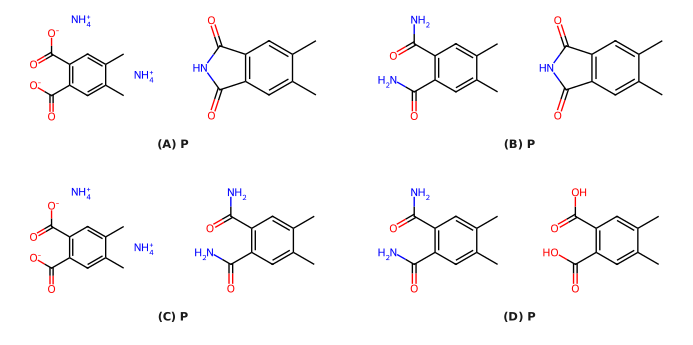
›Reveal solutionSolution
Ammonia converts the two –COOH groups to the ammonium salt –COONH4 (P); heating dehydrates and cyclises it to the cyclic imide (Q) — option (A).
The starting compound is a dimethylbenzene dicarboxylic acid (two –COOH groups on adjacent ring carbons).
Step 1 — reaction with NH3: a carboxylic acid reacts with ammonia to give its ammonium salt, so each –COOH becomes –COONH4.
P=the ring carrying two –COONH4 groups (diammonium carboxylate).
Step 2 — heating (Δ): the ammonium salt loses water to the amide and, because the two carbonyls sit on adjacent carbons, cyclises to the cyclic imide (an isoindole-1,3-dione / phthalimide-type ring with –NH– between the two C=O groups).
Q=the fused cyclic imide. …
- AP EAPCET 2022Set eng-2022-07-05-AN1 markMCQQ.Gabriel phthalimide synthesis is used for the preparation of which of the following? (A) C6H5NH2 (aniline, a benzene ring bearing an NH2 group) (B) pyrrolidine (a five-membered saturated ring containing one NH) (C) (C2H5)3N (triethylamine) (D) CH3CH2CH2NH2 (n-propylamine)
›Reveal solutionSolution
Gabriel synthesis is restricted to making primary aliphatic amines from alkyl halides; of the four options, only n-propylamine fits that description.
Concept and Intuition
The Gabriel phthalimide synthesis converts an alkyl halide into a primary amine by first alkylating the nitrogen of potassium phthalimide, then hydrolyzing (or hydrazinolysing) the phthaloyl group away. Its key limitation is that it requires an SN2-reactive alkyl halide — aryl halides don't work (they can't undergo the nucleophilic substitution step), so aromatic amines like aniline cannot be made this way. It's also inherently limited to primary amines, since only one alkylation of the imide nitrogen occurs.
Step-by-Step Solution
- (A) Aniline (C6H5NH2) is an aromatic primary amine — Gabriel synthesis fails here because aryl halides can't undergo the required nucleophilic substitution with the phthalimide anion.
- (B) Pyrrolidine is a cyclic secondary amine (the N is part of the ring, bonded to two carbons) — Gabriel synthesis gives primary amines, not secondary ones. …
🎓Unlock everything free for 14 days
- ✓Full step-by-step solutions
- ✓Concept-first explanations
- ✓Methods, shortcuts & mistakes
- ✓PYQ mapping + timed mock tests
Full access for 14 days. No credit card required.